The Ultimate Guide to Cloud Collaboration in Fort Lauderdale
Why Cloud Collaboration in Fort Lauderdale Is a Game-Changer for Local Businesses
Cloud collaboration in Fort Lauderdale is how local businesses share files, communicate, and work together — from anywhere — using tools hosted in the cloud instead of on-site servers.
Here's a quick snapshot of what it means for your business:
What it is: Cloud-based tools (like Microsoft 365, Teams, SharePoint, and Google Drive) that let your team work together in real time, from any location
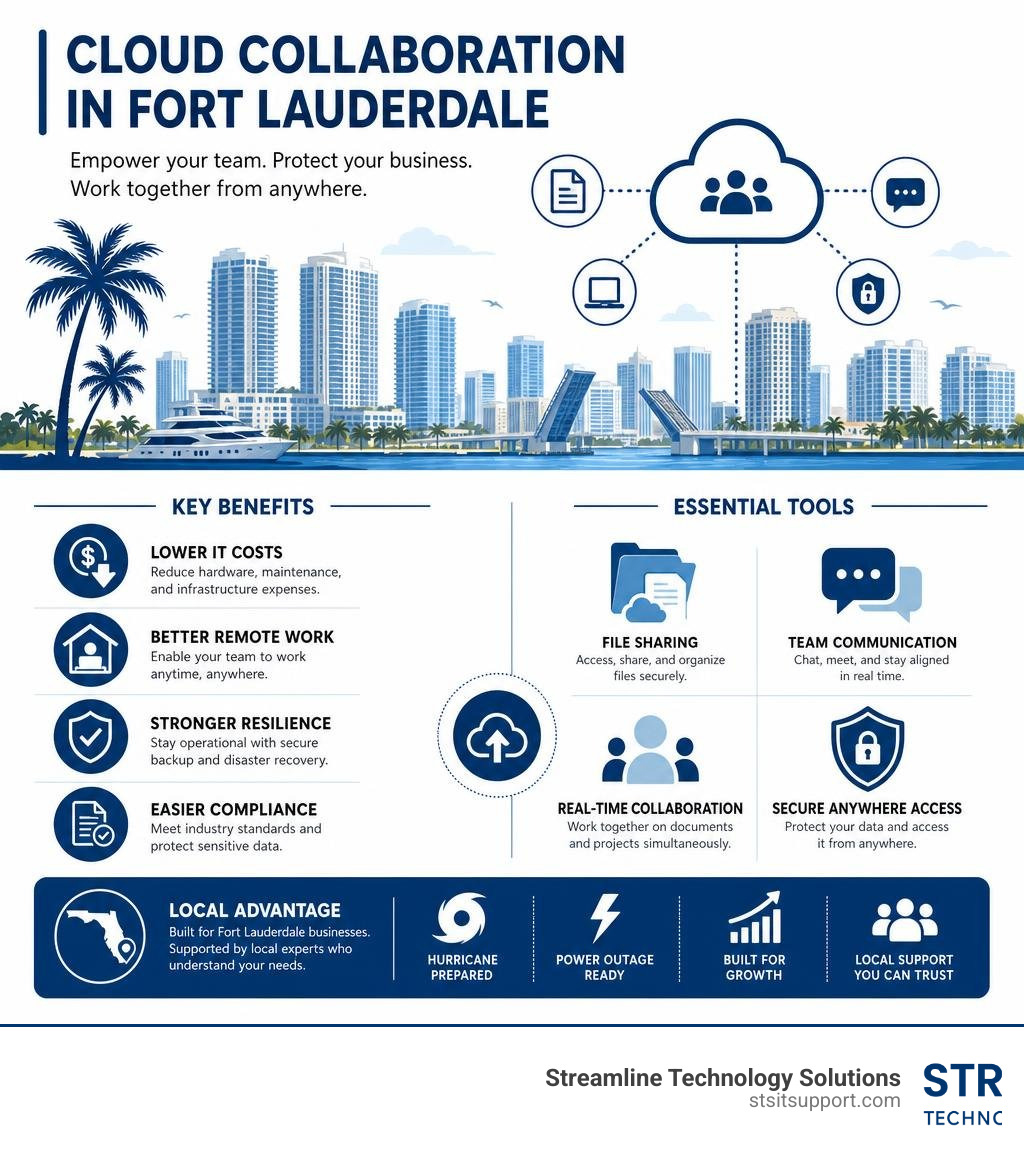
Why it matters: Fort Lauderdale businesses face real risks — hurricanes, power outages, and a fast-moving economy — that make flexible, resilient IT essential
Who provides it locally: Managed IT providers and data center operators across South Florida offer cloud setup, migration, security, and ongoing support
Key benefits: Lower IT costs, better remote work, stronger disaster recovery, and easier compliance for industries like healthcare, legal, and finance
The market opportunity: The enterprise collaboration market is growing at a 15.2% annual rate through 2032 — businesses that adopt now gain a real edge
South Florida's small businesses are under real pressure. Larger competitors have deep IT budgets. Remote workers expect seamless tools. And one bad storm can knock out an on-premise server room for days.
Cloud collaboration levels that playing field — if you have the right setup and the right support.
But choosing the wrong provider, or skipping a proper migration plan, leads to exactly the frustration many Fort Lauderdale business owners already know: surprise fees, slow response times, and systems that just don't work when you need them most.
This guide walks you through everything — from the tools that matter most, to the local infrastructure supporting them, to what to look for in a provider you can actually trust.
I'm Michael Gaigelas, and with over 20 years of hands-on experience in IT support, cloud servers, managed services, and business technology, I've helped countless South Florida companies navigate cloud collaboration in Fort Lauderdale and build systems that are reliable, secure, and built to grow. Let's break it all down so you can make a smart, confident decision for your business.
What is Cloud Collaboration and Why Does Your Business Need It?
At its core, cloud collaboration is about removing the physical boundaries of the traditional office. Instead of saving a file to a single hard drive or a local office server, your team works within a centralized, internet-based ecosystem. Multiple people can edit the exact same document at the same time, chat about changes in real time, and hop onto a video call without ever leaving their workflow.
By shifting your operations to a cloud-based infrastructure, you transition from rigid, localized systems to a dynamic setup that scales on demand. This shift is fundamental to modern business agility. When your software, files, and communication tools live in the cloud, your team is no longer tethered to a physical desk in Fort Lauderdale. Whether they are working from a coffee shop in Las Olas, a home office in Coral Springs, or traveling out of state, the experience remains identical.

This accessibility is powered by various service models, which you can explore further in our breakdown of Cloud Solutions. Cloud collaboration keeps your workflows continuous, prevents version-control nightmares, and ensures that your business can pivot instantly when market demands or local conditions shift.
The Rise of Cloud Collaboration Fort Lauderdale Teams Rely On
The business landscape in South Florida has changed dramatically over the last few years. As we move through July 2026, the hybrid work model is no longer a temporary perk—it is a standard operational requirement. Fort Lauderdale has experienced a major influx of technology companies, professional services, and remote talent, driving a massive need for robust, always-on connectivity.
To keep pace with this rapid growth, South Florida businesses are relying heavily on local cloud architectures. Local teams need to know that their data is accessible, secure, and fast. High latency or frequent downtime can ruin client relationships in the blink of an eye. Transitioning to local cloud storage solutions allows regional businesses to maintain high-speed access to vital documents while keeping collaboration seamless across Broward County. To understand how local infrastructure makes a difference, check out our guide on Cloud Storage South Florida.
Key Benefits of Cloud Collaboration Fort Lauderdale Businesses Can Leverage
When you move your collaboration tools to the cloud, you are not just upgrading your software; you are fundamentally transforming your business's financial and operational health. The most immediate impacts are felt in scalability, cost savings, and disaster recovery.
Let's look at how traditional, on-premise collaboration setups stack up against modern cloud-based solutions:
Feature On-Premise Infrastructure Cloud Collaboration Upfront Costs High capital expenditure (servers, licenses, cooling) Low, predictable monthly operating costs Scalability Slow; requires purchasing and installing new hardware Instant; add or remove users with a few clicks Disaster Recovery Vulnerable to local power outages, floods, and storms Geographically redundant; 99.99% uptime Maintenance Requires hands-on IT staff for patching and hardware Managed automatically by the provider Remote Access Complex VPNs that slow down performance Seamless, secure access from any device
By moving away from physical hardware, businesses can redirect capital from depreciating IT assets into direct growth strategies. Additionally, keeping your company data in a protected, off-site environment ensures that your files remain safe even if your physical office is compromised. You can read more about keeping your business assets protected in our guide to Secure Cloud Storage.
Enhancing Remote Work and Scalability
One of the greatest challenges of running a growing business in Fort Lauderdale is predicting your resource needs. With traditional IT, if you hire ten new employees, you have to buy more hardware, upgrade your server licenses, and spend days configuring new systems.
Cloud collaboration completely eliminates this friction. Because cloud platforms operate on a utility-based, pay-as-you-go model, you only pay for the active accounts your team actually uses. If you need to scale up for a busy seasonal project or scale back during a quiet period, you can adjust your licensing instantly. This flexibility gives small and medium-sized businesses access to the exact same enterprise-grade tools used by multinational corporations, without the enterprise-sized price tag. For more details on choosing the right storage model for your operations, read our article on Cloud-based Storage for Business.
Robust Security and Disaster Recovery in South Florida
In South Florida, disaster recovery isn't a theoretical exercise—it is an annual necessity. Every hurricane season brings the very real threat of prolonged power outages, localized flooding, and physical damage to office buildings. If your business relies on a physical server sitting in a closet in Fort Lauderdale, one bad storm could take your entire operation offline for weeks, or worse, destroy your data permanently.
By utilizing cloud collaboration, your operational data, communication channels, and document repositories are hosted in secure, geographically redundant data centers far outside the storm zone. If a hurricane forces your physical office to close, your employees can simply open their laptops from any safe location with internet access and pick up exactly where they left off.
This resilience is often referred to as Disaster Recovery as a Service, a critical strategy we implement to keep South Florida businesses operational through any event. Combined with modern cybersecurity measures like multi-factor authentication (MFA) and end-to-end encryption, the cloud offers a level of security and business continuity that on-premise systems simply cannot match.
Essential Cloud Collaboration Tools for Modern Enterprises
Selecting the right collaboration stack is essential for maximizing productivity. Different businesses have different workflows, but the market leaders have built incredibly mature ecosystems that integrate seamlessly into everyday operations.

Productivity Suites and Communication Platforms
For the vast majority of businesses in Fort Lauderdale, the cloud journey centers around a few key platforms:
Microsoft 365 (including Teams, SharePoint, and OneDrive): The gold standard for business productivity. Teams acts as your virtual office, combining chat, video conferencing, and phone systems. SharePoint serves as a highly customizable document management and intranet platform, while OneDrive provides secure personal file storage.
Google Workspace (including Google Drive): Known for its incredibly fast, real-time co-authoring capabilities. It is highly favored by creative agencies, startups, and fast-moving teams that prioritize browser-based simplicity.
Box & OneDrive: Industry-recommended solutions for secure enterprise file sharing, especially when working with external partners, contractors, or clients who need restricted access to specific folders.
Understanding how these applications interact with your broader network infrastructure is key. To get a better grasp of how software, platforms, and infrastructure connect in the cloud, take a look at our guide on Cloud IaaS PaaS SaaS.
Overcoming Challenges in Cloud Collaboration Fort Lauderdale Implementations
Despite the clear benefits, migrating to cloud collaboration tools is not always a walk in the park. Many businesses run into common roadblocks:
User Adoption: Employees are often resistant to change. If they are used to emailing file attachments back and forth, they might struggle to adapt to shared cloud folders.
Migration Hurdles: Moving legacy on-premises databases to the cloud without disrupting daily business operations requires careful, phased planning.
Interoperability: Getting different cloud systems to talk to each other can be complex, especially if you are running a hybrid cloud environment.
When custom integrations are required to bridge the gap between your legacy software and modern cloud tools, local expertise makes a huge difference. For instance, businesses looking to build custom web applications or integrate specialized software often leverage local resources, such as Software Development Services in Coral Springs - 2am.tech, to ensure their systems connect seamlessly.
How Infrastructure and Managed IT Support Local Cloud Ecosystems
While cloud tools feel invisible to the end-user, they rely on a massive physical infrastructure of data centers, fiber-optic networks, and enterprise-grade servers.
The Role of Local Data Centers and Edge Providers
In South Florida, the local cloud ecosystem is supported by major data center operators and strategic partnerships. For example, the industry saw a significant boost in regional capabilities through the 365 Data Centers Announces Strategic Collaboration with Liberty Center One to Expand Cloud Capabilities.
365 Data Centers operates 20 colocation data centers and 4 cloud regions, serving over 1,400 customers with hybrid cloud and collaboration services. By partnering with providers like Liberty Center One, they leverage combined capabilities to deliver public, private, and hybrid cloud solutions directly to enterprise clients.
This level of robust, redundant infrastructure is what keeps local businesses running at peak performance. For businesses operating in Fort Lauderdale, working with a managed service provider that understands these backend networks is essential to maintaining high availability. If you are looking for hands-on, local assistance to keep your systems connected to these networks, you can easily Find local IT support that understands the unique South Florida business landscape.
Compliance and Data Protection Across Regulated Industries
For businesses operating in highly regulated fields like healthcare, legal, and financial services, moving to the cloud requires strict adherence to compliance standards. You cannot simply drop patient records or confidential legal files into a basic, unmanaged cloud folder.
Modern cloud providers design their environments to meet rigorous standards, including HIPAA, PCI-DSS, and SOC 2 Type 2. By implementing role-based access controls, automated data encryption (both in transit and at rest), and comprehensive audit logs, we help businesses ensure that their collaborative spaces remain completely compliant. To learn more about setting up these secure virtual environments, read our detailed article on Secure cloud data storage.
Choosing the Right Cloud Service Provider in South Florida
Selecting the right partner to manage your cloud migration and ongoing support is one of the most critical decisions you will make for your business. The wrong choice can lead to hidden costs, slow support response times, and frustrating downtime.
When evaluating cloud and managed IT providers, keep this checklist in mind:
Transparent Pricing: Ensure the provider offers flat-fee monthly pricing with zero hidden costs or surprise invoices.
Fast Local Support: Do they have local engineers in Broward County who can come on-site if a critical hardware issue arises?
Direct Accountability: Avoid national call centers. You want to work with a team where you can speak directly to senior engineers who know your business by name.
Proven Migration Experience: Ask for case studies showing successful transitions from on-premise systems to cloud environments with minimal downtime.
Industry Compliance Knowledge: Ensure they understand the specific regulatory requirements of your industry (e.g., HIPAA for healthcare, PCI-DSS for retail).
To help you navigate this process, we have put together a comprehensive Guide to cloud service providers to help you make an informed choice.
Managed IT Services and Migration Support
A successful cloud migration is a phased process. It begins with a thorough assessment of your existing applications and database structures, followed by a detailed strategy to minimize business disruption.
Once your migration is complete, the work doesn't stop. Proactive monitoring, routine security patching, and ongoing user support are required to keep your team collaborative and secure. Partnering with an expert team for Managed IT services in Fort Lauderdale ensures that your cloud environment is constantly optimized, secure, and aligned with your long-term business goals.
Frequently Asked Questions about Cloud Collaboration
What are the security risks of cloud collaboration and how can they be mitigated?
The primary security risks include unauthorized access, data leaks, and weak user passwords. These risks are easily mitigated by implementing a Zero Trust security framework. This includes enforcing Multi-Factor Authentication (MFA), using role-based access permissions so employees only see the files they need, and ensuring all data is encrypted. Partnering with a reliable team for IT support for businesses ensures your security policies are constantly monitored and updated.
How does cloud collaboration support hurricane preparedness in Fort Lauderdale?
Because your business files, communication systems, and applications are hosted in secure, off-site data centers rather than on a physical server in your office, your operations are completely protected from local storm damage. If a hurricane causes power outages or physical damage in Fort Lauderdale, your team can work securely from any location with an internet connection. This level of business continuity is a core focus of our Broward County IT services.
Can small businesses afford enterprise-grade cloud collaboration tools?
Absolutely. Cloud collaboration operates on a highly flexible, pay-as-you-go subscription model. This means small businesses can access the exact same world-class productivity and security tools as major corporations without any massive upfront hardware investments. You only pay for the active users you need, significantly lowering your IT overhead. Learn more about cost-effective options in our guide to IT support services for small business.
Conclusion
Embracing cloud collaboration in Fort Lauderdale is no longer just about keeping up with technology—it is about positioning your business to thrive in a , unpredictable environment. By migrating your files, communications, and workflows to a secure cloud infrastructure, you unlock unparalleled flexibility, robust disaster resilience, and predictable cost savings.
At Streamline Technology Solutions, we are dedicated to helping South Florida businesses navigate this transition with absolute confidence. We provide comprehensive IT support, VoIP, and hardware solutions tailored to the unique needs of companies in Coral Springs, Boca Raton, Fort Lauderdale, Deerfield Beach, and Pompano Beach.
We do things differently. Our partnerships are built on:
Transparent pricing with absolutely no hidden fees or surprise invoices.
Fast, local support delivered by certified engineers who live and work right here in South Florida.
Direct accountability—when you call us, you speak directly to an expert who can solve your problem immediately.
Ready to take your business productivity to the next level without the headache of complex IT management? Get started with Streamline Technology Solutions today, and let's build a secure, collaborative, and storm-proof future for your business.