
Who Rules the Sky? Top 21 Cloud Service Providers Ranked
Who Are the Top Cloud Service Providers in 2026?
Cloud service providers are companies that deliver computing resources — like servers, storage, and software — over the internet, on demand.
Here are the top cloud service providers ranked by global market share in 2026:
Rank Provider Market Share Best For 1 Amazon Web Services (AWS) ~29-30% Breadth of services, global scale 2 Microsoft Azure ~20-22% Enterprise, Microsoft 365 integration 3 Google Cloud (GCP) ~12% AI, machine learning, data analytics 4 Alibaba Cloud ~5% Asia-Pacific, e-commerce workloads 5 IBM Cloud ~4% Hybrid cloud, regulated industries 6 Oracle Cloud (OCI) Niche Databases, enterprise apps 7 DigitalOcean Niche SMBs, developers
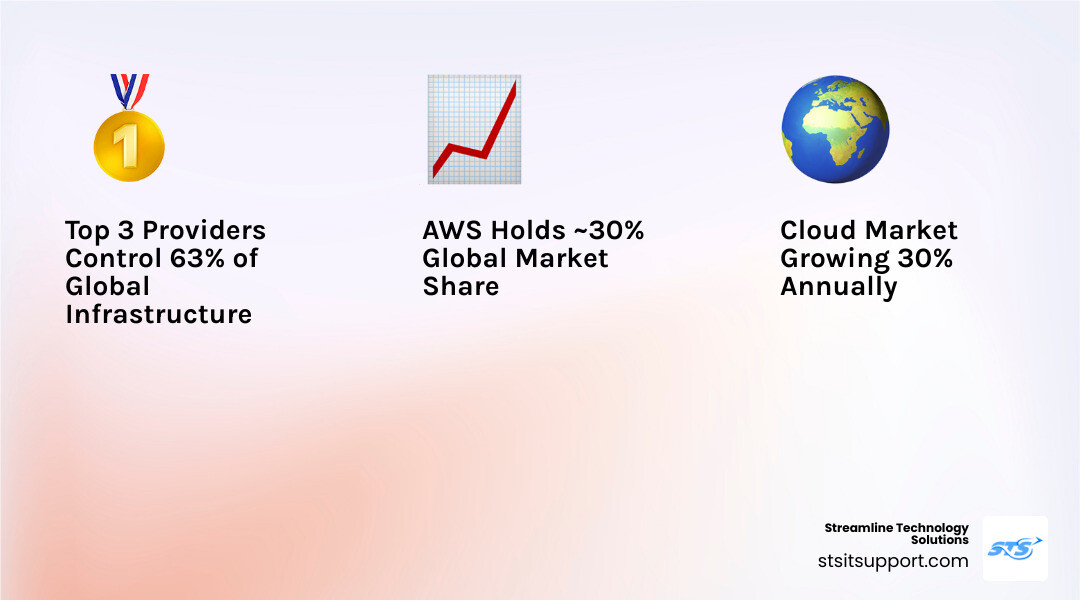
Together, AWS, Azure, and Google Cloud control roughly 63% of all global cloud infrastructure as of Q1 2026. The cloud market itself grows at around 30% per year — making the choice of provider one of the most consequential technology decisions a business can make today.
The question is no longer whether to use cloud services. It's which provider fits your business best.
I'm Michael Gaigelas, and with 20 years of hands-on experience in IT support, cloud servers, and managed services, I've helped countless businesses navigate the crowded world of cloud service providers to find solutions that actually fit their needs and budget. In this guide, I'll break down the top 21 providers so you can make a confident, informed decision.
Understanding the Ecosystem of Cloud Service Providers
Before we dive into the rankings, we need to speak the same language. If you've ever felt like cloud terminology is just a bowl of alphabet soup, you aren't alone. At its core, a cloud service provider is a third-party company that maintains massive data centers so you don't have to.
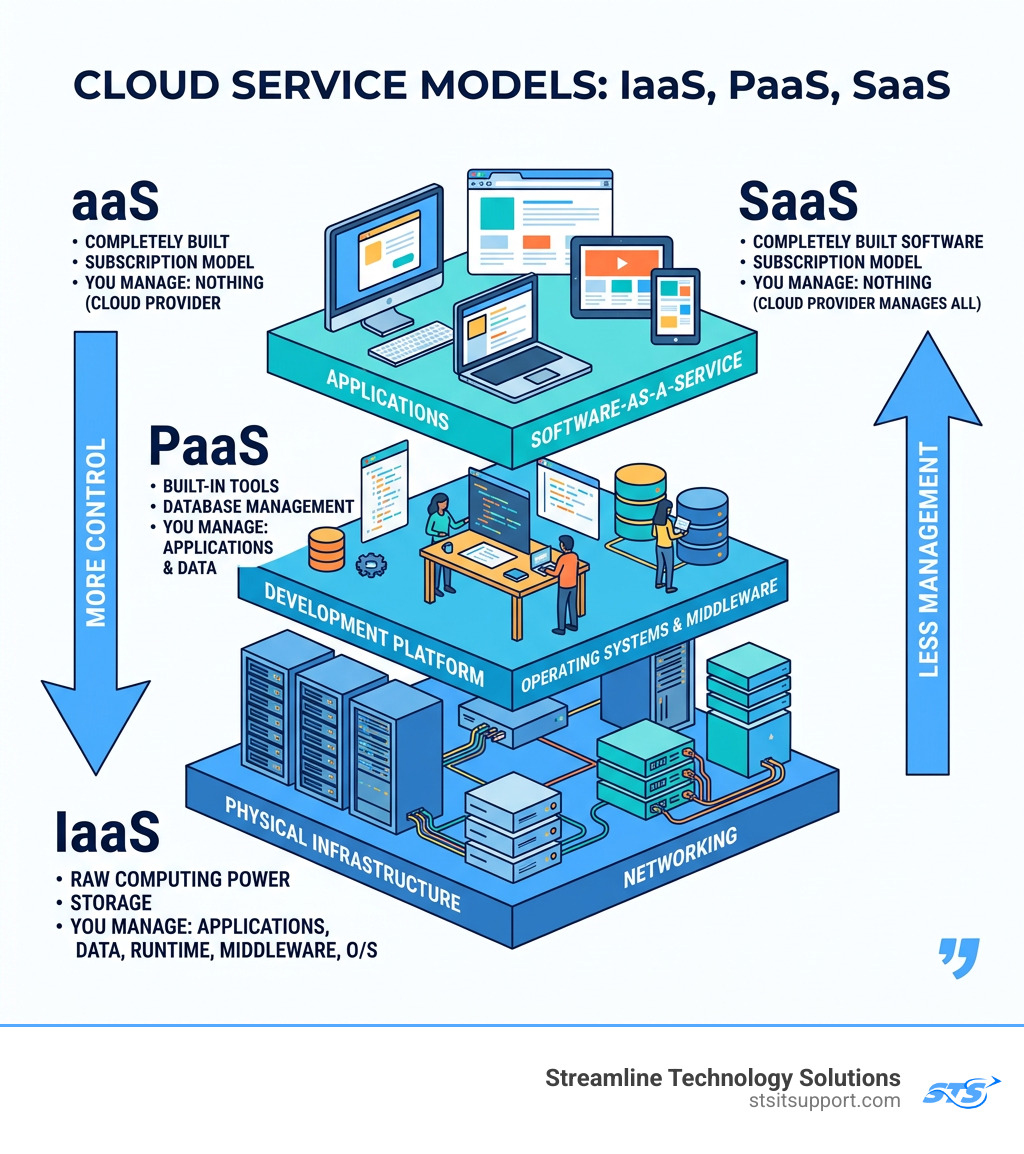
We generally categorize these services into three "layers" of a pyramid:
Infrastructure-as-a-Service (IaaS): This is the foundation. You're essentially renting the raw "bricks and mortar"—the servers, storage, and networking. You have the most control here, but you also have the most to manage.
Platform-as-a-Service (PaaS): Think of this as a pre-built workshop. It provides the hardware and a software framework (like operating systems and databases) so your developers can focus on building apps without worrying about the underlying "pipes."
Software-as-a-Service (SaaS): This is the finished house. You simply log in and use the software over the internet. Examples include Gmail, Microsoft 365, or Salesforce.
Beyond these layers, businesses must choose a deployment model. A Public Cloud shares infrastructure across many organizations (like an apartment building), while a Private Cloud is dedicated solely to one business (like a single-family home).
However, in 2026, the trend has shifted toward Hybrid Cloud—mixing on-premises servers with public cloud resources—and Multi-cloud strategies. A multi-cloud approach involves using different cloud service providers for different tasks (e.g., using Google for AI and AWS for storage) to avoid putting all your eggs in one basket.
The Big Three: Dominating the Global Infrastructure Market
The "Big Three"—AWS, Microsoft Azure, and Google Cloud—are the titans of the industry. They control 63% of the worldwide market because they offer a level of global infrastructure that is nearly impossible to replicate.
When evaluating these giants, we look at three key metrics:
Regions: Large geographic areas (like "US East") containing data centers.
Availability Zones (AZs): Isolated locations within a region designed to be "fault-tolerant." If one AZ goes down due to a local power outage, the others keep your business running.
Edge Locations: Smaller sites closer to users that speed up content delivery (like streaming video or loading a website).
Feature AWS Microsoft Azure Google Cloud (GCP) Market Share ~30% ~22% ~12% Global Regions 39 60+ 42 Best For Massive Scale Enterprise/Windows AI/Data Science
Amazon Web Services (AWS): The Global Leader among Cloud Service Providers
Since its launch in 2006, Amazon Web Services AWS has maintained a massive head start. By holding 30% of the global cloud infrastructure AWS remains the dominant player in 2026.
What makes it the king? It’s the sheer breadth of its ecosystem. AWS offers over 200 fully-featured services, from Amazon EC2 (virtual servers) to Amazon S3 (storage). Their infrastructure is staggering, spanning 123 Availability Zones across 39 Geographic Regions.
For businesses in South Florida, AWS is often the "safe" choice because of its maturity. Whether you are a startup or an enterprise like Pinterest—which uses AWS to serve 600 million users—the platform is built to scale infinitely. However, its pricing can be notoriously complex, often requiring specialized tools to manage monthly spend.
Microsoft Azure and Google Cloud: The Primary Challengers
20% of the global cloud infrastructure Microsoft Azure has secured its spot by playing to its strengths: the office. If your business runs on Windows, Active Directory, or Microsoft 365, the Azure cloud feels like a natural extension of your existing environment. Microsoft has more regions than any other provider and is currently pushing hard into "Agentic AI" to help automate business workflows.
Then there is Google Cloud. With 12% of the global cloud infrastructure market Google Cloud has carved out a niche as the smartest kid in the class. They are the leaders in AI and Machine Learning, thanks to tools like Vertex AI and BigQuery. If your business revolves around data analytics or high-performance container management (Kubernetes), Google is likely your top contender.
Beyond the Titans: Specialized Cloud Solutions
While the Big Three are impressive, they aren't always the right fit for every workload or budget. Several other major players cater to specific regional or technical needs.
Alibaba Cloud: This is the undisputed leader in Asia, holding over 40% of the market in China. It's the go-to for businesses expanding into the Asia-Pacific region.
IBM Cloud: IBM has pivoted to focus heavily on the IBM Cloud hybrid model. They are a favorite for highly regulated industries (like finance and healthcare) that need to keep some data on-site while leveraging the cloud for AI.
Oracle Cloud Infrastructure (OCI): Oracle was the first to offer IaaS, PaaS, and SaaS in a single platform. They excel in database management and running heavy-duty enterprise applications.
Salesforce: While often thought of as just a CRM, Salesforce pioneered the SaaS model. They offer specialized clouds for marketing, sales, and analytics that are entirely ready-to-use.
Tencent Cloud: Similar to Alibaba, Tencent is a powerhouse in China, with a specific focus on gaming, social media, and digital entertainment.
Evaluating Niche and Emerging Cloud Service Providers
Sometimes, you don't need a massive supermarket; you just need a local specialist. Niche cloud service providers often offer simpler interfaces and more predictable pricing.
DigitalOcean: Famous for its "Droplets" (virtual machines), DigitalOcean is a favorite for startups and SMBs. It strips away the complexity of AWS, offering transparent pricing that won't give your bookkeeper a heart attack.
Linode (Akamai): Known for being developer-friendly with flat, predictable pricing for Linux-based virtual machines.
Vultr: A rising star that specializes in high-performance cloud GPUs. If you are running AI workloads on a budget, Vultr is worth a look.
Wasabi & Backblaze: These two are the "storage specialists." Backblaze B2 and Wasabi offer object storage that is often 80% cheaper than AWS S3, with no "egress fees" (the sneaky charges providers hit you with when you try to move your data out).
VAST Data: A newcomer in the "Neocloud" revolution, VAST is building the software stack for AI supercomputing, claiming to be 35x faster than legacy cloud systems.
Strategic Benefits of Cloud Migration vs. On-Premises
In my 20 years of IT support in South Florida, I've seen the shift from "server rooms" to "serverless." Why are businesses in Boca Raton and Fort Lauderdale making the jump?
Cost Savings (CAPEX to OPEX): On-premises infrastructure requires a massive upfront investment in hardware (CAPEX). Cloud services use a "pay-as-you-go" model (OPEX), meaning you only pay for what you use.
Scalability: If your business has a sudden surge in traffic, the cloud can spin up new servers in seconds. On-premises, you'd have to buy, ship, and install new hardware—a process that takes weeks.
Reliability & Disaster Recovery: This is huge for us in South Florida. In the event of a hurricane or flood, having your data in a secure, geographically distant data center ensures business continuity. You can replicate your entire work environment and be back up and running while the office is still drying out.
Security: Major cloud service providers spend billions on security. They offer enterprise-grade protection that most small businesses simply couldn't afford on their own.
For more deep dives into how these technologies work, check out our Resources page.
Frequently Asked Questions about Cloud Computing
What are the main challenges of using a CSP?
While the cloud is powerful, it isn't magic. You need to be aware of:
Vendor Lock-in: This happens when you use so many of a provider's unique tools that it becomes too expensive or complex to leave.
Security Responsibility: This is a "Shared Responsibility Model." The provider secures the "cloud," but you are responsible for securing your data inside the cloud.
Complex Contracts: Egress fees and API call charges can lead to "sticker shock" if you don't have an expert monitoring your usage.
Why are organizations adopting a multi-cloud strategy?
Most modern businesses use at least two cloud service providers. This provides:
Redundancy: If Azure has a global outage, your AWS-backed services stay online.
Pricing Leverage: You can move workloads to whichever provider is offering the best deal this month.
Regulatory Compliance: Some industries require data to be stored in specific geographic regions or on specific types of hardware.
How do businesses optimize cloud costs?
Cloud waste is a real problem. We recommend:
Reserved Instances: Committing to a 1- or 3-year term can save you up to 70% compared to "on-demand" pricing.
Free Tiers: Almost every provider (AWS, Azure, Google) offers a free tier or $300 in credits for new users.
Automated Scaling: Setting your servers to "turn off" or shrink during nights and weekends when nobody is working.
Conclusion
The "sky" is more crowded than ever, but that’s good news for your business. Whether you need the sheer power of AWS, the seamless integration of Azure, or the budget-friendly simplicity of DigitalOcean, there is a cloud out there with your name on it.
At Streamline Technology Solutions, we specialize in helping businesses across Coral Springs, Boca Raton, Fort Lauderdale, and Deerfield Beach make these transitions smoothly. We don't believe in "hidden fees" or "complex contracts." We offer transparent pricing, fast local support, and direct accountability.
Whether you're looking for VoIP, hardware, or managed cloud services, we're here to ensure your technology supports your growth rather than hindering it.
Ready to take your business to the next level? Get started with expert IT support