
Stop Intruders with Network Intrusion Detection
Why Network Intrusion Detection Is Critical for Your Business
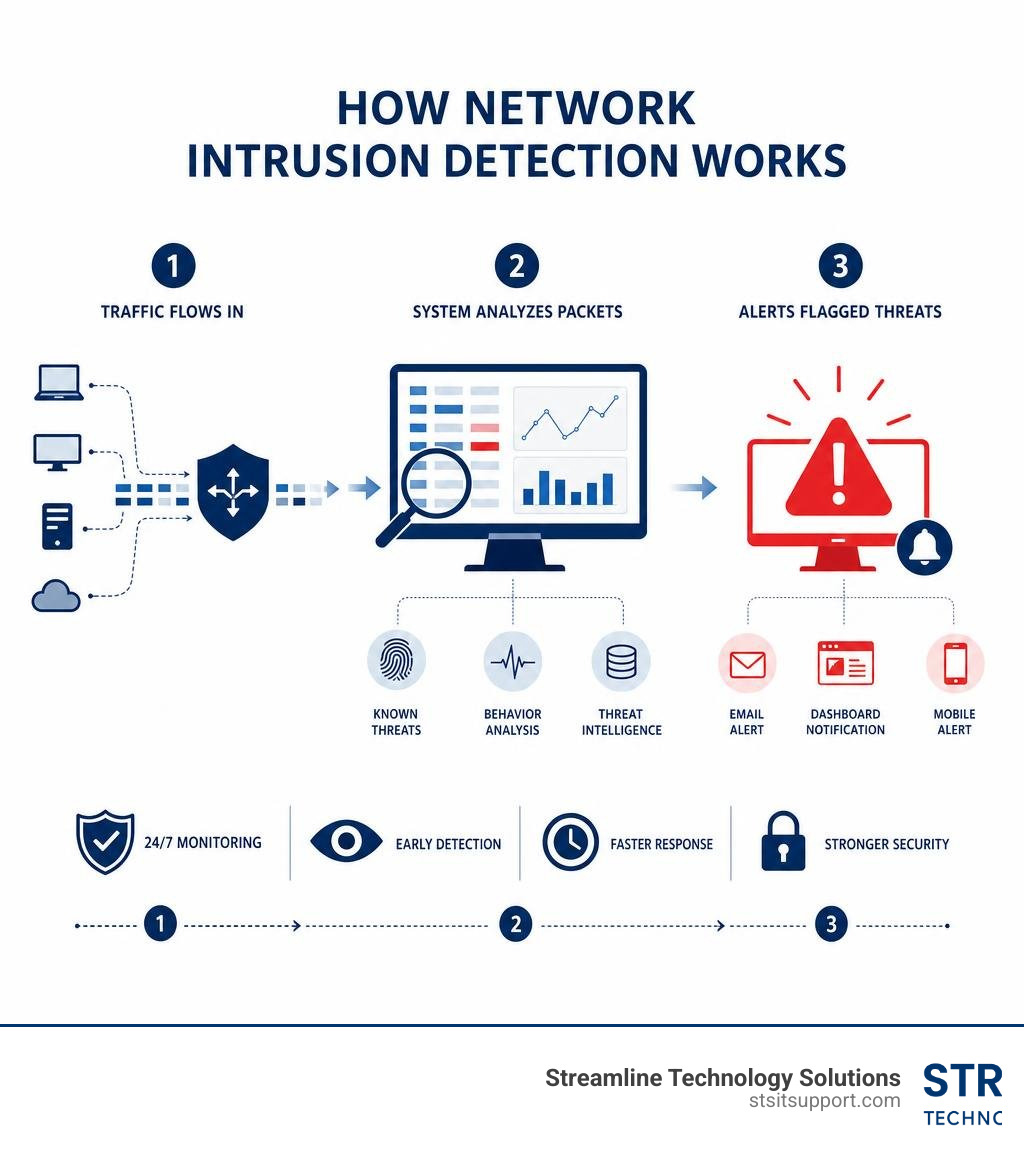
Network intrusion detection is the process of monitoring your network traffic for suspicious activity and alerting you before attackers can cause serious damage.
Here's what you need to know at a glance:
What it is: A system that watches your network traffic 24/7 and flags anything that looks malicious
How it works: It analyzes data packets flowing through your network and compares them against known attack patterns or unusual behavior
Why it matters: The average data breach cost businesses USD 4.45 million in 2023 — early detection is far cheaper than recovery
Who needs it: Any business that handles sensitive data, processes payments, or relies on its network to operate
Key options: Signature-based detection (known threats), anomaly-based detection (unusual behavior), or a hybrid of both
Cyberattacks are not slowing down. In 2023, 70% of attacks targeted critical infrastructure — but small businesses are hit just as hard, often with less resources to recover. Most attackers don't break in loudly. They move quietly through your network, stealing data or planting malware long before anyone notices.
That's exactly the gap a network intrusion detection system is designed to close.
My name is Michael Gaigelas, and I've spent 20 years helping businesses across South Florida protect and manage their networks, including hands-on work with intrusion detection systems as part of comprehensive IT security setups. In this guide, I'll walk you through everything you need to know to make smart decisions about network intrusion detection for your business.
What is Network Intrusion Detection and How Does It Work?
To understand network intrusion detection, think of it as a silent security guard sitting in a control room, watching a live video feed of all the hallways in your office building. The system doesn't physically stop people at the front door, but the second someone tries to pick a lock or slip into a restricted room, it sounds the alarm.
In technical terms, a Network Intrusion Detection System (NIDS) monitors network traffic as it travels across your physical or virtual environment. It performs deep packet inspection, looking closely at the headers and payloads of data packets to spot signs of malicious activity.
To do this without slowing down your business operations, a NIDS is typically deployed "out-of-band." This means it does not sit directly in the path of your active network traffic. Instead, we configure network switches to send a copy of all traffic to the NIDS using a Test Access Port (TAP) or a Switched Port Analyzer (SPAN) port. Because it analyzes a copy of the data, a NIDS can perform intensive security analysis without introducing latency or becoming a single point of network failure.
According to the NIST SP 800-94, Guide to Intrusion Detection and Prevention Systems (IDPS) , these systems are vital for identifying security policy violations, documenting existing threats, and catching reconnaissance activities like host or port scans before a full-scale exploit occurs. By keeping a constant eye on your data flows, a NIDS helps you identify and mitigate complex Security Threats in Network Security before they turn into full-blown disasters.
Using a NIDS is like having a digital lookout. This passive monitoring approach is a cornerstone of any mature defensive posture, giving security teams the visibility they need to catch bad actors in the act.
Network Intrusion Detection vs. Host-Based Intrusion Detection (HIDS)
When building a defense-in-depth strategy, it is common to wonder how network-based detection compares to host-based options. While both are intrusion detection systems, they look at completely different datasets.
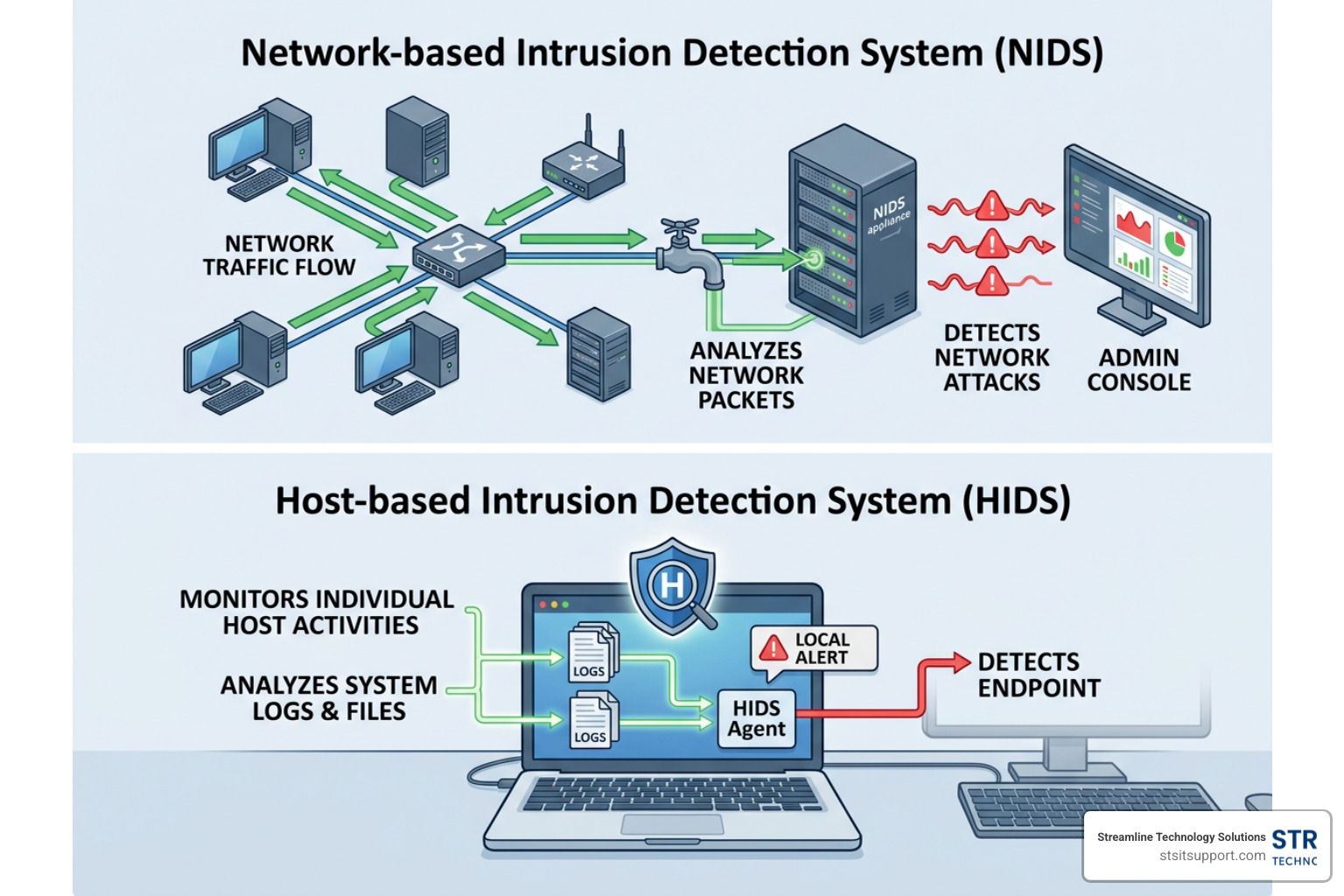
A Network Intrusion Detection System (NIDS) analyzes the traffic flowing between all your devices. It is agentless, meaning you do not need to install software on every single computer or server. It provides a broad, high-level view of your entire infrastructure, making it excellent for spotting lateral movement, rogue devices, and network-wide scanning.
A Host-Based Intrusion Detection System (HIDS), on the other hand, is installed directly on a specific device (a host), such as a critical database server or an executive's laptop. It monitors system logs, application logs, registry changes, and file system integrity on that specific machine. While a HIDS has deep visibility into what is happening inside a device, it is blind to the rest of the network.
For the strongest protection, we recommend combining both. NIDS catches the threat as it travels across the wire, while HIDS alerts you if a threat manages to execute on an individual endpoint.
Comparing NIDS, IPS, and Network Detection and Response (NDR)
As security technology has evolved, several closely related terms have emerged. Understanding the differences between NIDS, Intrusion Prevention Systems (IPS), and Network Detection and Response (NDR) is crucial for designing an effective security architecture.
Traditional perimeter security tools, like those discussed in our guide on the Proxy and the Firewall, act as gatekeepers. They block or filter traffic based on pre-defined access rules. However, once traffic is permitted past the firewall, you need specialized systems to monitor its behavior.
Here is how NIDS, IPS, and NDR compare:
Feature Network Intrusion Detection System (NIDS) Intrusion Prevention System (IPS) Network Detection and Response (NDR) Primary Role Passive monitoring and alerting Active blocking and prevention Behavioral analysis and threat hunting Deployment Out-of-band (analyzes copies of traffic) Inline (sits directly in the traffic path) Out-of-band or cloud-integrated Response Action Generates alerts for human analysts Automatically drops malicious packets Automates response and provides forensic data Detection Basis Known signatures and basic anomalies Known signatures and policy rules Advanced machine learning and heuristics Handling of Encryption Limited visibility into encrypted payloads Limited visibility unless acting as a decryptor High capability using metadata and behavioral patterns
While NIDS is a silent observer that alerts you to danger, an IPS takes immediate action to block the threat. NDR represents the modern evolution of these technologies, using artificial intelligence to detect complex, slow-moving attacks that bypass traditional signature-based systems.
Core Detection Methodologies and Modern Alternatives
Intrusion detection systems rely on different methodologies to separate normal business operations from actual cyberattacks. As hackers have developed stealthier techniques, detection methods have grown from simple pattern matching to highly sophisticated behavioral analysis.
Signature-Based Network Intrusion Detection
Signature-based detection is the traditional workhorse of the NIDS world. It operates much like classic antivirus software. The system maintains a large database of "signatures"—specific patterns of bytes, known malicious IP addresses, or specific sequences of commands that are unique to known exploits.
When the NIDS inspects a packet and finds a match in its database, it immediately triggers an alert. This method is incredibly accurate for identifying known threats and produces very few false positives when configured correctly.
The most famous open-source tool utilizing this approach is Snort. With over 5 million downloads and more than 600,000 registered users, Snort - Network Intrusion Detection & Prevention System is the most widely deployed intrusion prevention engine in the world. It uses a robust, community-driven ruleset to define malicious activity, allowing businesses to benefit from real-time threat intelligence updates.
However, signature-based detection has a major blind spot: it cannot detect zero-day exploits (newly discovered vulnerabilities that do not have a signature yet). It is also less effective at catching dynamic Wireless Network Threats or polymorphic malware that changes its code structure to evade detection.
Anomaly-Based and Hybrid Detection Methods
To catch the threats that signature-based systems miss, security engineers developed anomaly-based detection.
Instead of looking for known bad patterns, anomaly-based systems focus on learning what "normal" looks like on your specific network. During an initial calibration period, the system builds a baseline of your everyday traffic—such as typical data volumes, standard operating hours, and common protocol usage. Once the baseline is set, the system flags any activity that deviates significantly from these norms, such as a workstation suddenly transferring gigabytes of data to an external server at 3:00 AM.
This method is highly effective at spotting zero-day attacks and insider threats. The downside? It can generate a high volume of false positives. If your marketing department suddenly decides to upload a massive video archive to a cloud drive, an anomaly-based system might flag it as a data exfiltration attempt.
To solve this, modern security setups use hybrid detection methods. By combining signature-based and anomaly-based systems, security teams get the best of both worlds: rapid, highly accurate detection of known threats alongside the ability to spot unusual, suspicious behaviors that warrant closer investigation.
The Evolution to Network Detection and Response (NDR)
Traditional NIDS and IPS solutions were built for an era when network boundaries were clear and most traffic was unencrypted. Today, the landscape is entirely different. Encrypted traffic now comprises over 90% of internet traffic, which means traditional signature-based packet inspection is often blind to the actual data payload.
This challenge has driven the evolution toward Network Detection and Response (NDR). NDR solutions do not just look at individual packets; they analyze the broader context of network behaviors over time.
By utilizing advanced machine learning, NDR platforms can analyze encrypted traffic by examining metadata, packet sizes, transmission intervals, and connection patterns without needing to decrypt the payload itself. Modern solutions like Network detection and response (NDR) solutions - IBM Security integrate seamlessly with existing Security Information and Event Management (SIEM) platforms, helping security operations centers (SOCs) correlate network anomalies with endpoint data.
Furthermore, platforms such as Clear NDR® | Transparent Network Detection & Response | Stamus Networks focus on providing highly transparent, explainable alerts. Instead of burying analysts under millions of raw alerts, modern NDR systems group related events into high-fidelity "declarations of compromise," allowing local IT teams to focus their energy on real, actionable threats rather than chasing ghosts.
Key Challenges and Optimization Techniques in NIDS Deployment
Deploying a network intrusion detection system is not a set-it-and-forget-it project. Without careful planning and ongoing maintenance, organizations often face significant operational hurdles.
The first step to a successful deployment is always a thorough Cybersecurity Risk Assessment. Before you can decide where to place your detection sensors, you must understand where your most critical data lives, what compliance regulations apply to your industry, and where your network is most vulnerable.
Managing False Positives and Encrypted Traffic
The single biggest operational challenge with legacy NIDS is "alert fatigue." When a system is poorly tuned, it can generate thousands of alerts a day for harmless network events. Over time, IT staff begin to ignore these alerts, which is exactly how real, dangerous intrusions slip through the cracks.
Managing false positives requires systematic rule tuning and alert suppression. Legitimate administrative tools, network scanners, and proxy servers must be whitelisted or filtered out of the alerting stream.
At the same time, the massive rise in encrypted traffic means that traditional packet payload inspection is no longer enough. To maintain visibility, modern deployments must rely on behavioral fingerprinting (such as JA3/JA4 TLS fingerprinting) and metadata analysis to identify suspicious communication channels without exposing sensitive, encrypted business data.
Improving Efficiency with Feature Selection and Neurosymbolic AI
As network speeds increase to 10Gbps and beyond, processing every single byte of network data in real-time puts an immense computational strain on security hardware. Fortunately, cutting-edge computer science is providing elegant solutions to this problem.
One major area of improvement is advanced feature selection. High-dimensional network datasets contain a lot of redundant or noisy information that slows down machine learning classifiers. As detailed in the academic study Feature Selection for Network Intrusion Detection , researchers have developed information-theoretic methods using neural approximations of transfer entropy. By identifying and selecting only the most informative features of network packets, these techniques dramatically reduce computational complexity and improve detection accuracy without sacrificing security.
Additionally, researchers are leveraging hybrid artificial intelligence models to make detection engines smarter. The research paper Neurosymbolic Artificial Intelligence for Robust Network Intrusion Detection: From Scratch to Transfer Learning demonstrates how combining deep learning (for feature extraction) with symbolic reasoning (like decision trees or rule-based logic) creates highly robust NIDS models.
This neurosymbolic approach allows for "transfer learning," meaning a security model trained on one network can be successfully deployed to a completely different network with minimal training data. This is a massive breakthrough for small and mid-sized businesses, as it allows them to deploy highly sophisticated, AI-driven security models without needing massive datasets or enterprise-scale budgets to train them.
Frequently Asked Questions about Network Intrusion Detection
What is the primary difference between IDS and IPS?
An Intrusion Detection System (IDS) is a passive monitoring tool. It sits out-of-band, analyzes a copy of your network traffic, and generates alerts when it detects suspicious activity. It does not stop the traffic from reaching its destination. An Intrusion Prevention System (IPS) is deployed inline, directly in the path of your network traffic. It actively inspects packets in real-time and can automatically drop malicious traffic or block offending IP addresses to stop an attack as it happens.
How does encrypted traffic affect network intrusion detection?
Traditional NIDS relies on reading the plain-text payload of network packets to match known signatures. Because over 90% of web traffic is now encrypted, these systems cannot read the payloads directly. Modern systems overcome this by analyzing network metadata (such as connection duration, packet sizes, and destination ports) and using machine learning to identify behavioral patterns associated with malware, command-and-control communications, and data exfiltration.
Why is a hybrid detection method considered the most effective?
A hybrid detection method combines the precision of signature-based detection with the flexibility of anomaly-based detection. Signature-based systems are excellent at stopping known threats with almost zero false positives, but they are blind to new attacks. Anomaly-based systems can catch zero-day exploits and insider threats, but they often trigger false alarms on normal network variations. Combining both methods gives you a comprehensive defense that catches known and unknown threats while keeping false alarms to a minimum.
Conclusion
Securing a modern business network requires constant vigilance. Traditional firewalls are essential, but once an attacker finds a way past your perimeter, you need deep visibility into your internal traffic to catch them before they cause harm. Implementing a robust network intrusion detection strategy is one of the most effective ways to protect your digital assets and ensure compliance with industry regulations.
At Streamline Technology Solutions, we help South Florida businesses design, deploy, and manage advanced security architectures tailored to their unique needs. We provide comprehensive Network Security Services and detailed Cyber Security Audit solutions to identify vulnerabilities and keep your business safe from emerging threats.
Whether your business is located in Coral Springs, Boca Raton, Fort Lauderdale, Ft. Lauderdale, Deerfield Beach, or Pompano Beach, our team is here to support you. We pride ourselves on delivering:
Transparent pricing without hidden fees
Fast local support from highly experienced technicians
Direct accountability for your network's uptime and security
Ready to take the guesswork out of your business's cybersecurity? Contact us today at Streamline Technology Solutions to schedule a consultation and learn how we can help you build a secure, resilient network environment.