The Ultimate Guide to Network Security Services
Why Network Security Services Are Essential for Every Business in 2026
Network security services are the tools, technologies, and managed solutions that protect your business's data, devices, and users from cyber threats.
Here's a quick breakdown of what they include:
Firewalls — block unauthorized traffic from entering your network
Intrusion Prevention Systems (IPS) — detect and stop attacks in real time
Zero Trust Access — verify every user and device before granting access
Endpoint Protection — secure laptops, phones, and workstations
Managed Detection & Response (MDR) — 24/7 monitoring and incident response
Cloud-Based Security (NSaaS) — scalable protection delivered as a subscription service
Cyber threats are not slowing down. Ransomware, phishing, and AI-generated attacks are hitting businesses of every size — including small businesses in South Florida. And the cost of getting it wrong is steep: downtime, lost data, damaged customer trust, and regulatory fines.
The challenge for most small business owners isn't knowing that security matters. It's knowing where to start — and finding a provider who won't disappear when something goes wrong.
Traditional security setups required expensive hardware and a full-time IT team. Today, cloud-based and managed options make strong protection accessible to businesses of any size, without the surprise costs or complexity.
I'm Michael Gaigelas, and with over 20 years of hands-on experience in IT support, managed services, and business technology, I've helped countless South Florida businesses build reliable network security services that actually fit their needs and budgets. In this guide, I'll walk you through everything you need to know — from the core components of a solid defense strategy to the latest trends shaping security in 2026.
The Evolution of Network Security Services
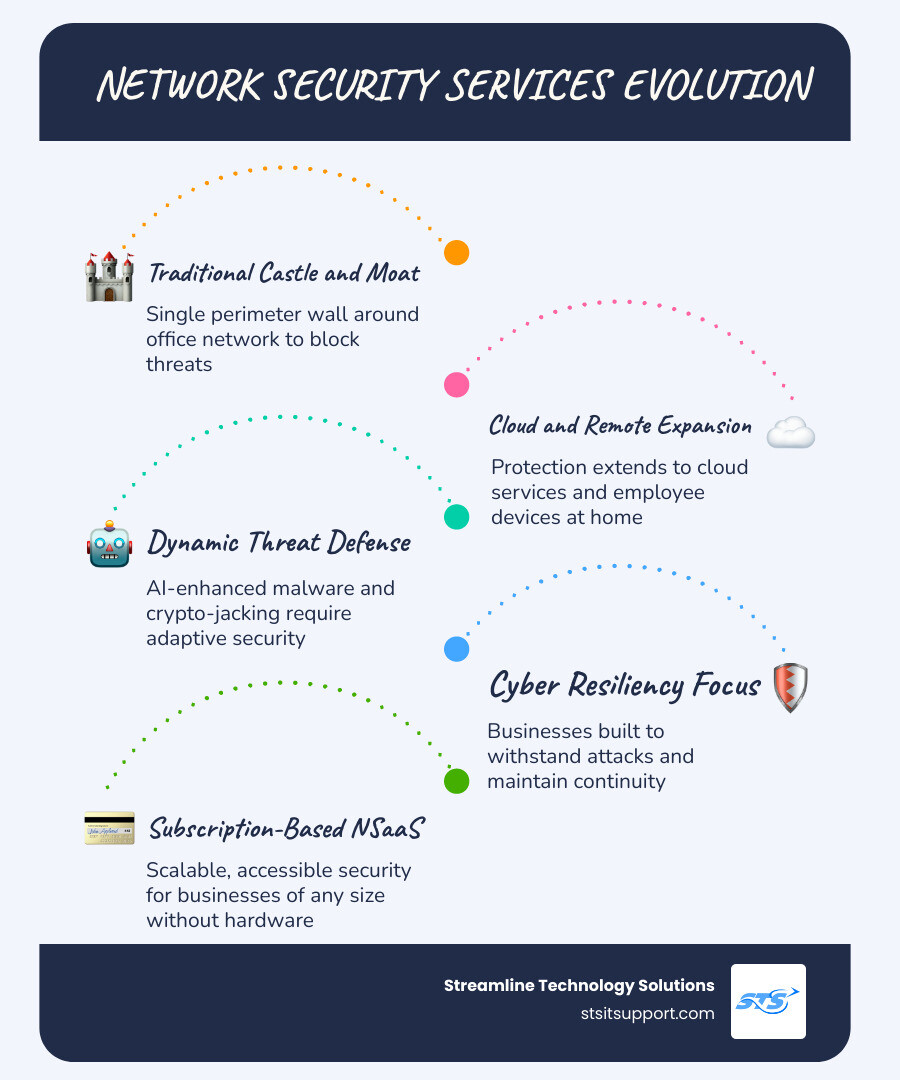
The digital world of May 2026 looks very different from the landscape of just a few years ago. We’ve moved beyond the "castle and moat" mentality where you simply built a big wall around your office and called it a day. Today’s network is everywhere—it’s in the cloud, on your employees' home Wi-Fi in Boca Raton, and inside the mobile devices used by your sales team in Fort Lauderdale.
Modern network security services are designed to ensure cyber resiliency and business continuity. This means your business doesn't just block attacks; it’s built to withstand them and keep running no matter what. With the rise of sophisticated threats like crypto-jacking and AI-enhanced malware, your defense must be as dynamic as the attacks themselves.

Defining Modern Network Security Services
At its core, network security is about protecting the integrity and usability of your internal systems. It involves a combination of hardware, software, and protocols designed to prevent unauthorized access, misuse, or theft of your data.
One of the foundational elements of this protection involves the use of cryptographic libraries. For example, Network Security Services (NSS) is a set of open-source libraries that support security standards like SSL v3, TLS, and various PKCS standards. These libraries are what allow your web browser and email clients to communicate securely. In fact, NSS has been validated five times for FIPS 140 conformance, proving that even the building blocks of our digital world require rigorous testing—sometimes involving over 1.6 million test cases—to ensure they can handle invalid or malicious data.
When we talk about Secure networking standards, we are referring to this deep integration of encryption and protocol enforcement that keeps your business data private.
Why Businesses Outsource Network Security Services
If you’re running a business in Coral Springs or Deerfield Beach, you likely don't have the time to monitor your firewall logs at 3:00 AM. This is why many organizations are turning to Managed IT Support Companies.
Outsourcing provides several key advantages:
Expert Access: You get a team of specialists who live and breathe cybersecurity, rather than a generalist who "knows a bit about computers."
Cost Reduction: Instead of hiring three full-time security analysts, you pay a predictable monthly fee.
24/7 Monitoring: Cybercriminals don't take the weekend off. Managed services ensure your network is watched around the clock.
Direct Accountability: When you work with a local partner for IT Support for Businesses, you know exactly who to call if a problem arises.
Core Components of a Layered Defense Strategy
Think of your network security like a high-end South Florida home. You don't just have a lock on the front door. You have a perimeter fence, a security camera system, motion sensors, and maybe even a safe for your most valuable items. This is "Defense in Depth."

Firewall and Perimeter Protection
The firewall is your first line of defense. It acts as a barrier between your internal network and the chaotic world of the internet. Modern firewalls do much more than just block certain ports; they perform stateful inspection and deep packet inspection to look inside the data moving through your network.
Leading Network Security Solutions & Services now offer geographic IP filtering, allowing you to block traffic from entire regions where you don't do business. If you only operate in Pompano Beach and Fort Lauderdale, there’s often no reason to allow incoming connections from overseas servers known for hosting botnets. Furthermore, Advanced network firewall capabilities now allow for automated, intelligence-driven blocking that scales with your traffic, which is especially critical for Law Firm Cybersecurity Services where client confidentiality is legally mandated.
Endpoint and Access Control
With the shift toward permanent remote work, the "perimeter" has moved to the device. Every laptop, smartphone, and tablet is an endpoint that could be a gateway for an attacker.
Effective network security services must include:
Multi-Factor Authentication (MFA): Requiring a second form of ID (like a code on a phone) makes it significantly harder for hackers to use stolen passwords.
VPN Encryption: A Virtual Private Network ensures that even if an employee is working from a coffee shop in Boca Raton, their data stays encrypted.
Workstation Protection: Advanced anti-virus and Endpoint Detection and Response (EDR) tools monitor for suspicious behavior on the device itself, stopping malware before it can spread to the rest of the network.
Transitioning to Network Security as a Service (NSaaS)
The biggest shift we’ve seen by 2026 is the move from on-premises hardware to Network Security as a Service (NSaaS). In the old days, you’d buy a "black box," plug it into the wall, and hope it didn't break. Today, security is delivered through the cloud.
Feature On-Premises Hardware Cloud-Based NSaaS Upfront Cost High (Hardware purchase) Low (Subscription-based) Scalability Limited by physical capacity Instant and unlimited Maintenance Manual updates and patches Automated by the provider Remote Support Difficult / Requires on-site Built-in for all locations Expertise Requires in-house specialist Provided by the service
By using Local Cybersecurity Services Florida, businesses can reduce their physical infrastructure while gaining access to top-tier security tools that were previously only affordable for Fortune 500 companies.
Managed Detection and Response (MDR)
MDR is the "human element" of modern security. While AI can catch 99% of threats, that 1% of sophisticated, human-led attacks requires a human response. Leading managed detection & response (MDR) security services focus on radical transparency.
The stats are impressive: organizations using high-quality MDR services have reported a 90% time savings in containing incidents and a 64% improvement in Mean Time to Remediate (MTTR). Instead of an investigation taking 6 hours, it takes 15 minutes. This speed is what prevents a minor "glitch" from becoming a catastrophic data breach.
Cloud-Native Security Architectures
For businesses with multiple locations—say, offices in both Coral Springs and Ft. Lauderdale—cloud-native architectures like SASE (Secure Access Service Edge) are a game changer. SASE combines networking (SD-WAN) with security functions, delivering them all from the "edge" of the network. This means faster speeds for your employees and better protection for your data. One entertainment company recently saved 5,000 man-hours per month by switching to a cloud-delivered security and SD-WAN solution.
Emerging Trends: AI-Powered Detection and Zero Trust
We are currently in the era of "fighting AI with AI." As hackers use artificial intelligence to create more convincing phishing emails and faster-spreading malware, our network security services must use AI to stay ahead.
Implementing Zero Trust Architecture
The core philosophy of Zero Trust is "Never Trust, Always Verify." In a traditional network, once you were "in," you had access to everything. In a Zero Trust model, identity is the new perimeter.
Least Privilege: Users only get access to the specific files and apps they need for their job.
Continuous Verification: The system doesn't just check your password once; it constantly monitors for suspicious behavior.
Lateral Movement Prevention: If one computer gets infected, Zero Trust prevents the virus from jumping to the server next to it.
The Role of AI in Threat Mitigation
Modern security platforms now use "Precision AI" to analyze connections in real-time. This is essential for catching "Shadow AI"—the unauthorized use of generative AI tools by employees that could accidentally leak company data. By using machine learning, these systems can identify a zero-day threat (a brand new attack no one has seen before) by recognizing patterns that don't match normal business operations.
Best Practices for Implementing Network Security
Building a secure network isn't a "one and done" project. It’s a continuous process of improvement.
Continuous Monitoring and Maintenance
You wouldn't drive a car for five years without an oil change, and you shouldn't run a network without regular maintenance. This includes:
Patch Management: Keeping all software up to date to close security holes.
Vulnerability Scanning: Regularly testing your own network to find weaknesses before a hacker does.
Security Awareness Training: Your employees are your strongest defense—or your weakest link. Regular training helps them spot phishing attempts and follow best practices.
A Cybersecurity Risk Assessment is the best way to start. It gives you a roadmap of where your biggest risks are so you can spend your budget where it matters most.
Incident Response and Recovery
Every business needs a "Plan B." If a hurricane hits South Florida or a ransomware attack locks your files, how quickly can you get back to work?
Forensic Analysis: Understanding how a breach happened so it never happens again.
Threat Intelligence: Using data from around the world to anticipate new types of attacks.
Disaster Recovery: Having off-site, encrypted backups that allow you to restore your entire business in hours, not weeks.
Frequently Asked Questions about Network Security
What is the difference between a firewall and an intrusion prevention system?
Think of a firewall as a security guard at the gate who checks IDs. An Intrusion Prevention System (IPS) is like a plainclothes detective walking around inside the building, looking for people who are acting suspiciously even if they had a valid ID to get in. You need both for complete protection.
How does Zero Trust improve network security for remote workers?
Zero Trust is perfect for remote work because it doesn't care where the user is located. Whether an employee is in our Deerfield Beach office or at a home office in Pompano Beach, the security requirements remain the same. It ensures that the device is secure and the user is who they say they are before any data is exchanged.
Why is Network Security as a Service (NSaaS) more cost-effective for SMBs?
NSaaS eliminates the need for expensive hardware refreshes every three years. It turns a large capital expense into a predictable operating expense. Plus, you get access to enterprise-grade tools and a team of experts for a fraction of what it would cost to build that capability in-house.
Conclusion
Navigating network security services can feel overwhelming, but it doesn't have to be. At Streamline Technology Solutions, we believe that every business in South Florida deserves enterprise-level protection without the enterprise-level headache.
Whether you are looking to secure a law firm in Boca Raton or scale a growing business in Fort Lauderdale, our focus is on providing transparent pricing without hidden fees and fast, local support. We don't just sell you a "black box"; we provide direct accountability and a partnership that grows with your business.
Don't wait for a breach to realize your defenses are outdated. Let's build a network that is resilient, secure, and ready for whatever 2026 throws at it.
Visit us at https://stsitsupport.com to learn how we can safeguard your business today.