
Network Security Threats and How to Keep Your Data from Going Rogue
Why Security Threats in Network Security Are a Growing Problem for Every Business
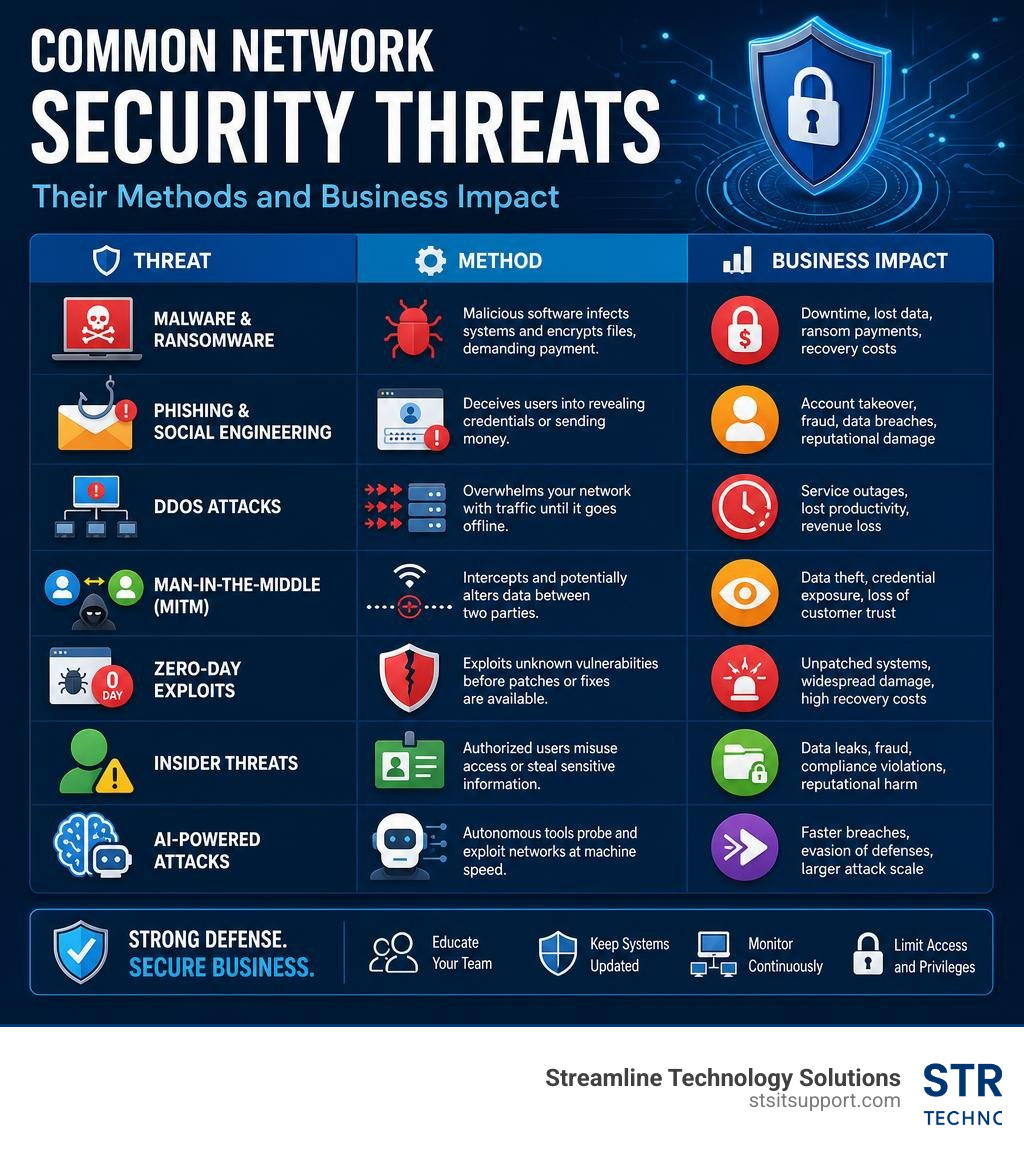
The most common security threats in network security include:
Threat Type What It Does Malware & Ransomware Infects systems, encrypts files, demands payment Phishing & Social Engineering Tricks users into handing over credentials or money DDoS Attacks Floods your network until it goes offline Man-in-the-Middle (MITM) Intercepts data moving between two parties Zero-Day Exploits Attacks unpatched vulnerabilities before fixes exist Insider Threats Abuse of access by employees or contractors AI-Powered Attacks Autonomous tools that probe and exploit networks at machine speed
Security threats in network security don't just hit big corporations — they hit businesses of every size, every day. And the numbers are hard to ignore.
According to IBM's 2024 Cost of a Data Breach Report, the average breach now costs $4.88 million. Ransomware alone is projected to cost victims $57 billion in 2026. For small and mid-sized businesses, even a few minutes of downtime can cost thousands of dollars — and some never fully recover.
The threat landscape has also shifted fast. Attackers no longer rely on just one method. Modern attacks blend malware, stolen credentials, and automated tools to move through networks quickly and quietly. In one documented case, a sophisticated threat actor maintained undetected access inside a compromised network for three full years before anyone noticed.
Your network is the backbone of your business. When it's breached, everything stops — operations, revenue, customer trust.
I'm Michael Gaigelas, and I've spent 20 years helping businesses navigate IT infrastructure, network security, and managed services. In that time, I've seen security threats in network security evolve from simple viruses to AI-driven autonomous attacks — and I've helped businesses in South Florida build defenses that hold up. Let's walk through exactly what you're up against.
Network Security vs. Cybersecurity: Understanding the Core Differences
To build an effective defense, we first need to clarify a common point of confusion: the difference between network security and broader cybersecurity. While people often use these terms interchangeably, they focus on different areas of your digital environment.
┌──────────────────────────────────────────────────────────┐
│ CYBERSECURITY │
│ (Data Security, Cloud, Endpoints, Applications, Identity)│
│ │
│ ┌──────────────────────────────────────┐ │
│ │ NETWORK SECURITY │ │
│ │ (Firewalls, VPNs, Segmentation, │ │
│ │ Transit Encryption, Routers) │ │
│ └──────────────────────────────────────┘ │
└──────────────────────────────────────────────────────────┘
Cybersecurity is the overarching umbrella. It encompasses the protection of all digital assets, including cloud environments, individual endpoints (like laptops and phones), application code, identity databases, and data at rest.
Network security is a specialized, foundational subset of cybersecurity. Its primary job is to protect the infrastructure that allows your devices to talk to one another. If cybersecurity is about protecting every room inside a building, network security is about securing the hallways, the entry gates, and the plumbing that connects them. It focuses on data in transit, network protocols, hardware appliances, and the boundaries between trusted internal systems and the untrusted public internet.
Both disciplines rely on the classic CIA Triad:
Confidentiality: Ensuring sensitive data is only accessible to authorized users (e.g., using strong encryption so sniffed packets are unreadable).
Integrity: Preventing unauthorized modification of data while it travels across your network.
Availability: Keeping your systems online and functional so your team can work without interruption (e.g., stopping a DDoS attack from crashing your servers).
For businesses operating in South Florida, keeping this distinction clear is vital. If you only focus on endpoint antivirus but ignore how your branch offices in Fort Lauderdale, Pompano Beach, and Boca Raton communicate, you leave a massive gap.
Developing a comprehensive strategy requires looking at both spheres. If you want to evaluate your broader posture, exploring local cybersecurity services Florida can help you map out a balanced defense that covers both your endpoints and your network infrastructure.
The Most Common Security Threats in Network Security
To protect your organization, you must know how adversaries attempt to break in. Attackers look for the path of least resistance, which often means exploiting software vulnerabilities, tricking your employees, or overwhelming your hardware.
If you want to ensure your business is fully protected, partnering with dedicated professionals for network security services is the most reliable way to implement the defenses detailed below.
Malware and Ransomware: The Cost of System Infection
Malware remains a highly common threat to modern business networks. It is an umbrella term for malicious software designed to disrupt, damage, or gain unauthorized access to systems. Let's break down the most destructive types:
Ransomware: This is the most financially devastating category of malware. Once inside, it encrypts critical files across your network and demands a ransom for the decryption key. In 2021, ransomware downtime cost US businesses an estimated $159 billion, with payment demands averaging $7.9 million. Paying the ransom is a massive gamble: 24% of organizations that chose to pay ransomware attackers did not recover their data.
Worms: Unlike standard viruses, which require a human to open an infected file to spread, worms are network-aware. They can replicate and spread across an entire network completely on their own by exploiting unpatched system vulnerabilities. At its peak, the infamous WannaCry worm infected up to 10,000 devices per hour worldwide by exploiting a single vulnerability in Windows' file-sharing protocol.
Spyware and Keyloggers: These programs run silently in the background. Keyloggers record every keystroke with timestamps, allowing attackers to harvest administrative credentials, banking passwords, and sensitive client information without raising any alarms.
Ransomware and malware often target known gaps in your network defenses. To find these gaps before attackers do, conducting regular cybersecurity risk assessments is crucial for identifying where your network is most vulnerable.
Phishing and Social Engineering: Exploiting the Human Element
The strongest firewall in the world cannot protect your business if an employee willingly hands over their login credentials. Social engineering exploits human psychology rather than technical flaws.
Spear Phishing: Unlike generic spam, spear phishing attacks are highly targeted. Attackers research a specific employee (often using public social media or LinkedIn profiles) to craft a highly convincing email that appears to come from a trusted vendor, partner, or internal department.
Whaling: This is spear phishing directed at high-level executives, such as CEOs or CFOs. Attackers attempt to compromise these accounts to gain administrative access to the network or authorize high-value financial transfers.
Business Email Compromise (BEC): Once an attacker compromises an executive or accounting email account, they intercept legitimate invoice conversations and trick clients or internal staff into routing payments to fraudulent bank accounts. Across the industry, the average cost of phishing incidents has risen to $14.8 million per company.
Man-in-the-Middle (MITM) and Protocol Attacks: Intercepting Data in Transit
Man-in-the-Middle (MITM) attacks occur when an adversary inserts themselves between two communicating endpoints—such as an employee's laptop and your cloud database—to intercept or alter data in real time.
[Employee Laptop] <─── Encrypted Session (Hijacked!) ───> [Attacker Router] <─── forwarded ───> [Company Server]
Packet Sniffing: If your network traffic is unencrypted, attackers on the same network (like a public Wi-Fi network or a compromised office network) can use packet-sniffing software to read your data in plain text.
Session Hijacking: Attackers can steal active session tokens or cookies, allowing them to bypass multi-factor authentication (MFA) and masquerade as a legitimate, logged-in user.
Protocol Vulnerabilities: Older cryptographic protocols (like SSL or TLS 1.0/1.1) have known mathematical weaknesses that allow attackers to decrypt intercepted traffic.
Defending against these transit-level threats requires a strong combination of modern encryption and strict gateway controls. To learn how to properly route and filter this traffic, you can read more about proxy and firewall configurations to secure your data paths.
Emerging Network Security Threats: AI, Zero-Days, and Real-World Breaches

The threat landscape is constantly changing. As defensive technologies improve, cybercriminals develop highly automated, intelligent, and stealthy methods to bypass traditional blocklists and signature-based detection systems.
AI-Powered Security Threats in Network Security
Artificial intelligence is no longer just a defensive tool; attackers are actively using it to speed up and scale their operations.
We have moved beyond theoretical risks into proven capabilities. Academic and real-world findings show that an Autonomous AI-driven worm can reason its way through corporate networks without relying on commercial cloud AI platforms. These prototype worms run on small, open-weight language models hosted locally on compromised hardware (often using stolen GPU compute). They can analyze a target network, read public security advisories on the fly to exploit vulnerabilities disclosed after their training cutoff, and autonomously rewrite their own code to bypass active defenses.
Additionally, automated threats are targeting cloud environments directly. Security researchers recently documented an Agentic threat actor hits the orchestration plane: AI agent-driven container escape. In this attack, an LLM-driven agent exploited a container vulnerability, detected a mounted Docker socket, and autonomously executed a series of complex commands to escape the container, gain root access to the host machine, and steal Kubernetes secrets—all without human intervention.
Zero-Day Exploits and Edge Device Vulnerabilities
A zero-day exploit targets a software vulnerability that is completely unknown to the vendor, meaning there is "zero days" of protection available. Edge devices—like VPN gateways, firewalls, and routers—are primary targets because they face the public internet.
A clear example of this occurred when Attackers exploit Palo Alto GlobalProtect flaw days after disclosure. This vulnerability allowed attackers to bypass authentication entirely without needing valid credentials, malware, or phishing. By sending a forged cookie to the VPN gateway, attackers gained direct access to corporate networks. Even though the vulnerability was initially rated as medium severity, attackers began actively exploiting it in the wild just four days after its disclosure, forcing CISA to issue emergency remediation mandates.
Real-World Breaches: Critical Lessons from Modern Network Exploits
Analyzing recent high-profile breaches reveals how sophisticated threat actors exploit edge devices and maintain persistence inside enterprise networks.
Consider CVE-2026-20182: The Cisco SD-WAN Zero-Day That Let UAT-8616 Own Enterprise Networks for Three Years. A state-sponsored threat group (tracked as UAT-8616) exploited a logic flaw in the Cisco Catalyst SD-WAN vdaemon service. By declaring a connecting device as a specific "vHub" type, the system skipped certificate verification entirely, granting the attacker unauthenticated access to the central control plane.
The attackers injected SSH keys, downgraded software to exploit older vulnerabilities, and maintained a backdoor that survived reboots and upgrades. They controlled routing policies and intercepted communications for three undetected years before discovery, highlighting the severe risk of control-plane vulnerabilities.
Another critical lesson comes from The Third Shadow of CitrixBleed — Large-Scale Exploitation of a NetScaler Memory Overread Reignites. This vulnerability (CVE-2026-3055) is a memory overread flaw in Citrix NetScaler gateways configured for SAML Single Sign-On (SSO). Attackers exploit this memory leak to harvest valid active session tokens from the device's memory. With these tokens, they can bypass MFA and hijack active user sessions.
The key takeaway here is that patching the device's software is not enough to stop the attack. If an attacker stole a session token before you applied the patch, that token remains valid after the patch is installed. Organizations must explicitly invalidate all active sessions immediately after patching to prevent ongoing exploitation.
Defensive Strategies and Incident Response: Mitigating Network Risks

Protecting your business from modern security threats in network security requires a proactive, multi-layered approach. Relying on a single firewall is no longer sufficient; you need a comprehensive defense-in-depth strategy.
Implementing Zero Trust to Prevent Security Threats in Network Security
The traditional network model relied on a "castle-and-moat" approach: secure the perimeter, and trust everyone inside. Today, with remote work and cloud services, that model is obsolete. Modern security relies on Zero Trust: never trust, always verify.
Network Segmentation: Divide your network into isolated security zones using virtual local area networks (VLANs) and internal firewalls. For example, your guest Wi-Fi, accounting databases, and IoT devices (like smart thermostats) should never sit on the same network segment. If an attacker compromises a smart thermostat, segmentation prevents them from moving laterally to access your financial records.
Micro-segmentation: This takes segmentation a step further by isolating individual workloads or devices within the same zone. This is especially critical in cloud and container environments to prevent container-escape attacks from compromising your entire cluster.
Multi-Factor Authentication (MFA): Enforce MFA for all network access points, especially VPNs and remote gateways. Choose phishing-resistant MFA methods (like FIDO2/WebAuthn keys) over SMS-based codes, which can be easily intercepted.
Firewalls, Encryption, and Continuous Monitoring
To maintain visibility and control over your network traffic, you need to implement robust technical safeguards:
Next-Generation Firewalls (NGFWs): Traditional firewalls only look at IP addresses and port numbers. NGFWs perform deep packet inspection, identify specific applications, and integrate real-time threat intelligence to block advanced attacks.
Modern Encryption Standards: Enforce TLS 1.3 for all data in transit across your network. Ensure your remote access points use strong, modern cryptographic suites and disable deprecated protocols like TLS 1.0 and 1.1.
Continuous Monitoring and SIEM: Deploy Security Information and Event Management (SIEM) systems to aggregate and analyze logs from your firewalls, routers, and endpoints. By establishing a behavioral baseline for your network, you can quickly detect anomalies—such as an administrative account logging in from an unrecognized IP address at 3:00 AM.
To verify that these defenses are working effectively, conducting regular, independent cyber security audits is essential for identifying hidden misconfigurations and outdated protocols.
Frequently Asked Questions about Network Security
What is the difference between internal and external network threats?
External threats originate from outside your network perimeter. These are launched by hackers, state-sponsored actors, or automated bots attempting to exploit public-facing vulnerabilities (like open ports or VPN flaws) or tricking your employees via phishing.
Internal threats (or insider threats) originate from within your network. These involve individuals who already have authorized access, such as employees, contractors, or business partners. Internal threats can be malicious (a disgruntled employee stealing proprietary data) or accidental (a staff member misconfiguring a database or falling for a phishing scam). Because insiders already bypass perimeter defenses, they often cause significant damage before discovery.
Why is patching alone insufficient for memory-leak vulnerabilities?
When a memory-leak vulnerability (like CitrixBleed or CVE-2026-3055) is exploited, the attacker extracts active session tokens directly from the device's system memory.
Applying the software patch fixes the code vulnerability so that future memory-leak attempts will fail. However, the patch does not invalidate session tokens that were already stolen. Those stolen tokens remain completely valid in the eyes of your authentication servers. If you patch the system but do not forcibly terminate all active user sessions and rotate administrative credentials, the attacker can continue to access your network using the hijacked sessions.
How does network segmentation limit the blast radius of an attack?
Without network segmentation, a network is "flat." If an attacker gains a foothold on a single device—such as a receptionist's laptop or a compromised smart printer—they can scan the entire network and move laterally to high-value targets like domain controllers and database servers.
Network segmentation acts like the bulkheads of a ship. By dividing your network into isolated, firewalled compartments, you contain the damage. If the receptionist's laptop is compromised, the threat is locked inside that specific segment. The attacker cannot access your accounting department or production servers because the internal firewall blocks unauthorized traffic between those segments, effectively limiting the "blast radius" of the breach.
Conclusion
Securing your business against modern security threats in network security is an ongoing process. From ransomware and phishing to AI-driven worms and zero-day edge exploits, the risks are real, and the costs of a breach are incredibly high.
At Streamline Technology Solutions, we help businesses across South Florida—including Coral Springs, Boca Raton, Fort Lauderdale, Deerfield Beach, and Pompano Beach—build resilient, secure networks. We deliver comprehensive IT support and managed network security designed to keep your business running safely.
We do things differently:
Transparent Pricing: No hidden fees, no unexpected surcharges, and no confusing contracts. You always know exactly what you are paying for.
Fast Local Support: When you need help, our local South Florida technicians respond quickly to resolve your issues.
Direct Accountability: We take full ownership of your IT infrastructure so you can focus on running your business.
Don't wait for a breach to find the gaps in your network. Secure your network today and let's make sure your data stays exactly where it belongs.