Don't Gamble with Data: A Risk Assessment Guide
Why a Cybersecurity Risk Assessment Is the Foundation of Your Business Security
A cybersecurity risk assessment is the process of identifying, analyzing, and prioritizing threats to your organization's data and systems — so you can make smart decisions about where to focus your defenses.
Here's what it covers at a glance:
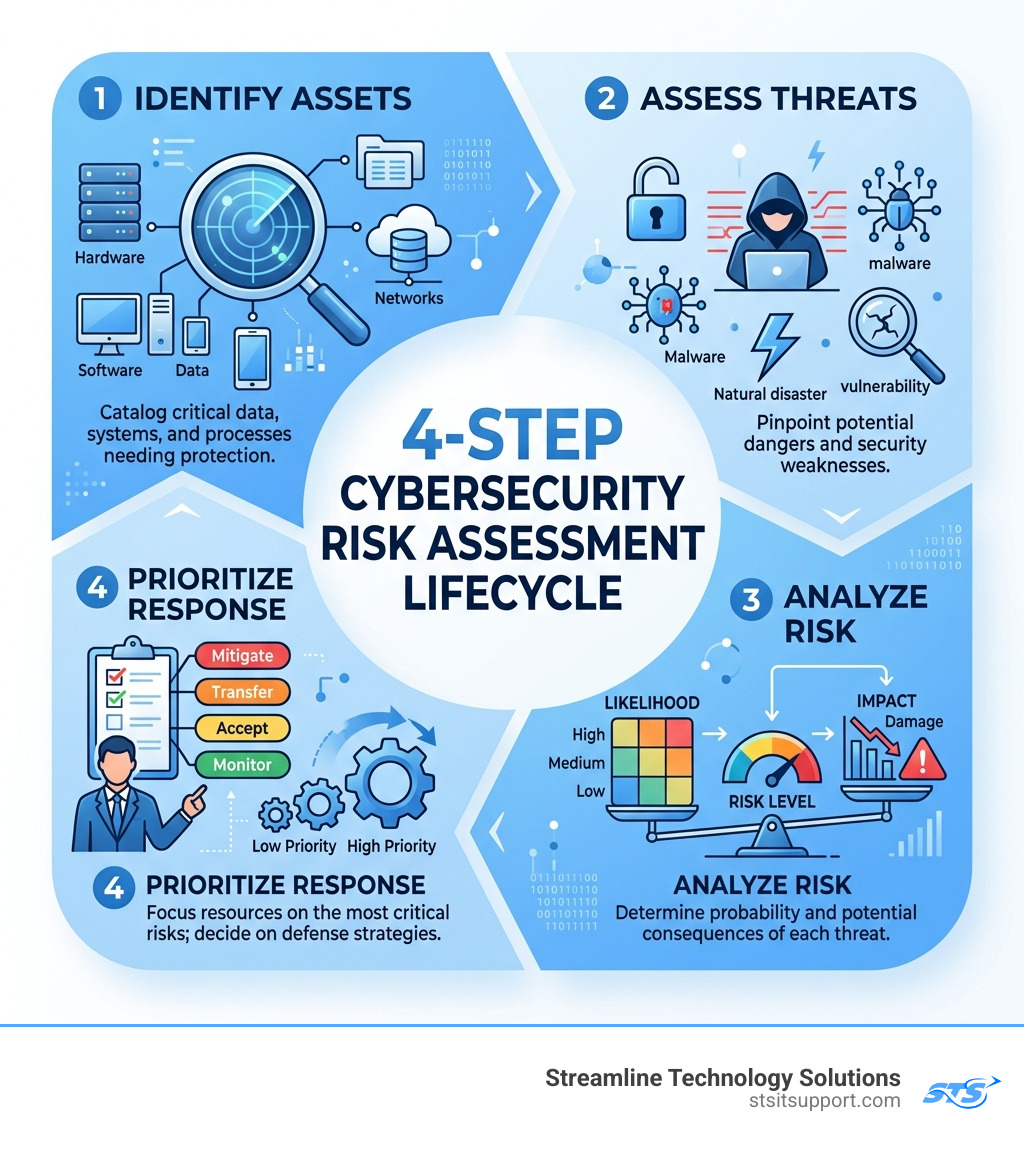
Identify assets — What data, systems, and processes need protection?
Find threats and vulnerabilities — What could go wrong, and where are the weak spots?
Analyze likelihood and impact — How probable is each threat, and how bad would the damage be?
Prioritize and respond — Which risks need immediate action, and which can be accepted or monitored?
The average cost of a data breach hit $4.88 million globally in 2024. For a small business, that's not just a budget problem — it can be a business-ending event.
And yet, many organizations still treat cybersecurity as an afterthought. They patch problems after something breaks. They spend money on tools without knowing which threats actually apply to them. That's not security — that's gambling.
A proper cybersecurity risk assessment changes that. It gives you a clear, structured picture of where you're exposed and what to do about it — before attackers make that decision for you.
I'm Michael Gaigelas, and with over 20 years of experience in IT support, managed services, and business technology, I've helped countless organizations use cybersecurity risk assessments to stop guessing and start protecting what matters most. In this guide, I'll walk you through exactly how the process works — step by step.
Understanding the NIST Framework for Cybersecurity Risk Assessment
When we talk about doing things "by the book," in IT security, that book is usually written by NIST (the National Institute of Standards and Technology). For any business in South Florida—from Coral Springs to Fort Lauderdale—following these standards isn't just for federal agencies; it’s the gold standard for anyone who wants a defensible, proven security posture.
The primary "manual" for this process is NIST Special Publication 800-30. This document provides the fundamental Guide for Conducting Risk Assessments. It’s designed to amplify NIST SP 800-39, which covers the broader topic of managing information security risk.
Think of SP 800-39 as the "Strategy" and SP 800-30 as the "Tactics." While the strategy tells you why you need to manage risk, the assessment guide shows you exactly how to identify it. This is all part of the larger Risk Management Framework (RMF), a process that ensures security isn't a one-time event, but a continuous cycle of improvement. If you're looking for more foundational knowledge, you can check out our IT resources to see how these frameworks apply to modern business technology.
The Three Tiers of Risk Management
NIST organizes risk management into a three-tiered hierarchy. This ensures that risk isn't just something the "IT guy" worries about, but something the CEO and department heads understand as well.
Tier 1: Organization: This is the bird's-eye view. At this level, senior leadership defines the "risk appetite"—essentially, how much a business is willing to lose or gamble. It sets the strategic direction for the entire company.
Tier 2: Mission/Business Process: This tier looks at specific workflows. For example, how does a breach in your billing system affect your ability to provide services in Boca Raton? It focuses on "Mission Essential Functions" (MEFs).
Tier 3: Information System: This is the technical layer. It’s where we look at specific servers, software, and endpoints. Assessments here identify vulnerabilities in the actual tools your team uses every day.
How Risk Assessment Supports the RMF
A cybersecurity risk assessment isn't a standalone project; it’s the engine that drives the Risk Management Framework (RMF). It supports several critical steps:
Categorization: You can't protect everything with the same intensity. Assessments help you categorize systems based on the impact a loss would have.
Control Selection: Once you know the risk, you can pick the right "locks" (security controls) for the door.
Continuous Monitoring: As we move through April 2026, the threat landscape changes daily. Regular assessments ensure your controls are still working.
For organizations in regulated industries, such as healthcare, these assessments are often mandatory. For instance, the CMS Information Security and Privacy Program details how these assessments are used to maintain compliance and protect sensitive patient data.
The Core Components of a Modern Risk Model
To understand risk, we have to break it down into its DNA. In 2026, we don't just look at "hackers"; we look at a complex web of factors that contribute to your overall exposure.
A modern risk model consists of several moving parts:
Threat Sources: These are the "who" or "what." It could be a sophisticated cyber-criminal group, a disgruntled employee (insider threat), or even a natural disaster like a hurricane hitting our Deerfield Beach offices.
Threat Events: This is the "how." Examples include a ransomware attack, a SQL injection, or a phishing campaign.
Vulnerabilities: These are the "weak spots." It could be unpatched software, a weak password, or a lack of multi-factor authentication (MFA).
Predisposing Conditions: These are factors that make a threat event more likely or more successful, such as having a 100% remote workforce without a secure VPN.
Understanding these components is vital when planning technical projects, as every new piece of hardware or software introduces new variables into this equation.
Determining Likelihood and Severity of Impact
Once we identify a potential threat event, we have to ask two questions: How likely is it to happen? and How much will it hurt?
Likelihood isn't just a guess. We look at adversary capability (do they have the tools?), intent (do they want to hit your industry?), and targeting (are they actively looking at businesses in Pompano Beach?).
Severity of impact is measured by the damage to your "Mission Essential Functions." If your server goes down, can you still process payroll? Can you still communicate with clients? NIST provides deep dives into this in IR 8286A Rev. 1, Identifying and Estimating Cybersecurity Risk for Enterprise Risk Management, which helps businesses translate technical risks into "business speak" that owners can understand.
The Role of Automation in Cybersecurity Risk Assessment
In April 2026, manual spreadsheets are no longer enough. The speed of "threat shifting"—where attackers change their tactics the moment a new patch is released—requires a more agile approach.
We now use AI-driven scanning and continuous automated assessments to keep "risk registers" updated in real-time. Instead of a static report that gathers dust on a shelf, modern risk management uses tools that alert us the second a new vulnerability appears on your network. This proactive stance is exactly what we facilitate through our support center, ensuring that South Florida businesses aren't left behind by rapidly evolving threats.
A Step-by-Step Guide to Conducting a Cybersecurity Risk Assessment
Ready to roll up your sleeves? Conducting a cybersecurity risk assessment requires a structured approach to ensure nothing falls through the cracks.
Step 1: Preparing for the Assessment
Before you scan a single computer, you need to set the boundaries. This is where we define the scope. Are we assessing the entire company, or just the new remote work setup for the Fort Lauderdale branch?
During preparation, we also identify:
Assumptions: What are we taking for granted? (e.g., "We assume our cloud provider is handling physical security.")
Constraints: What limits our assessment? (e.g., budget, time, or access to certain legacy systems.)
Risk Tolerance: How much risk is the business owner comfortable with?
Establishing these ground rules is a key part of our technical documentation and ensures the final report is actually useful for decision-making.
Step 2: Conducting a Cybersecurity Risk Assessment
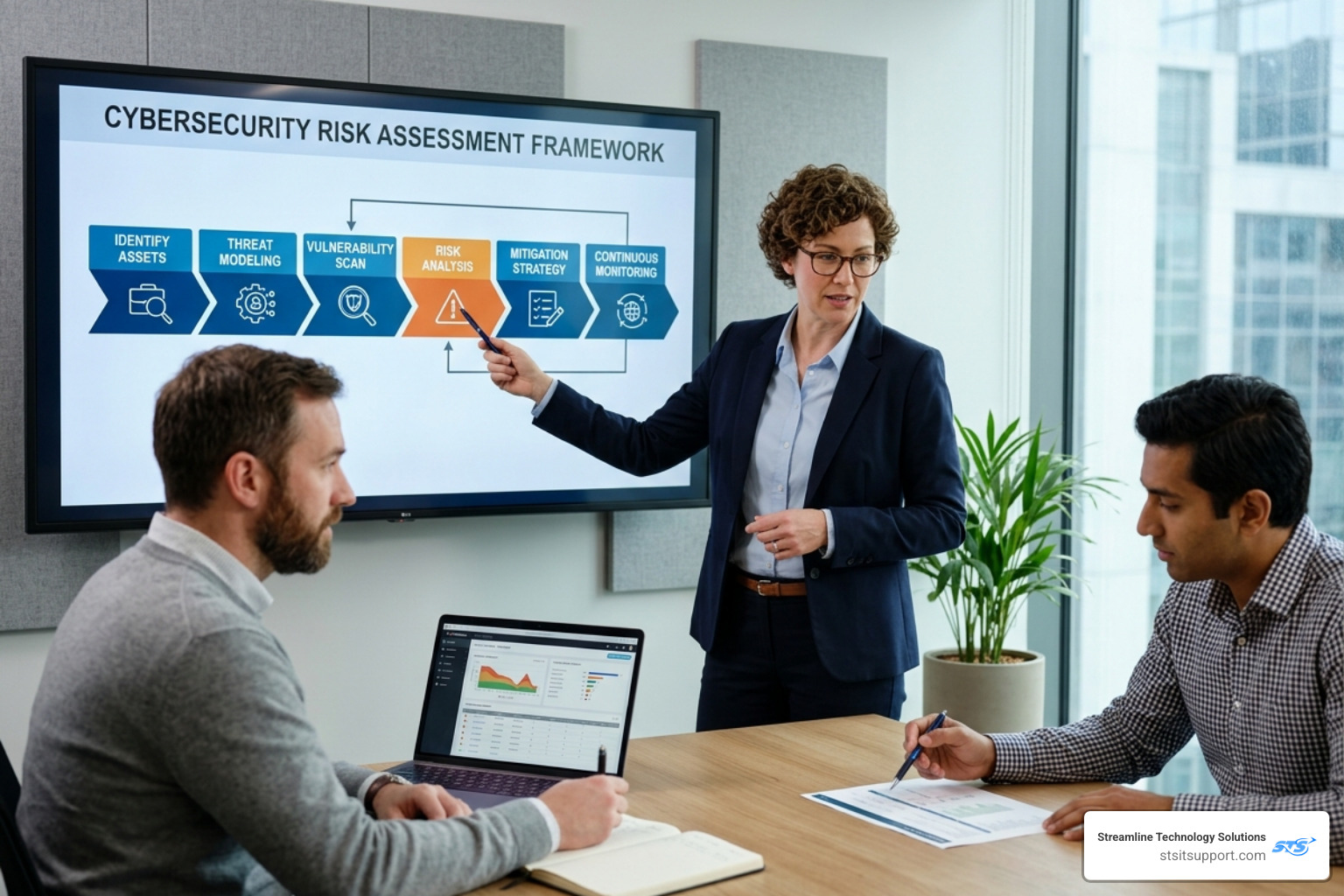
This is the "doing" phase. Following the CISA Guide to Getting Started with a Cybersecurity Risk Assessment, we follow a logical flow:
Identify Threat Sources and Events: Who might attack and how?
Identify Vulnerabilities: Where are the holes in your current "armor"?
Determine Likelihood: Given the threats and vulnerabilities, what are the odds of a successful hit?
Determine Impact: If they get through, what happens to the data and the business?
Calculate Risk: This is usually a combination of Likelihood x Impact.
Step 3: Communicating and Maintaining Results
The best assessment in the world is useless if it stays in a drawer. You must communicate the findings to stakeholders. This doesn't mean giving the CEO a 200-page list of CVE numbers; it means providing an executive summary that highlights the biggest risks to the business’s bottom line.
Maintaining the assessment is equally important. A risk assessment is a snapshot in time. As you add new employees in Ft. Lauderdale or adopt new software, that snapshot becomes outdated. Integration into the System Development Life Cycle (SDLC) ensures that security is considered every time a change is made to your IT environment.
Strategic Approaches: Qualitative vs. Quantitative Analysis
Not all assessments are created equal. Depending on your needs, you might use different "math" to determine your risk level.
Methodology Description Best For Qualitative Uses descriptive scales (High, Medium, Low). Based on expert judgment. General prioritization and smaller businesses. Quantitative Uses numerical values and dollar amounts (e.g., "This risk has a $50,000 expected loss"). Budgeting for insurance and complex ROI calculations. Semi-quantitative Uses numeric scales (1-10) to represent qualitative values. Balancing ease of use with a bit more "math" for comparison.
Many advanced organizations use the FAIR model (Factor Analysis of Information Risk) or Monte Carlo simulations to predict the probability of different loss outcomes. This helps in "risk aggregation," where we look at how multiple small risks might combine into one massive problem.
Analysis Orientations
How you look at the problem matters. NIST suggests three main orientations for your analysis:
Threat-oriented: Focuses on the "bad guys" and their tactics.
Asset/Impact-oriented: Focuses on your "crown jewels" (sensitive data) and what happens if they are lost.
Vulnerability-oriented: Focuses on the flaws in your systems and how to patch them.
For a deep dive into these methodologies, NIST IR 8286A provides a comprehensive look at identifying and estimating risk for enterprise-level management.
Addressing Uncertainty and Risk Shifting
We have to be honest: no assessment is 100% perfect. There is always uncertainty. This can come from poor data quality, assessor bias (thinking your own systems are better than they are), or the simple fact that hackers are creative.
In 2026, supply chain risks and cloud misconfigurations are the two biggest wildcards. You might have a perfectly secure office in Coral Springs, but if a software vendor you use gets breached, you are at risk. A good assessment accounts for these external factors and plans for the "what if."
Frequently Asked Questions about Cybersecurity Risk Assessment
What is the difference between a vulnerability scan and a risk assessment?
A vulnerability scan is an automated tool that looks for known "holes" in your software—it's like a home inspector checking if your windows are locked. A cybersecurity risk assessment is much broader. It looks at the locks, the neighborhood (threat landscape), the value of what's inside (assets), and the likelihood of someone actually trying to break in.
How often should an organization update its cybersecurity risk assessment?
At a minimum, you should conduct a full assessment annually. However, "trigger-based" updates are better. If you open a new office in Boca Raton, move your data to a new cloud provider, or if a major new global threat emerges, it’s time to re-evaluate.
Can small businesses use the NIST SP 800-30 framework?
Absolutely. While the document is long, the principles are scalable. You don't need a team of 50 to identify your most important data, find the threats to it, and decide how to protect it. It’s about the mindset of risk-informed decision-making.
Conclusion
In the business environment of South Florida, data is your most valuable asset—and your biggest liability if it’s not protected. A cybersecurity risk assessment isn't just a compliance "check-box"; it’s a strategic roadmap that ensures your business continuity and protects your reputation.
By integrating these assessments into your enterprise architecture and daily operations, you move from a state of "hoping for the best" to "preparing for the worst." At Streamline Technology Solutions, we pride ourselves on providing transparent, fast, and accountable IT support to businesses across Coral Springs, Fort Lauderdale, and beyond. We don't believe in hidden fees—just high-quality security that lets you sleep at night.
Don't leave your data to chance. Contact Streamline Technology Solutions today, and let’s build a defense that actually works for your business.