Why a Cybersecurity Audit is the Digital Physical You Can't Skip
Your Business Is One Breach Away — Here's What a Cyber Security Audit Actually Does
A cyber security audit is a formal, independent review of your organization's digital defenses — checking whether your security controls, policies, and systems actually protect you from threats.
Quick answer: What is a cybersecurity audit?
Question Answer What is it? A point-in-time, independent review of your security controls, policies, and systems What does it check? Networks, data protection, access controls, software, physical security, and compliance Who performs it? An independent internal team or qualified external auditor How often? At minimum annually; high-risk areas quarterly What do you get? A prioritized report of vulnerabilities and remediation recommendations How much does it cost? ~$5,000 for small businesses; $100,000+ for enterprises
Every business today runs on digital systems and handles sensitive data. That makes cybersecurity not optional — it's survival.
Think of a cybersecurity audit like a physical exam at the doctor. You might feel fine. But without the tests, you won't catch the problems quietly building beneath the surface. By the time symptoms show, the damage is already done.
The same is true for your IT environment. A breach doesn't announce itself in advance. It exploits the gap you didn't know existed — an outdated firewall rule, a misconfigured access policy, an unpatched system sitting quietly on your network.
The stakes are real. Federal agencies alone reported over 32,000 significant security incidents in a single fiscal year. Small and mid-sized businesses face the same threats, often with far fewer resources to respond.
A cybersecurity audit gives you a clear, honest picture of where you stand — before an attacker finds out first.
I'm Michael Gaigelas, and I've spent 20 years working in IT support, network security, managed services, and business technology — giving me a front-row seat to how often a proper cyber security audit reveals critical vulnerabilities that businesses had no idea existed. In the sections below, I'll walk you through everything you need to know to understand, plan, and act on one.
What is a Cyber Security Audit and How Does It Differ from an Assessment?
To understand how to protect your business, we must first clear up a common piece of industry confusion. Many business owners use the terms "cybersecurity audit" and "cybersecurity assessment" interchangeably. However, in IT security, they serve two entirely different purposes.
A cyber security audit is a formal, point-in-time, independent evaluation. Its primary goal is to verify compliance and existence. An auditor checks your system against a specific set of established standards or regulations (like HIPAA, PCI DSS, or SOC 2). They ask: "Do you have a firewall policy? Yes or no? Show me the documentation." It is an objective validation, usually performed by an independent third party, to prove to stakeholders, insurance companies, or regulators that your security controls exist.
A cybersecurity assessment, on the other hand, is a broader, more collaborative process. It focuses on effectiveness and risk mitigation. Instead of just checking if a control exists, an assessment tests how well that control actually works in the real world. For example, an audit might verify that you have a firewall. An assessment will look at the firewall's configuration to see if a clever hacker could bypass it. Assessments are often continuous, offering real-time risk monitoring rather than a static snapshot.
Here is a quick breakdown to help you visualize the differences:
Feature Cyber Security Audit Cybersecurity Assessment Primary Goal Compliance verification & control existence Risk identification & control effectiveness Nature Independent, formal, and objective Collaborative, strategic, and analytical Timeline Point-in-time snapshot Continuous or periodic monitoring Deliverable Compliance checklist & signed formal report Risk register & prioritized remediation plan Audience External stakeholders, regulators, board members Internal IT teams, leadership, security officers
While some industry voices argue that assessments are more useful for day-to-day security, the truth is that a healthy organization needs both. An audit proves your baseline defenses are officially in place, while an assessment helps you fine-tune those defenses against active threats.
If you want to dive deeper into how to evaluate your operational risks from a strategic perspective, you can read our More info on Cybersecurity Risk Assessment guide.
The Core Components and Scope of a Security Audit
When we conduct a cyber security audit, we don't just look at your computers. A truly thorough audit must evaluate your entire business ecosystem. If an auditor only looks at your software but ignores your physical office space or your employees' daily habits, they are leaving massive doors open for cybercriminals.

A comprehensive audit typically covers six core areas:
Data Security: We look at how your business stores, processes, and transmits sensitive information. Is customer data encrypted at rest and in transit? Who has access to it?
Network Security: This involves checking your firewalls, routers, switches, and network boundaries. We analyze your Network Access Control (NAC) policies to ensure unauthorized devices can't plug into your office network. For more details on how to secure your infrastructure, see our More info on Network Security Services page.
Operational Security: This covers your daily business processes. Do you have a formal employee onboarding and offboarding checklist? What are your password management policies?
Physical Security: Security isn't just digital. If a bad actor can walk right into your server room in Coral Springs or Boca Raton and put a USB drive into a machine, your firewalls won't save you. We audit security cameras, keycard access, and visitor logs.
Software Systems: We check that all operating systems, business applications, and firmware are licensed, supported, and regularly patched. Outdated software is one of the easiest entry points for malware.
System Security: This evaluates your identity and access management (IAM). We ensure your team uses Multi-Factor Authentication (MFA) and Role-Based Access Control (RBAC) so employees only have access to the specific files they need to do their jobs.
To structure these evaluations, professional auditors rely on respected industry standards. A prime example is the GAO Cybersecurity Program Audit Guide, which outlines robust methodologies for evaluating asset management, configuration controls, and incident response readiness.
Key Steps to Conduct a Successful Audit
A successful audit is not a random, chaotic search for problems. It is a highly structured, step-by-step process designed to gather clear evidence without disrupting your daily business operations.

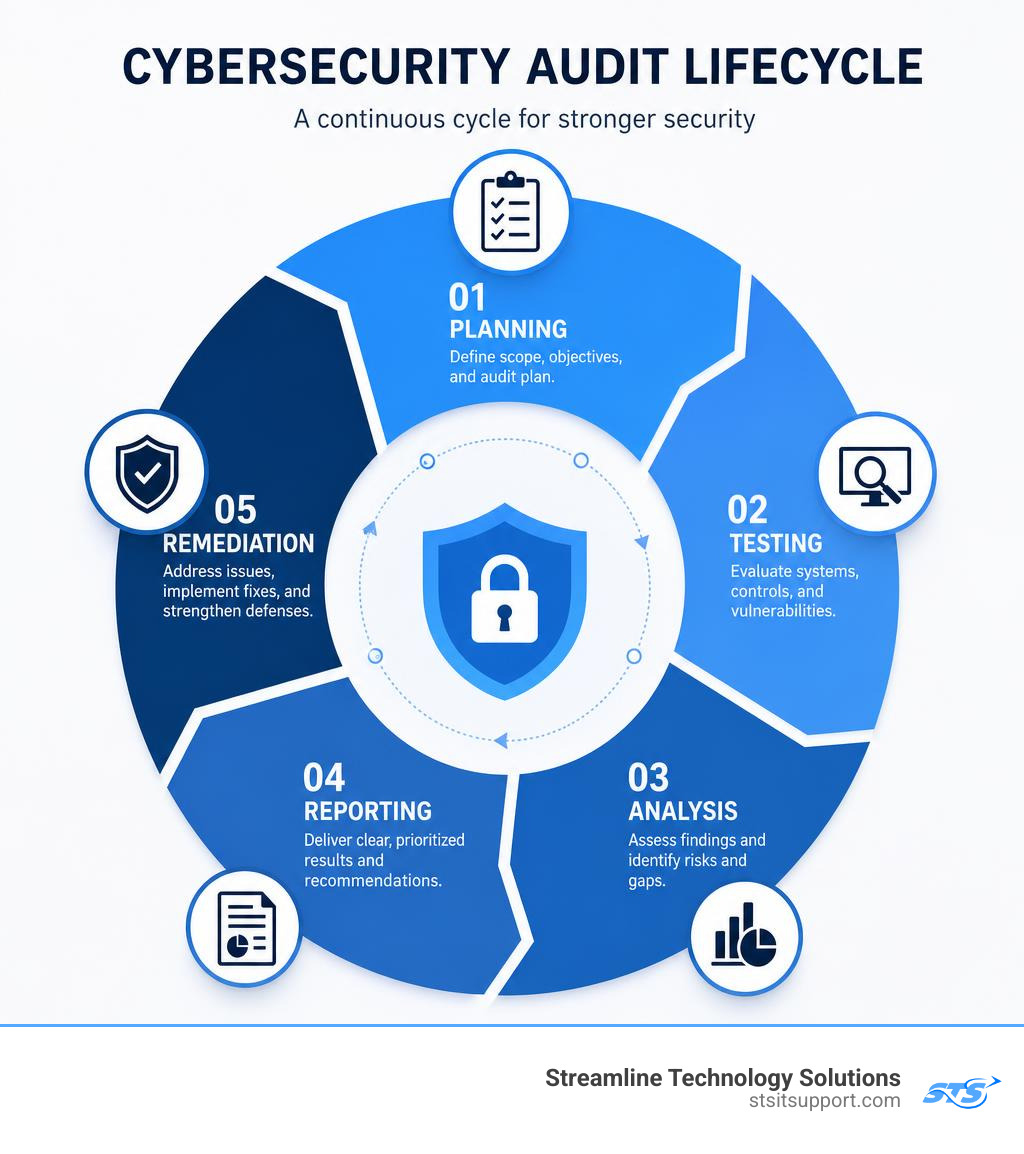
To ensure consistency and accuracy, we align our auditing procedures with frameworks like the Practice Guide for Security Risk Assessment & Audit. The entire process flows through a series of planned phases.
Planning and Scoping the Cyber Security Audit
Before a single test is run, we must define the rules of engagement. During the planning phase, we sit down with your leadership team to establish clear boundaries.
Define the Scope: Which office locations (such as your Fort Lauderdale or Deerfield Beach branches) are included? Are we auditing your local physical servers, your cloud environments, or both?
Asset Mapping: We build a complete inventory of all digital and physical assets. You cannot secure what you do not know you own.
Stakeholder Interviews: We talk to key department heads to understand your daily workflows, business goals, and current pain points.
Executing Technical Testing and Vulnerability Analysis
Once the scope is locked in, the hands-on technical testing begins. This is where we move from theory to practical proof.
Vulnerability Scanning: We run automated tools to scan your systems for known security gaps, missing patches, and weak configurations.
Penetration Testing: Also known as ethical hacking, this involves simulating real-world attacks to see if we can break through your defenses. To see how this applies to compliance standards, you can read more about SOC 2 Pen Testing Services.
Vulnerability Classification: When we find a vulnerability, we don't just hand you a scary-looking list. We classify each issue using two critical metrics:
CVSS (Common Vulnerability Scoring System): This tells us how severe the vulnerability is on a scale from 0 to 10.
EPSS (Exploit Prediction Scoring System): This calculates the probability (0 to 100%) that cybercriminals are actively exploiting this specific vulnerability in the wild right now.
Log Analysis: We review your security event logs to look for suspicious patterns, unauthorized access attempts, or past breaches that may have gone unnoticed.
Standards, Frameworks, and Compliance Requirements
To ensure your audit is objective, we measure your defenses against globally recognized frameworks. These frameworks act as the gold standard for security, giving your clients, investors, and insurance providers confidence that your business is truly protected.
Some of the most common frameworks we work with include:
ISO 27001: A holistic, internationally recognized standard for managing information security. Thousands of organizations globally use ISO 27001 to build a resilient security foundation.
NIST SP 800-53: A highly detailed security catalog developed by the U.S. government, widely considered the benchmark for robust risk management.
SOC 2 (System and Organization Controls): A framework designed for service providers storing customer data in the cloud, built around five key "Trust Services Criteria": Security, Availability, Confidentiality, Processing Integrity, and Privacy.
HIPAA: The law of the land for healthcare providers, requiring strict administrative, physical, and technical safeguards to protect patient health information.
PCI DSS: The mandatory security standard for any business in South Florida that accepts, stores, or processes credit card payments.
For organizations looking to understand how these risks tie into overall business governance, the Assessing Cybersecurity Risk Guide is an invaluable resource.
Compliance is particularly critical for highly regulated professional sectors. For example, law firms handle incredibly sensitive client data, making them prime targets for cybercriminals. If you run a firm in Pompano Beach or Boca Raton, you can learn more about securing your practice in our guide on More info on Law Firm Cybersecurity Services.
Aligning Your Cyber Security Audit with Global Frameworks
Aligning your audit with these standards does more than just keep you compliant—it protects your bottom line. If your business fails to meet its industry-specific compliance mandates, the consequences can be devastating. Regulatory bodies can issue massive fines, payment processors can strip away your ability to accept credit cards, and a single public data breach can permanently destroy your reputation.
Fortunately, modern technology has made achieving these standards much simpler. For instance, AI-native platforms like Chiaro · SOC 2 for AI builders are revolutionizing how fast-growing tech teams handle compliance, allowing them to prepare for SOC 2 audits directly within their development environments.
No matter your industry, mapping your security controls to these global frameworks ensures you are always prepared for an unexpected audit or compliance check.
Audit Frequency, Costs, and Best Practices
One of the most common mistakes we see South Florida businesses make is treating a cyber security audit as a "one-and-done" project. Cyber threats evolve at a breakneck pace. A system that is perfectly secure today could be completely vulnerable tomorrow when a new exploit is discovered.
To maintain a strong security posture in May 2026, we recommend a hybrid approach:
Annual Comprehensive Audits: A complete, deep-dive review of your entire digital and physical infrastructure.
Quarterly Focused Reviews: Targeted checks on high-risk areas, such as access controls, external-facing firewalls, and cloud configurations.
Continuous Validation: Automated monitoring systems that run in the background to catch configuration drift or unauthorized software installations in real-time.
Pricing and Budgeting in 2026
The cost of an audit depends heavily on the size of your business and the complexity of your network.
Small Business Audits: For small, local businesses with straightforward networks, basic audits typically start around $5,000.
Enterprise Assessments: For larger organizations with complex cloud environments, multiple office locations, and strict compliance needs, detailed audits can easily exceed $100,000.
Specialist Rates: If you hire external cybersecurity consultants on an hourly basis, expect rates to range from $100 to $149 per hour.
While those numbers might seem high at first glance, they pale in comparison to the cost of a data breach. When you factor in regulatory fines, lost business, data recovery fees, and reputation damage, an audit is an incredibly cost-effective investment.
Emerging Trends to Watch
As we move through 2026, the technology behind cybersecurity auditing is changing rapidly. The most significant shift is the integration of Artificial Intelligence (AI).
Traditional, manual audits often take weeks or months to analyze system logs and detect threats. Today, AI-driven security tools can analyze massive amounts of network data in real-time, cutting threat detection times down from weeks to just minutes. Furthermore, AI has boosted threat detection accuracy from an average of 70-80% up to an impressive 90-95%.
Another critical trend is supply chain auditing. Cybercriminals have realized that if a major company has great security, they can simply hack one of their smaller vendors instead. In fact, a recent study showed that 65% of supply chain professionals report that their companies now actively audit their supply, manufacturing, or logistics partners. If you want to win contracts with larger clients, having a clean, documented cybersecurity audit of your own is quickly becoming a strict requirement.
Frequently Asked Questions
How much does a cybersecurity audit cost?
The cost of a cyber security audit is determined by your organization's size, the number of devices on your network, and your specific compliance requirements. A basic audit for a small business typically starts around $5,000. For mid-sized to large enterprises with complex cloud networks and strict regulatory demands (like SOC 2 or HIPAA), costs can exceed $100,000. On average, external cybersecurity specialists charge between $100 and $149 per hour.
How often should our organization conduct an audit?
At a minimum, your organization should conduct a comprehensive cybersecurity audit once a year. However, you should schedule additional audits if you undergo major infrastructure changes (such as migrating to the cloud), open new office locations, or experience a security incident. High-risk areas should be evaluated quarterly, and critical controls should be monitored continuously.
What is the difference between an internal and external audit?
An internal audit is conducted by your own in-house IT or security staff. It is an excellent tool for continuous monitoring, self-assessment, and preparing your team for an upcoming official review. An external audit is performed by an independent, third-party firm. External audits carry much more weight with regulators, insurance companies, investors, and clients because the auditors are completely objective and have no conflict of interest.
Conclusion: Take Control of Your Digital Health
Just like a physical exam, the real value of a cyber security audit isn't the test itself—it's what you do with the results. Once the audit is complete, you will receive a prioritized list of vulnerabilities. The next step is remediation: systematically patching the gaps, updating your policies, and strengthening your defenses.
At Streamline Technology Solutions, we believe that securing your business shouldn't be a confusing, stressful ordeal. We provide comprehensive IT support, managed security, VoIP, and hardware solutions tailored specifically for businesses across South Florida, including Coral Springs, Boca Raton, Fort Lauderdale, Deerfield Beach, and Pompano Beach.
We stand out by offering:
Transparent Pricing: No hidden fees, no surprise charges, and no confusing contracts. You always know exactly what you are paying for.
Fast Local Support: Our engineers live and work right here in South Florida. When you need help, we are on-site and ready to assist without delay.
Direct Accountability: We don't pass the buck. We take ownership of your technology so you can focus on running your business.
Don't wait for a security breach to show you where your weak points are. Protect your business, secure your customer data, and gain peace of mind.
To learn more about how we protect local organizations, check out our guide on More info on Local Cybersecurity Services Florida, or contact us directly at Streamline Technology Solutions today to schedule your security consultation.