Blog
Home / Blog

Why Managed IT is the Best Partner Your Law Firm Ever Had
Why IT Managed Services for Law Firms Are No Longer Optional
IT managed services for law firms are specialized, outsourced technology solutions that keep a law firm's systems secure, reliable, and compliant — so attorneys can focus on billable work instead of tech problems.
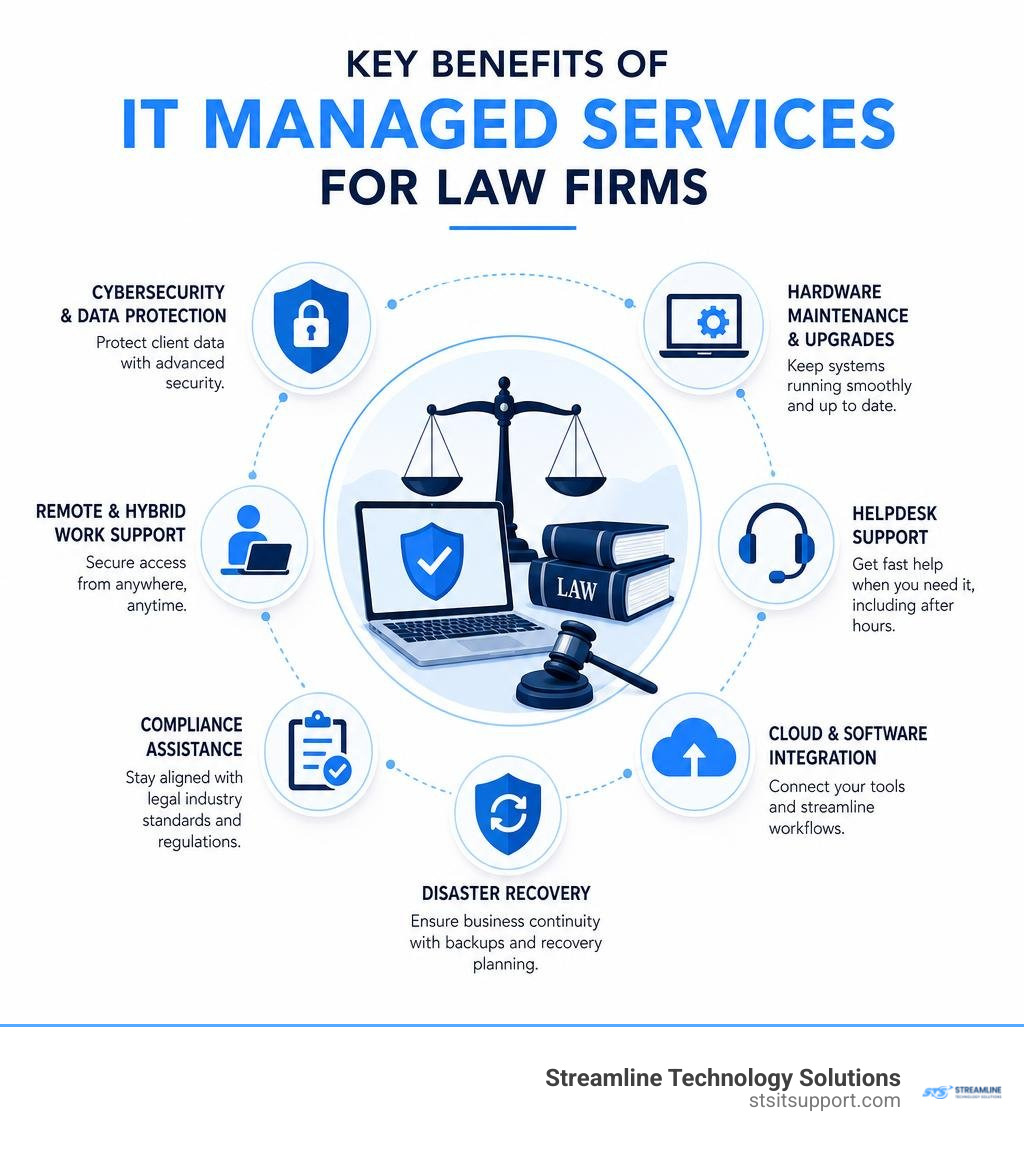
Here's what they typically cover:
Cybersecurity and data protection — encryption, threat monitoring, access controls
Hardware maintenance and upgrades — proactive device management and lifecycle planning
Remote and hybrid work support — secure VPNs, multi-factor authentication, cloud access
Compliance assistance — HIPAA, ABA standards, and client data regulations
Helpdesk support — fast resolution when systems fail, including after hours
Cloud and software integration — connecting practice management tools with your IT infrastructure
Disaster recovery — automated backups and business continuity planning
Law school trains attorneys to argue cases, draft contracts, and advise clients. It does not train them to manage networks, secure servers, or troubleshoot a system crash at 11 PM the night before trial. Yet that's exactly the kind of crisis that can derail an entire case — and the firm's reputation with it.
According to the American Bar Association, 27% of law firms have already experienced a security breach. That number makes one thing clear: technology risk is a legal business risk, and it deserves the same serious attention as any other operational threat.
I'm Michael Gaigelas, and I've spent 20 years working in IT support, cloud infrastructure, managed IT services, and business technology. During that time, I've seen how the right IT managed services for law firms transform a firm from reactive and vulnerable to stable and scalable. In the sections below, I'll walk you through exactly what that looks like — and how to find the right partner for your practice.
Overcoming Tech Challenges and Securing Sensitive Data
Law firms handle a unique combination of high-stakes responsibilities: confidential client communications, strict ethical duties, strict compliance mandates, and tight court deadlines. Unlike a standard retail store or corporate office, an hour of IT downtime at a law firm doesn't just delay internal work - it directly destroys billable hours and risks severe regulatory penalties.
Modern legal practices face mounting pressure to modernize while maintaining ironclad privacy standards. Navigating these requirements demands robust law firm cybersecurity services tailored specifically to legal workflows.
Resolving System Downtime and Lost Billable Time
In the legal industry, time literally equals money. When an attorney's workstation crashes, or when access to document management systems goes down, billable time stops instantly. If five attorneys billing at $350 per hour are locked out of their systems for three hours, the firm loses $5,250 in unrecoverable revenue - not to mention the emotional stress of missed filing deadlines.
Traditional "break-fix" IT models react only after something collapses. Someone calls a technician, waits for a response, and sits idly while the problem is diagnosed. Modern it managed services for law firms flip this script through proactive 24/7 monitoring. Specialized managed service providers (MSPs) use automated software agents that continuously track system health, identifying memory leaks, drive failures, and software conflicts before they cause system crashes.
When minor hiccups do occur, rapid-response IT helpdesk support ensures issues are resolved in minutes rather than hours, protecting billable hours across your legal team.
Mitigating Cyber Breaches and Safeguarding Client Data
With 27% of law firms having suffered a security breach, law practices have become premier targets for cybercriminals. Attackers know that attorneys hold confidential medical records, financial statements, intellectual property documents, and trade secrets - data worth millions on the black market or ideal for extortion via ransomware.

Safeguarding sensitive legal data requires a defense-in-depth approach. Implementing specialized network security services establishes continuous network threat detection, strict access controls, multi-factor authentication (MFA), and mandatory end-to-end data encryption (utilizing protocols like TLS and AES-256 for data in transit and at rest).
Furthermore, regulatory compliance isn't optional. Personal injury, estate planning, and healthcare defense practices routinely handle Protected Health Information (PHI), subjecting them to HIPAA rules alongside ABA Model Rules of Professional Conduct (such as Rule 1.6 on Confidentiality of Information). While law firms are ultimately responsible for advising their IT partners regarding practice-specific compliance duties, an experienced MSP implements technical safeguards - such as audit logging and role-based access permissions - to meet those standards smoothly.
To evaluate where your firm currently stands, performing a comprehensive cybersecurity risk assessment is the critical first step toward closing dangerous vulnerabilities.
Core Benefits of IT Managed Services for Law Firms
Partnering with an MSP offers advantages that extend far beyond firefighting technical glitches. It provides a strategic framework designed to optimize your hardware, streamline firm operations, and support modern workplace dynamics. For a deeper dive into modern tech frameworks, explore our managed IT support guide 2026.

Empowering Hybrid Teams with IT Managed Services for Law Firms
The traditional legal work environment has undergone permanent changes over recent years:
In-Office Attorney Presence: Lawyers spent an average of 14 days per month in the office in 2019, which dropped to 13 days by mid-2022.
Staff Presence: Non-lawyer staff spent 16 days in the office in 2019, decreasing to an average of 12 days per month.
Firm Office Policies: Industry data shows 56% of law firms remain 'Office-only', 26% operate as 'Office-mostly', and 10% operate fully as 'Hybrid'.
Supporting attorneys who work from courtrooms, home offices, or client sites demands seamless remote connectivity that doesn't compromise security. IT managed services for law firms equip hybrid legal teams with encrypted Virtual Private Networks (VPNs), secure device management via tools like Microsoft Intune, and robust multi-factor authentication. Whether an associate is reviewing documents in a court waiting room or a partner is drafting motions at home, their environment remains fast, secure, and compliant.
Proactive Hardware Maintenance and Asset Upgrades
Nothing frustrates an attorney faster than a sluggish laptop during a virtual court hearing or a failing server during closing argument preparation. Hardware components inevitably age, but unexpected failures can be avoided through disciplined lifecycle management.
Managed IT providers establish standardized asset documentation and preventive maintenance routines. This includes automated operating system patching, routine hardware cleaning, fan testing, and scheduled storage health checks. By tracking device age and performance metrics, your MSP plans laptop and server replacements well in advance, avoiding emergency hardware expenses and eliminating sudden unexpected technical bottlenecks.
Cloud Integration and Disaster Recovery for Legal Growth
Cloud computing has transformed legal operations, allowing law firms of all sizes to access enterprise-grade infrastructure without massive capital investments in physical hardware.

Practice Management Software Collaboration
Modern law practices rely heavily on cloud-based legal practice management platforms (such as Clio, PracticePanther, or LexisNexis) alongside document management software and Microsoft 365. However, cloud software alone isn't a silver bullet; it must be securely integrated with local devices, email systems, and firewalls.
An experienced managed IT provider collaborates directly with software vendors to ensure optimal performance. They handle identity management (e.g., via Entra ID), secure single sign-on (SSO) configurations, and permission structures. This tight integration ensures smooth document workflows, automated billable time tracking synchronization, and unified security policies across all platforms.
Disaster Recovery and Automated Backups
From hurricane threats and localized power grid outages to severe ransomware infections, disaster can strike without warning. For a law firm, losing client files or court documents can result in legal malpractice allegations and catastrophic business failure.
Managed IT services protect your firm by deploying robust cloud data storage coupled with comprehensive disaster recovery as a service (DRaaS).
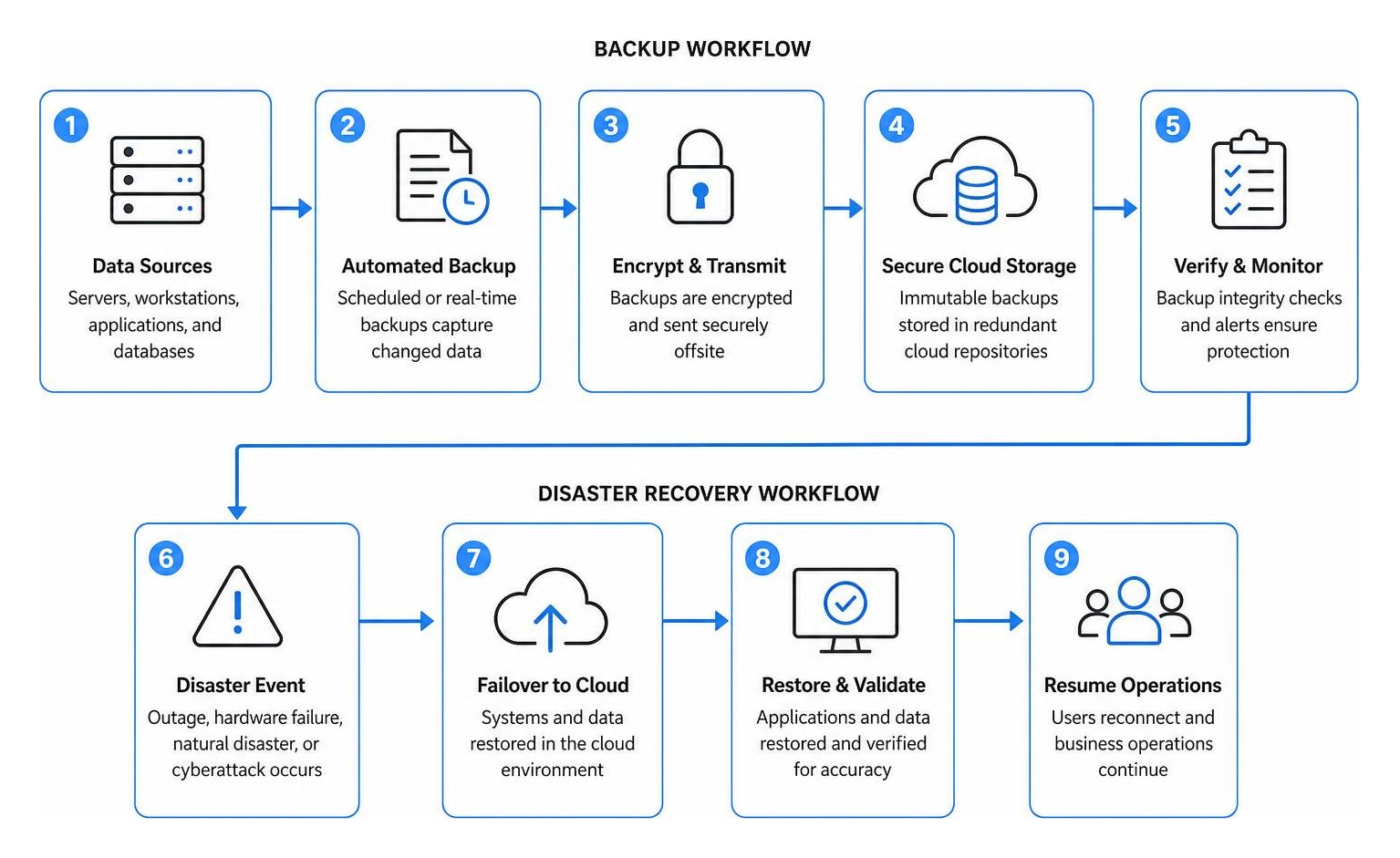
Key disaster recovery best practices include:
Automated, Immutable Backups: Daily or real-time snapshot backups sent offsite to secure cloud repositories.
Strict Data Retention Policies: Custom retention rules that align with state bar requirements for client file retention.
Rapid System Failover: Cloud virtualization that allows your firm to run core applications in the cloud within hours if your physical office suffers physical damage.
Regular Testing: Bi-annual recovery simulations ensuring backups restore cleanly when emergency situations arise.
Financial Comparison: In-House IT vs. Outsourced IT Support
Many growing law firms struggle with a common dilemma: should they hire a full-time, in-house IT technician or partner with an outsourced managed IT provider?
While having a dedicated technician down the hall sounds convenient, it comes with high fixed costs, limited skill sets (one person cannot be an expert in cybersecurity, cloud engineering, legal compliance, and network routing all at once), and vulnerability during holidays or sick leave.
Outsourcing to fixed-rate managed IT solutions gives your firm access to an entire team of certified specialists for a predictable, transparent monthly fee.
Cost & Operational Factors Full-Time In-House IT Specialist Managed IT Services Provider (MSP) Annual Direct Salary / Fees High ($85,000 – $120,000+ base salary) Flat-rate, predictable monthly subscription Benefits & Overhead Add 25-30% (Health insurance, 401k, taxes) $0 overhead costs Availability & Coverage 40 hours/week; offline during sick days & vacation 24/7/365 continuous monitoring & helpdesk support Breadth of Expertise Limited to single individual’s skill set Diverse team of cloud, network, and security engineers Legal Industry Software Familiarity Varies; requires training on firm software Deep experience with legal practice management platforms Scalability Hard to scale without hiring additional staff Instantly scales up or down as staff counts change
How to Select the Right Provider for Your Firm
Choosing the right IT partner is one of the most critical operational decisions your law firm will make. You need a partner who understands that technical delay directly hurts your bottom line and who respects the sensitive nature of attorney-client privilege.
When evaluating external IT support for businesses, look beyond general technology skills. Seek out providers who offer clear Service Level Agreements (SLAs), fast response guarantees, and flat-rate pricing models without hidden fees. Top-tier MSPs will always build security directly into every configuration from day one.
Key Vetting Questions for IT Managed Services for Law Firms
Before signing a contract with any prospective IT managed services provider, ask these targeted questions during your initial consultation:
"What specific experience do you have supporting law firms and legal software?"
Why it matters: You don't want to pay an IT company to learn your document management software on your dime."What are your helpdesk hours, and how do you handle emergency weekend support during trial prep?"
Why it matters: Legal emergencies don't restrict themselves to 9-to-5 Monday through Friday."How do your security protocols support HIPAA and ABA compliance obligations?"
Why it matters: Your provider must understand encryption standards, audit logging, and strict access governance."What is your average helpdesk ticket resolution time, and what guarantees are in your SLA?"
Why it matters: Response time guarantees protect your team from losing billable hours while waiting on hold."Can you walk us through your onboarding process and asset lifecycle planning model?"
Why it matters: Onboarding should follow a structured 4-step process (Discovery, Transition, Ongoing Management, Strategic Optimization) rather than a chaotic scramble.
Frequently Asked Questions About Legal Managed IT
How do managed IT service providers handle emergency weekend technical issues during trial prep?
Reputable managed IT providers serving law firms offer guaranteed after-hours and weekend helpdesk availability. During high-stakes trial prep, MSPs establish emergency escalation paths. If a attorney's system crashes on a Saturday night while organizing evidence, dedicated engineers log on remotely or dispatch on-site technicians to resolve the issue immediately, ensuring trial preparation proceeds without delay.
Does a law firm need to replace all existing hardware when hiring an MSP?
No. Onboarding begins with a thorough discovery and technical assessment of your firm's current environment. Existing workstations, servers, and network devices that meet performance and security standards are retained and optimized. If legacy equipment presents critical security risks or severe performance bottlenecks, your MSP will construct a phased replacement roadmap that fits your budget.
How does an MSP collaborate with an existing in-house IT specialist?
Managed IT services do not have to replace an existing in-house IT professional. Under a "co-managed IT" model, the MSP collaborates directly with your internal staff member. The MSP handles routine 24/7 network monitoring, software patching, data backups, and after-hours helpdesk tickets, freeing your internal specialist to focus on high-level legal tech strategies, firm-specific workflows, and localized user support.
Conclusion
In the modern legal environment, firm success depends heavily on technical reliability. Technology shouldn't be a constant source of stress, unexpected costs, or vulnerability; it should be an invisible engine that protects client trust and accelerates legal productivity.
By partnering with an experienced MSP for it managed services for law firms, your practice gains predictable operational costs, ironclad data protection, smooth hybrid work capabilities, and rapid support whenever technical issues arise.
At Streamline Technology Solutions, we specialize in delivering fast, local, and accountable IT services south florida legal practices rely on daily across Coral Springs, Boca Raton, Fort Lauderdale, Deerfield Beach, and Pompano Beach. With our transparent pricing, zero hidden fees, and legal industry focus, we ensure your tech works flawlessly so you can focus on winning cases.
Ready to secure your firm's infrastructure and eliminate billable downtime? Contact Streamline Technology Solutions today to schedule your comprehensive technology risk assessment!

How Can We Help?
Call us at (954) 787-3288 or fill out the form below.
Featured Posts
Why Managed IT is the Best Partner Your Law Firm Ever Had
Why IT Managed Services for Law Firms Are No Longer Optional
IT managed services for law firms are specialized, outsourced technology solutions that keep a law firm's systems secure, reliable, and compliant — so attorneys can focus on billable work instead of tech problems.
Here's what they typically cover:
Cybersecurity and data protection — encryption, threat monitoring, access controls
Hardware maintenance and upgrades — proactive device management and lifecycle planning
Remote and hybrid work support — secure VPNs, multi-factor authentication, cloud access
Compliance assistance — HIPAA, ABA standards, and client data regulations
Helpdesk support — fast resolution when systems fail, including after hours
Cloud and software integration — connecting practice management tools with your IT infrastructure
Disaster recovery — automated backups and business continuity planning
Law school trains attorneys to argue cases, draft contracts, and advise clients. It does not train them to manage networks, secure servers, or troubleshoot a system crash at 11 PM the night before trial. Yet that's exactly the kind of crisis that can derail an entire case — and the firm's reputation with it.
According to the American Bar Association, 27% of law firms have already experienced a security breach. That number makes one thing clear: technology risk is a legal business risk, and it deserves the same serious attention as any other operational threat.
I'm Michael Gaigelas, and I've spent 20 years working in IT support, cloud infrastructure, managed IT services, and business technology. During that time, I've seen how the right IT managed services for law firms transform a firm from reactive and vulnerable to stable and scalable. In the sections below, I'll walk you through exactly what that looks like — and how to find the right partner for your practice.
Overcoming Tech Challenges and Securing Sensitive Data
Law firms handle a unique combination of high-stakes responsibilities: confidential client communications, strict ethical duties, strict compliance mandates, and tight court deadlines. Unlike a standard retail store or corporate office, an hour of IT downtime at a law firm doesn't just delay internal work - it directly destroys billable hours and risks severe regulatory penalties.
Modern legal practices face mounting pressure to modernize while maintaining ironclad privacy standards. Navigating these requirements demands robust law firm cybersecurity services tailored specifically to legal workflows.
Resolving System Downtime and Lost Billable Time
In the legal industry, time literally equals money. When an attorney's workstation crashes, or when access to document management systems goes down, billable time stops instantly. If five attorneys billing at $350 per hour are locked out of their systems for three hours, the firm loses $5,250 in unrecoverable revenue - not to mention the emotional stress of missed filing deadlines.
Traditional "break-fix" IT models react only after something collapses. Someone calls a technician, waits for a response, and sits idly while the problem is diagnosed. Modern it managed services for law firms flip this script through proactive 24/7 monitoring. Specialized managed service providers (MSPs) use automated software agents that continuously track system health, identifying memory leaks, drive failures, and software conflicts before they cause system crashes.
When minor hiccups do occur, rapid-response IT helpdesk support ensures issues are resolved in minutes rather than hours, protecting billable hours across your legal team.
Mitigating Cyber Breaches and Safeguarding Client Data
With 27% of law firms having suffered a security breach, law practices have become premier targets for cybercriminals. Attackers know that attorneys hold confidential medical records, financial statements, intellectual property documents, and trade secrets - data worth millions on the black market or ideal for extortion via ransomware.
Safeguarding sensitive legal data requires a defense-in-depth approach. Implementing specialized network security services establishes continuous network threat detection, strict access controls, multi-factor authentication (MFA), and mandatory end-to-end data encryption (utilizing protocols like TLS and AES-256 for data in transit and at rest).
Furthermore, regulatory compliance isn't optional. Personal injury, estate planning, and healthcare defense practices routinely handle Protected Health Information (PHI), subjecting them to HIPAA rules alongside ABA Model Rules of Professional Conduct (such as Rule 1.6 on Confidentiality of Information). While law firms are ultimately responsible for advising their IT partners regarding practice-specific compliance duties, an experienced MSP implements technical safeguards - such as audit logging and role-based access permissions - to meet those standards smoothly.
To evaluate where your firm currently stands, performing a comprehensive cybersecurity risk assessment is the critical first step toward closing dangerous vulnerabilities.
Core Benefits of IT Managed Services for Law Firms
Partnering with an MSP offers advantages that extend far beyond firefighting technical glitches. It provides a strategic framework designed to optimize your hardware, streamline firm operations, and support modern workplace dynamics. For a deeper dive into modern tech frameworks, explore our managed IT support guide 2026.
Empowering Hybrid Teams with IT Managed Services for Law Firms
The traditional legal work environment has undergone permanent changes over recent years:
In-Office Attorney Presence: Lawyers spent an average of 14 days per month in the office in 2019, which dropped to 13 days by mid-2022.
Staff Presence: Non-lawyer staff spent 16 days in the office in 2019, decreasing to an average of 12 days per month.
Firm Office Policies: Industry data shows 56% of law firms remain 'Office-only', 26% operate as 'Office-mostly', and 10% operate fully as 'Hybrid'.
Supporting attorneys who work from courtrooms, home offices, or client sites demands seamless remote connectivity that doesn't compromise security. IT managed services for law firms equip hybrid legal teams with encrypted Virtual Private Networks (VPNs), secure device management via tools like Microsoft Intune, and robust multi-factor authentication. Whether an associate is reviewing documents in a court waiting room or a partner is drafting motions at home, their environment remains fast, secure, and compliant.
Proactive Hardware Maintenance and Asset Upgrades
Nothing frustrates an attorney faster than a sluggish laptop during a virtual court hearing or a failing server during closing argument preparation. Hardware components inevitably age, but unexpected failures can be avoided through disciplined lifecycle management.
Managed IT providers establish standardized asset documentation and preventive maintenance routines. This includes automated operating system patching, routine hardware cleaning, fan testing, and scheduled storage health checks. By tracking device age and performance metrics, your MSP plans laptop and server replacements well in advance, avoiding emergency hardware expenses and eliminating sudden unexpected technical bottlenecks.
Cloud Integration and Disaster Recovery for Legal Growth
Cloud computing has transformed legal operations, allowing law firms of all sizes to access enterprise-grade infrastructure without massive capital investments in physical hardware.
Practice Management Software Collaboration
Modern law practices rely heavily on cloud-based legal practice management platforms (such as Clio, PracticePanther, or LexisNexis) alongside document management software and Microsoft 365. However, cloud software alone isn't a silver bullet; it must be securely integrated with local devices, email systems, and firewalls.
An experienced managed IT provider collaborates directly with software vendors to ensure optimal performance. They handle identity management (e.g., via Entra ID), secure single sign-on (SSO) configurations, and permission structures. This tight integration ensures smooth document workflows, automated billable time tracking synchronization, and unified security policies across all platforms.
Disaster Recovery and Automated Backups
From hurricane threats and localized power grid outages to severe ransomware infections, disaster can strike without warning. For a law firm, losing client files or court documents can result in legal malpractice allegations and catastrophic business failure.
Managed IT services protect your firm by deploying robust cloud data storage coupled with comprehensive disaster recovery as a service (DRaaS).
Key disaster recovery best practices include:
Automated, Immutable Backups: Daily or real-time snapshot backups sent offsite to secure cloud repositories.
Strict Data Retention Policies: Custom retention rules that align with state bar requirements for client file retention.
Rapid System Failover: Cloud virtualization that allows your firm to run core applications in the cloud within hours if your physical office suffers physical damage.
Regular Testing: Bi-annual recovery simulations ensuring backups restore cleanly when emergency situations arise.
Financial Comparison: In-House IT vs. Outsourced IT Support
Many growing law firms struggle with a common dilemma: should they hire a full-time, in-house IT technician or partner with an outsourced managed IT provider?
While having a dedicated technician down the hall sounds convenient, it comes with high fixed costs, limited skill sets (one person cannot be an expert in cybersecurity, cloud engineering, legal compliance, and network routing all at once), and vulnerability during holidays or sick leave.
Outsourcing to fixed-rate managed IT solutions gives your firm access to an entire team of certified specialists for a predictable, transparent monthly fee.
Cost & Operational Factors Full-Time In-House IT Specialist Managed IT Services Provider (MSP) Annual Direct Salary / Fees High ($85,000 – $120,000+ base salary) Flat-rate, predictable monthly subscription Benefits & Overhead Add 25-30% (Health insurance, 401k, taxes) $0 overhead costs Availability & Coverage 40 hours/week; offline during sick days & vacation 24/7/365 continuous monitoring & helpdesk support Breadth of Expertise Limited to single individual’s skill set Diverse team of cloud, network, and security engineers Legal Industry Software Familiarity Varies; requires training on firm software Deep experience with legal practice management platforms Scalability Hard to scale without hiring additional staff Instantly scales up or down as staff counts change
How to Select the Right Provider for Your Firm
Choosing the right IT partner is one of the most critical operational decisions your law firm will make. You need a partner who understands that technical delay directly hurts your bottom line and who respects the sensitive nature of attorney-client privilege.
When evaluating external IT support for businesses, look beyond general technology skills. Seek out providers who offer clear Service Level Agreements (SLAs), fast response guarantees, and flat-rate pricing models without hidden fees. Top-tier MSPs will always build security directly into every configuration from day one.
Key Vetting Questions for IT Managed Services for Law Firms
Before signing a contract with any prospective IT managed services provider, ask these targeted questions during your initial consultation:
"What specific experience do you have supporting law firms and legal software?"
Why it matters: You don't want to pay an IT company to learn your document management software on your dime."What are your helpdesk hours, and how do you handle emergency weekend support during trial prep?"
Why it matters: Legal emergencies don't restrict themselves to 9-to-5 Monday through Friday."How do your security protocols support HIPAA and ABA compliance obligations?"
Why it matters: Your provider must understand encryption standards, audit logging, and strict access governance."What is your average helpdesk ticket resolution time, and what guarantees are in your SLA?"
Why it matters: Response time guarantees protect your team from losing billable hours while waiting on hold."Can you walk us through your onboarding process and asset lifecycle planning model?"
Why it matters: Onboarding should follow a structured 4-step process (Discovery, Transition, Ongoing Management, Strategic Optimization) rather than a chaotic scramble.
Frequently Asked Questions About Legal Managed IT
How do managed IT service providers handle emergency weekend technical issues during trial prep?
Reputable managed IT providers serving law firms offer guaranteed after-hours and weekend helpdesk availability. During high-stakes trial prep, MSPs establish emergency escalation paths. If a attorney's system crashes on a Saturday night while organizing evidence, dedicated engineers log on remotely or dispatch on-site technicians to resolve the issue immediately, ensuring trial preparation proceeds without delay.
Does a law firm need to replace all existing hardware when hiring an MSP?
No. Onboarding begins with a thorough discovery and technical assessment of your firm's current environment. Existing workstations, servers, and network devices that meet performance and security standards are retained and optimized. If legacy equipment presents critical security risks or severe performance bottlenecks, your MSP will construct a phased replacement roadmap that fits your budget.
How does an MSP collaborate with an existing in-house IT specialist?
Managed IT services do not have to replace an existing in-house IT professional. Under a "co-managed IT" model, the MSP collaborates directly with your internal staff member. The MSP handles routine 24/7 network monitoring, software patching, data backups, and after-hours helpdesk tickets, freeing your internal specialist to focus on high-level legal tech strategies, firm-specific workflows, and localized user support.
Conclusion
In the modern legal environment, firm success depends heavily on technical reliability. Technology shouldn't be a constant source of stress, unexpected costs, or vulnerability; it should be an invisible engine that protects client trust and accelerates legal productivity.
By partnering with an experienced MSP for it managed services for law firms, your practice gains predictable operational costs, ironclad data protection, smooth hybrid work capabilities, and rapid support whenever technical issues arise.
At Streamline Technology Solutions, we specialize in delivering fast, local, and accountable IT services south florida legal practices rely on daily across Coral Springs, Boca Raton, Fort Lauderdale, Deerfield Beach, and Pompano Beach. With our transparent pricing, zero hidden fees, and legal industry focus, we ensure your tech works flawlessly so you can focus on winning cases.
Ready to secure your firm's infrastructure and eliminate billable downtime? Contact Streamline Technology Solutions today to schedule your comprehensive technology risk assessment!