Managed IT Support Companies: A Buyer's Guide
Why Choosing the Right Managed IT Support Company Matters for Your Business
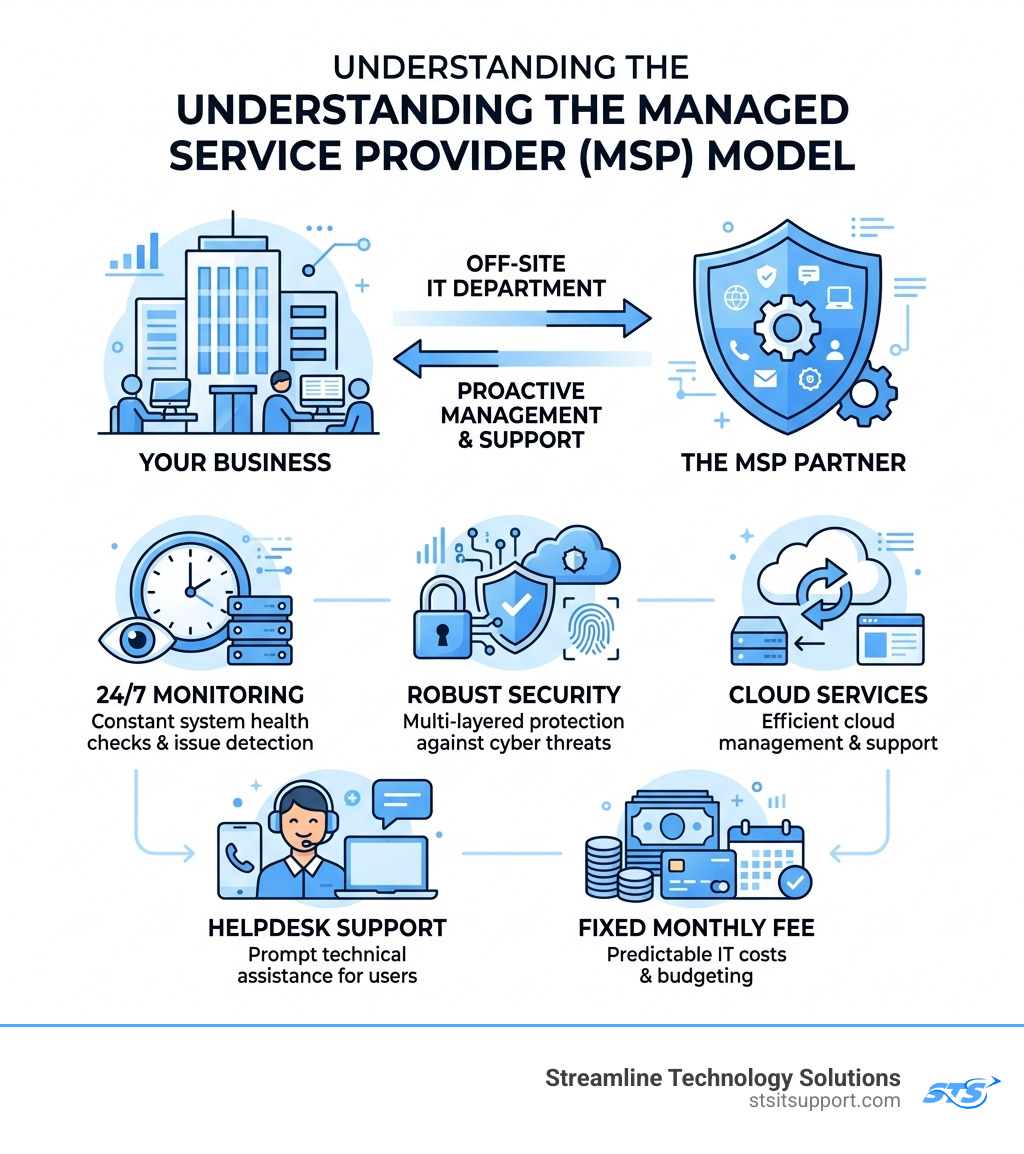
Managed IT support companies are third-party providers that take over the day-to-day management of your business technology — including security, monitoring, cloud services, and helpdesk support — for a predictable monthly fee.
Keeping your business running smoothly depends on reliable IT — and right now, that's harder than ever. Cyberattacks hit every 11 seconds. According to resources from CISA, small businesses are increasingly targeted by sophisticated threats. Sixty percent of small businesses that suffer a breach close within six months. And yet, many small business owners are still stuck with IT providers who don't respond, don't communicate, and surprise them with fees they didn't budget for.
That's a real problem — and it's exactly why more businesses are turning to managed IT support companies to get consistent, proactive coverage instead of reactive break-fix chaos.
I'm Michael Gaigelas, and with over 20 years of hands-on experience in IT support, cloud infrastructure, VoIP, and managed IT support companies of all sizes, I've seen what separates a great MSP from one that costs you more in downtime than it saves. In this guide, I'll walk you through everything you need to make a confident, informed choice.
What are Managed IT Support Companies?

At their core, managed it support companies act as your off-site IT department. Instead of waiting for a server to crash or a laptop to catch a virus before calling for help (the old "break-fix" model), these providers use advanced software to watch your systems 24/7.
When we talk about "Managed Services," we are talking about a proactive partnership. A quality provider doesn't just fix what’s broken; they prevent the break from happening in the first place. This involves constant Remote Monitoring and Maintenance (RMM), where engineers track the health of your devices, apply security patches automatically, and ensure your backups are actually working.
For businesses in South Florida, from Fort Lauderdale to Boca Raton, this means you aren't just buying "tech support"—you're buying uptime. You're hiring a team that handles infrastructure oversight, lifecycle planning for your hardware, and vendor coordination so you don't have to spend hours on the phone with your internet service provider.
To learn more about how we approach this mission, you can visit our About Us page.
Evaluating Managed IT Support Companies by Industry
Not all managed it support companies are created equal, especially when it comes to the specific "language" of your industry. In 2026, compliance is the name of the game.
Healthcare: If you're running a medical or dental practice in Deerfield Beach or Pompano Beach, your MSP must be an expert in HIPAA compliance. They need to ensure patient data is encrypted, access is logged, and staff are trained to avoid phishing attempts.
Legal: Law firms handle massive amounts of sensitive discovery data. MSPs serving this sector focus on secure document management, remote access for attorneys on the go, and rigorous data retention policies.
Finance & Accounting: With the 2026 tightening of cybersecurity requirements by insurance companies, CPAs and financial advisors need MSPs who can prove compliance through regular audits and standardized security basuaries.
The Role of AI in Managed IT Support Companies
By April 2026, Artificial Intelligence has moved from a "cool feature" to a mandatory tool for top-tier MSPs. Leading managed it support companies now use AI to stay one step ahead of hackers.
AI-powered support allows for "predictive maintenance." Imagine a system that notices a hard drive's temperature rising slightly over three days and automatically alerts an engineer to swap it out before it fails. That is the power of machine learning in IT.
Furthermore, AI is the front line in ransomware defense. Modern threats move too fast for human intervention. AI-enabled security tools can detect the "behavior" of ransomware—such as a sudden mass encryption of files—and kill the process in milliseconds, isolating the infected machine before the virus spreads across your entire network in Fort Lauderdale.
Core Services and Infrastructure Oversight
What exactly are you paying for? When you sign a contract with a managed service provider, you are typically getting a "full spectrum" of technology management.
Cybersecurity: This isn't just an antivirus program anymore. It’s a multi-layered defense including threat blocking, defense reinforcement, and AI-enabled ransomware training for your employees.
Cloud Services: Whether you are migrating to Microsoft 365 or need a private cloud for digital transformation, MSPs manage the transition to ensure efficiency and flexibility.
Remote Monitoring and Maintenance (RMM): This is the "engine room" of managed IT. It involves 24/7 health checks on every device, automated patching of software vulnerabilities, and asset inventory management.
Business Continuity & BUDR: Backup and Disaster Recovery (BUDR) ensures that if a hurricane hits Coral Springs or a server fails in Boca Raton, your data is safe and your business can be back online in minutes, not days.
If you have a specific technical hurdle or a one-time setup need, you might be looking for IT Projects rather than ongoing support, though most top MSPs handle both seamlessly.
Strategic Benefits of Partnering with Managed IT Support Companies
Outsourcing your IT isn't just about offloading a headache; it's a strategic business move. Many companies find that "boring IT" is actually a competitive advantage. When your systems just work, your team is more productive, and your costs become predictable.
Feature In-House IT Team Managed IT Support Company Cost High (Salary, Benefits, Training) Predictable Monthly Fee Availability Business Hours (Mostly) 24/7/365 Monitoring & Support Expertise Limited to the team's skill set Access to 1,700+ Engineers (Network-wide) Scalability Slow (Must hire more staff) Instant (Add users/devices as needed) Security Often reactive Proactive AI-driven defense
Beyond the table above, consider the "Chaos Factor." Many businesses suffer from "structural" IT problems—recurring outages or security blind spots caused by a lack of standardization. Professional managed it support companies enforce aggressive standardization. By using the same approved "stack" of tools across all clients, they reduce the risk of breaches and make it much easier to govern how AI is used within your company.
Selecting a Provider: Metrics and Standards in 2026
When you are interviewing potential managed it support companies, don't just take their word for it. Look at the hard data. In 2026, the industry has standardized several key metrics that demonstrate effectiveness:
Customer Satisfaction (CSAT): Leading providers often boast scores of 96% or higher. This measures how happy clients are immediately after a support ticket is closed.
Net Promoter Score (NPS): A score above 80 is considered world-class. It indicates how likely a client is to recommend the provider to a peer.
Product Quality (PQUAL): This tracks how well the solutions provided actually perform under pressure. Look for scores around 97%.
Service Level Agreements (SLAs): These are the legal promises the MSP makes regarding response times. If your server goes down, how fast will they respond? 15 minutes? One hour? Get it in writing.
Standardization is another key "green flag." A provider that refuses to lower their standards to match a small budget is actually doing you a favor. They know that cutting corners on security or using outdated hardware creates "chaos" that eventually costs more in the long run.
To see what real business owners in South Florida think about these standards, you can check out our Reviews.
Co-Managed IT: Supporting Your Internal Team
You might already have a "tech guy" or a small IT team in your Fort Lauderdale office. Does that mean you don't need an MSP? Not necessarily.
Co-managed IT services are designed to augment your existing staff. Perhaps your internal team is great at day-to-day user support but doesn't have the time to manage a complex cloud migration or 24/7 security monitoring.
By partnering with an MSP, your internal team can focus on high-level strategic projects that grow your business, while the MSP handles the "heavy lifting" of infrastructure maintenance, patching, and the 3:00 AM server alerts. It’s a hybrid approach that gives you the best of both worlds: local, intimate knowledge of your business combined with the specialized skills and tools of a national network.
For quick answers to common technical hurdles your team might face, our Support Center is a great resource.
Frequently Asked Questions about Managed IT Support
What is the typical pricing model for managed IT?
Most managed it support companies in 2026 use a "per-user" or "per-device" monthly fee. This is often called a fixed-fee model. It is designed to be predictable, meaning you don't get a surprise bill because you had a busy month with lots of support calls. Prices can vary based on the level of security and the complexity of your infrastructure, but transparency is key—always ask if there are hidden fees for "on-boarding" or "emergency after-hours support."
How do MSPs protect against ransomware in 2026?
Modern protection is multi-layered. It starts with employee training (since 90% of attacks start with a human error) and moves into AI-enabled threat detection. MSPs also use "immutable backups"—backups that cannot be deleted or changed even by a hacker—ensuring that if you are attacked, you can restore your data without ever paying a ransom.
What is the difference between managed and co-managed IT?
Think of "Managed IT" as outsourcing the entire department. The MSP is your IT manager, your helpdesk, and your security officer. "Co-managed IT" is a partnership where the MSP shares responsibilities with your in-house staff, usually taking over the routine maintenance and security while your team handles business-specific software or strategy.
Conclusion
Finding the right partner among the many managed it support companies available today can feel overwhelming, but it boils down to three things: transparency, accountability, and local expertise.
At Streamline Technology Solutions, we take pride in serving our South Florida neighbors—from Coral Springs and Boca Raton to Pompano Beach and Deerfield Beach. We believe in transparent pricing without hidden fees and fast local support that treats your business like our own.
Whether you need a full-service partner to eliminate IT chaos or a co-managed solution to support your internal team, we're here to help you navigate the complexities of 2026 technology.
Ready to see how smart IT can empower your business? Visit us at our Home page to start a conversation.