
How Much Should You Really Pay for Managed IT Support
What Managed IT Support Pricing Really Costs in 2026
Managed IT support pricing in 2026 typically ranges from $50 to $200 per user per month for a fully managed business-hours plan. For a 10-person company, that usually means a monthly budget of about $1,000 to $2,000, plus a one-time onboarding fee of roughly $1,000 to $5,000.
Support model Typical 2026 cost Best fit Fully managed, per user $50-$200 per user/month Businesses that want predictable support and proactive maintenance Per device $50-$150 per endpoint/month Teams with few devices per employee Break-fix $100-$200 per hour Very small, stable businesses with limited support needs Monitoring only $30-$50 per user/month Companies with internal IT staff that need extra coverage
The lowest quote is not always the lowest total cost. Missing security tools, unclear response times, after-hours charges, and surprise setup fees can turn a cheap monthly rate into an expensive problem when systems go down. South Florida businesses should compare what each provider includes, not just the number at the bottom of the proposal.
I am Michael Gaigelas, with 20 years of experience in business IT support, cloud servers, VoIP, telecommunications, Wi-Fi, and managed services. I have seen how clear managed IT support pricing helps business owners avoid surprise bills and choose support that matches their real needs.
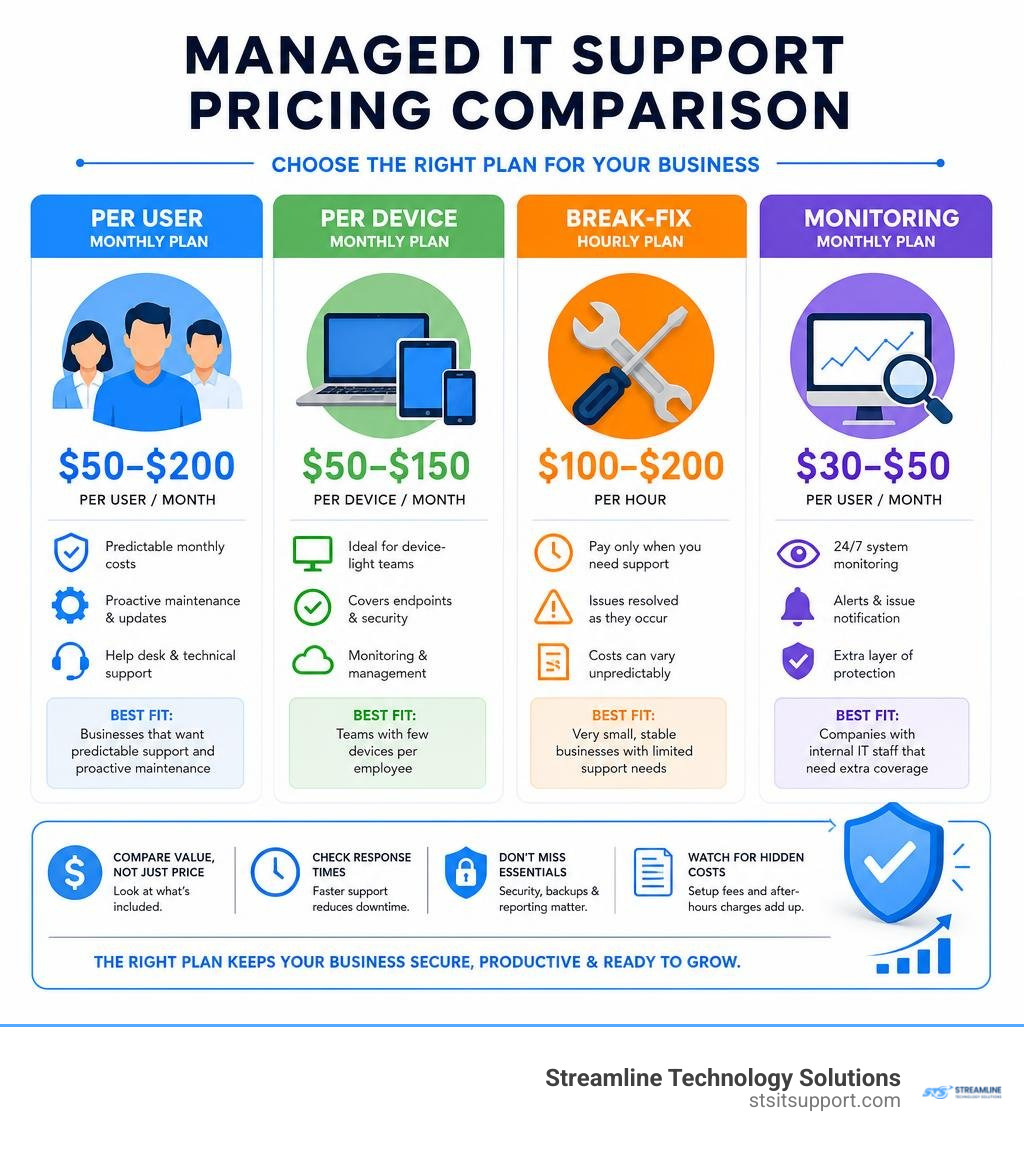
Managed IT Support Pricing Breakdown: What to Expect in 2026
When evaluating managed IT support pricing in South Florida—whether you operate out of Fort Lauderdale, Boca Raton, Coral Springs, Deerfield Beach, or Pompano Beach—understanding how managed service providers (MSPs) construct their proposals is essential. In 2026, technology infrastructure is no longer just a back-office expense; it is the central engine of daily business operations. However, navigating managed IT support pricing structures can feel intentionally confusing if you do not know what line items to look for.
Most outsourced IT support proposals revolve around four main pricing mechanisms: per-user monthly subscription rates, per-device monthly management fees, hourly break-fix billing, and one-time onboarding or setup fees. To help you evaluate these options side-by-side, our managed it support guide 2026 breaks down how these models operate across typical South Florida business environments.
Pricing Factor / Model Per-User Pricing Per-Device Pricing Break-Fix (Hourly) Average 2026 Rate $50 – $200 / user / month $50 – $150 / device / month $100 – $200 / hour Predictability High (Scales cleanly with headcount) Moderate (Scales with hardware growth) Low (Fluctuates based on downtime) Maintenance Type Proactive (24/7 monitoring & patching) Proactive (Endpoint focused) Reactive (Fixes items after breaking) Cybersecurity Suite Usually fully bundled (EDR, MFA, Backup) Often basic antivirus & endpoint patches Billed separately or client responsibility Onboarding Fee $1,000 – $5,000 standard setup $1,000 – $3,000 hardware audit None (Pay per engagement)
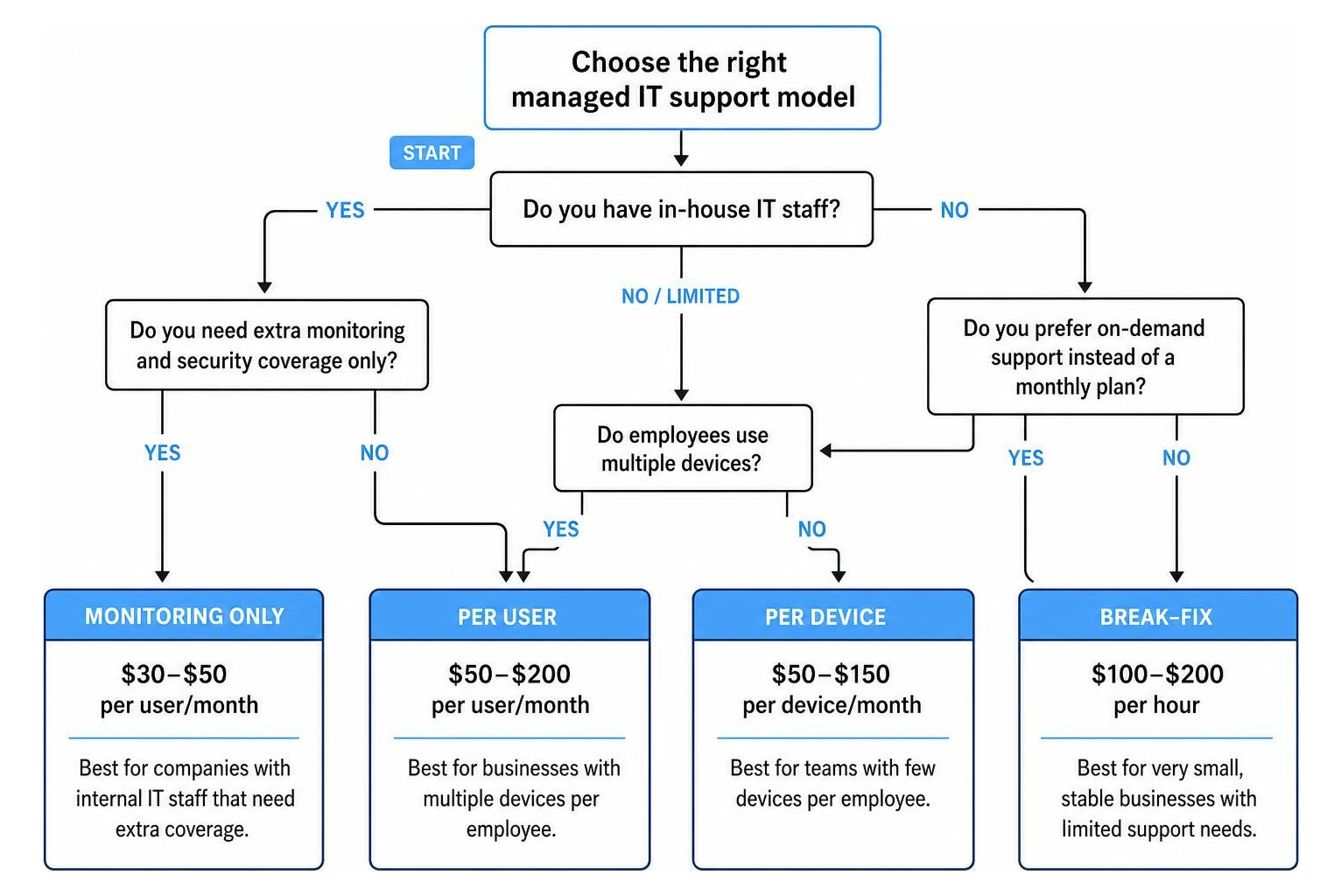
Per-User vs. Per-Device Managed IT Support Pricing
The two most popular recurring payment structures in managed IT support are per-user pricing and per-device pricing. Understanding the mathematical difference between them ensures you do not overpay for technology coverage.
Per-User Pricing ($50 to $200/user/month): Under this structure, you pay a flat monthly rate for each employee regardless of how many devices they operate. If an accountant at your Fort Lauderdale office uses a desktop workstation, a laptop for remote days, a corporate smartphone, and a tablet, all four devices are covered under a single per-user fee. On average across the industry, per-user pricing ranges between $175 and $250 per user per month for premium, fully comprehensive plans, while standard baseline user coverage sits between $50 and $150.
Per-Device Pricing ($50 to $150/device/month): In a per-device model, the provider charges an individualized fee for every endpoint connected to the network—$50 to $100 for desktop computers, $100 to $150 for servers, and separate fees for firewalls, switches, or mobile devices.
To figure out which model saves your organization money, apply the 1.5 Device Ratio Rule:
Calculate the total number of work devices in your company (desktops + laptops + tablets + smartphones).
Divide the total device count by the total number of full-time employees.
If your device-to-user ratio is greater than 1.5, a per-user pricing model will almost always save you money.
If your device-to-user ratio is less than 1.2 (for instance, a manufacturing floor or call center where shift workers share dedicated desktop stations), per-device pricing is often the more cost-effective choice.
If you want to plug in your exact team size, server counts, and security requirements to build a personalized budget estimate, you can test scenarios using an external IT Support Cost Calculator — 2026 Managed IT Pricing Estimator | UseCalcPro .
Break-Fix Rates vs. Managed IT Crossover Points
Some business owners wonder if they should skip recurring contracts entirely and stick with a break-fix model. With break-fix support, you pay no monthly retainer; instead, an IT contractor bills you an hourly rate between $100 and $200 per hour whenever something breaks.
While break-fix sounds cheaper on paper because there is no recurring bill, it carries significant financial risks:
Misaligned Incentives: A break-fix provider only makes money when your business suffers technology problems. A managed service provider makes money when your network runs smoothly with zero downtime.
Unpredictable Budget Spikes: A single ransomware attack, server failure, or network outage can require 30 to 50 hours of emergency remediation labor, generating a single month invoice of $5,000 to $10,000.
Neglected Maintenance: Break-fix arrangements rarely include background patch management, offsite backups, or proactive threat monitoring.
For most growing companies in Boca Raton or Deerfield Beach, the crossover point occurs between 10 and 15 users.
Below 10 users with minimal cloud software needs, a business might temporarily survive on break-fix support if ticket volume stays under 2 to 4 hours per month. However, once a team reaches 10 to 15 employees, ticket frequency naturally increases, security requirements tighten, and the costs of hourly labor exceed the flat rate of managed support. Exploring affordable it support packages allows companies reaching this milestone to transition into a predictable monthly budget without taking on unexpected hourly costs.
Core Pricing Models in the Managed Services Market
Beyond per-user and per-device billing, providers structure their commercial agreements using several specialized pricing delivery frameworks. Selecting the right framework depends heavily on your existing internal resources, regulatory demands, and long-term cloud growth strategy.

When reviewing proposals for managed it services, you will typically encounter these distinct structures:
Flat-Rate, Tiered, and Value-Based Models
Flat-Rate All-Inclusive Pricing: This model bundles all help desk labor, network management, endpoint security, cloud maintenance, and executive IT strategy into one fixed monthly fee. There are no extra charges for remote support calls or on-site visits. It gives financial officers maximum predictability.
Tiered Pricing (Gold/Silver/Bronze): Providers offer structured service tiers. A Silver plan might cover remote help desk and basic patch management; a Gold plan adds advanced endpoint protection (EDR) and cloud management; a Platinum plan includes 24/7 coverage, dedicated compliance auditing, and hardware refreshes.
Value-Based Pricing: Rather than tying fees solely to labor hours or user counts, value-based pricing bases the contract on tangible business outcomes—such as achieving 99.99% network uptime, maintaining continuous HIPAA compliance, or optimizing enterprise cloud expenditures. Value-based pricing creates the tightest strategic alignment between the MSP and the client, because the provider directly profits from making your technology ecosystem reliable and self-sufficient.
Monitoring-Only and Co-Managed Solutions
Not every business requires an outsourced team to handle every single ticket. Mid-sized companies in South Florida that already employ an internal IT manager often choose specialized support arrangements:
Monitoring-Only Plans ($30 to $50/user/month): In a monitoring-only agreement, the provider supplies automated Remote Monitoring and Management (RMM) software tools, tracks server health, deploys security patches, and alerts your team to active network threats. Your internal staff remains responsible for end-user support and day-to-day tickets.
Co-Managed IT Support: Co-managed IT splits responsibilities between internal staff and the provider. For example, your internal IT manager handles high-level internal applications and executive projects, while our team provides tier-1 help desk ticketing, emergency after-hours escalation, and complex cloud infrastructure management.
Key Factors Driving Managed IT Support Pricing
If you gather three proposals from different IT companies in South Florida, you might see monthly pricing vary by 30% to 50% for the exact same headcount. Why does this gap exist? Managed IT support pricing is driven by backend operational expenses, licensing tooling, and labor coverage commitments.

The primary cost drivers include:
Infrastructure Size & Complexity: A business running 20 local servers, complex multi-site firewalls, and legacy databases costs significantly more to support than a 20-person team operating entirely on cloud software like Microsoft 365.
Software Licensing Stack: Modern MSPs bundle enterprise security software into their per-user rates. High-grade Endpoint Detection and Response (EDR), Security Operations Center (SOC) monitoring, spam filters, and cloud backup software carry high baseline licensing fees.
Wage Inflation & Technical Expertise: Experienced tier-2 and tier-3 network engineers command competitive market salaries. Providers that invest in certified, local technical talent charge rates that reflect that level of service.
Coverage Windows: Business Hours (8x5) vs. 24/7 Operations
The operational window you select directly impacts your monthly contract cost.
Standard Business Hours (8x5): Covers help desk and network monitoring from 8:00 AM to 5:00 PM, Monday through Friday. This model fits standard office environments, law firms, and corporate services that shut down during evenings and weekends.
24/7/365 Round-the-Clock Coverage: Demands dedicated night-shift engineers and continuous emergency incident response capabilities.

Expanding from an 8x5 coverage schedule to full 24/7 support typically adds a 25% to 50% premium to your baseline monthly fee. For many small-to-medium businesses in Coral Springs or Pompano Beach, full 24/7 coverage is unnecessary. A cost-effective alternative is an 8x5 agreement paired with an agreed-upon after-hours emergency hourly rate for rare weekend issues.
Standard Help Desk Inclusions vs. Advanced Cybersecurity
What is included under the hood of a managed plan varies wildly across providers. A cheap $50/user proposal often strips out essential security layers, charging you extra later when you need them.
Standard entry-level plans generally include:
Remote it help desk assistance for everyday user software issues
Basic web-based antivirus software
Automated operating system patching and updates
Centralized network uptime monitoring
Premium managed plans, by contrast, integrate enterprise-grade security tools and strategic services directly into the monthly rate:
Advanced Endpoint Detection and Response (EDR) with automated AI threat isolation
24/7 Security Operations Center (SOC) log monitoring
Comprehensive cybersecurity risk assessment reviews and penetration tests
Immutable, encrypted cloud backup and disaster recovery validation
Regulatory compliance management (HIPAA, PCI-DSS, CMMC)
Virtual CIO (vCIO) guidance for executive technology roadmapping
How to Compare Bids and Decide Between MSPs vs. In-House
When executive leadership decides to upgrade their technical capabilities, they must evaluate two distinct paths: partnering with an outsourced provider or building an internal IT department. Making the right strategic choice requires looking beyond basic salary figures to analyze total operational costs.
To evaluate external proposals effectively, business leaders should request itemized bid line items, allowing clear side-by-side comparisons using it support for businesses standards.
Red Flags and Hidden Charges in Vendor Bids
When reviewing managed IT support quotes, watch out for red flags that lead to budget overruns down the road:
Unusually Low Per-User Pricing: Bids priced 30% below market averages (e.g., $30 to $40 per user for "all-inclusive" support) almost always hide critical omissions—such as excluding security software, charging extra for basic on-site visits, or lacking active insurance policies.
Vague Service Level Agreements (SLAs): If a proposal promises "fast response times" without defining written timeframes (such as 15-minute emergency response or 1-hour standard response SLAs), you have no contractual recourse when support tickets linger unresolved for days.
Surprise Onboarding & Project Fees: Ensure the proposal clearly states whether initial network cleanups, user provisioning, and cloud migrations are included or billed separately as a multi-thousand-dollar onboarding project.
Proprietary Tool Lock-In: Avoid providers that force you to buy non-standard, proprietary hardware or software agents that make it impossible to switch vendors if service quality deteriorates.
Managed Services vs. Hiring an In-House IT Department
Building an internal IT department requires substantial capital investment. Hiring a single qualified System Administrator in the South Florida market carries a base salary of $85,000 to $110,000 per year. Once you factor in payroll taxes, health benefits, continuing education certifications, and software management tools, the true annual cost of one internal employee exceeds $130,000.
Furthermore, relying on a single internal engineer creates significant operational risks:
Single Point of Failure: Who handles server crashes when your IT administrator is on vacation, sick, or attending training?
Skillset Limitations: A single individual rarely possesses deep expertise across cloud architecture, cybersecurity compliance, VoIP telephony, enterprise networking, and end-user help desk management simultaneously.
Tool Stack Expenses: An internal employee requires enterprise software tools (RMM, PSA, backup storage, security consoles) that cost thousands of dollars in separate standalone software licensing.
By contrast, engaging an outsourced team or leveraging a certified onsite it support technician gives you immediate access to an entire team of tier-1 through tier-3 specialists, advanced security tooling, and 365-day operational redundancy at a fraction of the cost of one full-time salary.
Frequently Asked Questions about Managed IT Support Costs
How much have IT support costs increased from 2023 to 2026?
Between 2023 and 2026, managed IT support pricing increased across the industry by approximately 10% to 15%.
This upward shift was driven by three primary economic and technological factors:
Rising Enterprise Security Tooling Costs: Cybersecurity software vendors increased licensing fees for EDR, multi-factor authentication (MFA), and cloud backup platforms due to expanding global threat landscapes.
Tech Labor Inflation: High demand for certified cybersecurity specialists and cloud engineers pushed technical salaries higher across South Florida.
Third-Party Regulatory Requirements: Insurance carriers increasingly require MSPs to deploy advanced threat-hunting software across all client endpoints to maintain active cyber insurance policies.
How many MSP quotes should a business get before choosing a provider?
We recommend obtaining at least 3 written proposals from insured, local providers.
Requesting three bids allows you to:
Compare local market rates across South Florida accurately.
Identify outliers that are either severely under-scoped or overpriced.
Evaluate cultural fit, executive communication styles, and local office proximity.
Ensure all providers are bidding on the exact same technology scope (e.g., verifying that all three proposals include enterprise security tools, managed cloud backups, and clear SLA guarantees).
What are standard onboarding and network assessment fees?
Standard one-time onboarding fees in 2026 range between $1,000 and $5,000, depending on your network's size and current condition.
The onboarding process covers critical foundational work:
Conducting a comprehensive network security audit and vulnerability scan.
Mapping all existing hardware, switches, firewalls, and server connections.
Installing RMM monitoring agents and endpoint security software across all user devices.
Standardizing password vaults, role-based access controls, and administrative privileges.
Verifying and testing immutable offsite backup restorations.
Documenting all vendor contracts, line circuits, and cloud tenant configurations.
Some MSPs will waive or discount onboarding fees if you sign a multi-year managed services contract, amortizing those initial setup costs over the lifecycle of the relationship.
Conclusion
Understanding managed IT support pricing empowers business leaders to make confident technology investments that protect their operations without ballooning corporate budgets. In 2026, a fully managed, high-tier IT support framework typically ranges from $50 to $200 per user per month. While lower bids might look tempting initially, true budget stability comes from comprehensive service packages that include proactive cybersecurity, robust SLAs, transparent onboarding fees, and dedicated local support.
At Streamline Technology Solutions, we believe that transparent pricing without hidden fees, ultra-fast local response times, and direct accountability are the foundation of a great partnership. Whether you need complete managed IT services, cloud server management, VoIP telephony, or hardware provisioning for your offices in Coral Springs, Boca Raton, Fort Lauderdale, Deerfield Beach, or Pompano Beach, our team is ready to deliver technology solutions that help your business grow smoothly.
Ready to gain total clarity on your technology budget? Visit Streamline Technology Solutions today to speak with our local team and receive a straightforward, customized IT support estimate for your business.