
Why You Should Demand IT Support Without Strings Attached
The Real Cost of Being Locked Into an IT Contract
IT support without contracts gives your business the freedom to pay only for help when you actually need it — no monthly retainers, no multi-year commitments, no penalties for leaving.
Here's a quick breakdown of what that means in practice:
Feature Non-Contract IT Support Traditional Managed Service Billing Hourly or per-issue Fixed monthly fee Commitment None 12–36 months typical Best for Small/sporadic IT needs Ongoing, complex environments Flexibility Cancel anytime Often locked in SLA guarantee Usually not included Typically included Cost predictability Variable Predictable
If you've ever signed a long-term IT contract and felt stuck — watching monthly fees pile up even when nothing broke — you're not alone.
Many South Florida small business owners face the same frustration. They need reliable tech help, but they don't need (or want) a rigid agreement that charges them whether they call or not. They want a technician who shows up, fixes the problem, and bills them fairly. That's it.
The traditional IT support model wasn't built for small businesses. It was built for mid-size companies with predictable, high-volume IT needs. For a 10-person office in Fort Lauderdale, a $1,000-per-month managed services contract can feel like paying for a gym membership you use twice a year.
The good news? There's a growing shift toward flexible, pay-as-you-go IT support — and it's a legitimate option worth understanding before you sign anything.
I'm Michael Gaigelas, and over the past 20 years I've helped startups and small businesses navigate IT support without contracts — from cloud servers and VoIP to managed services and everything in between. In this guide, I'll walk you through exactly how non-contract IT support works, what it costs, and how to get quality service without giving up accountability.
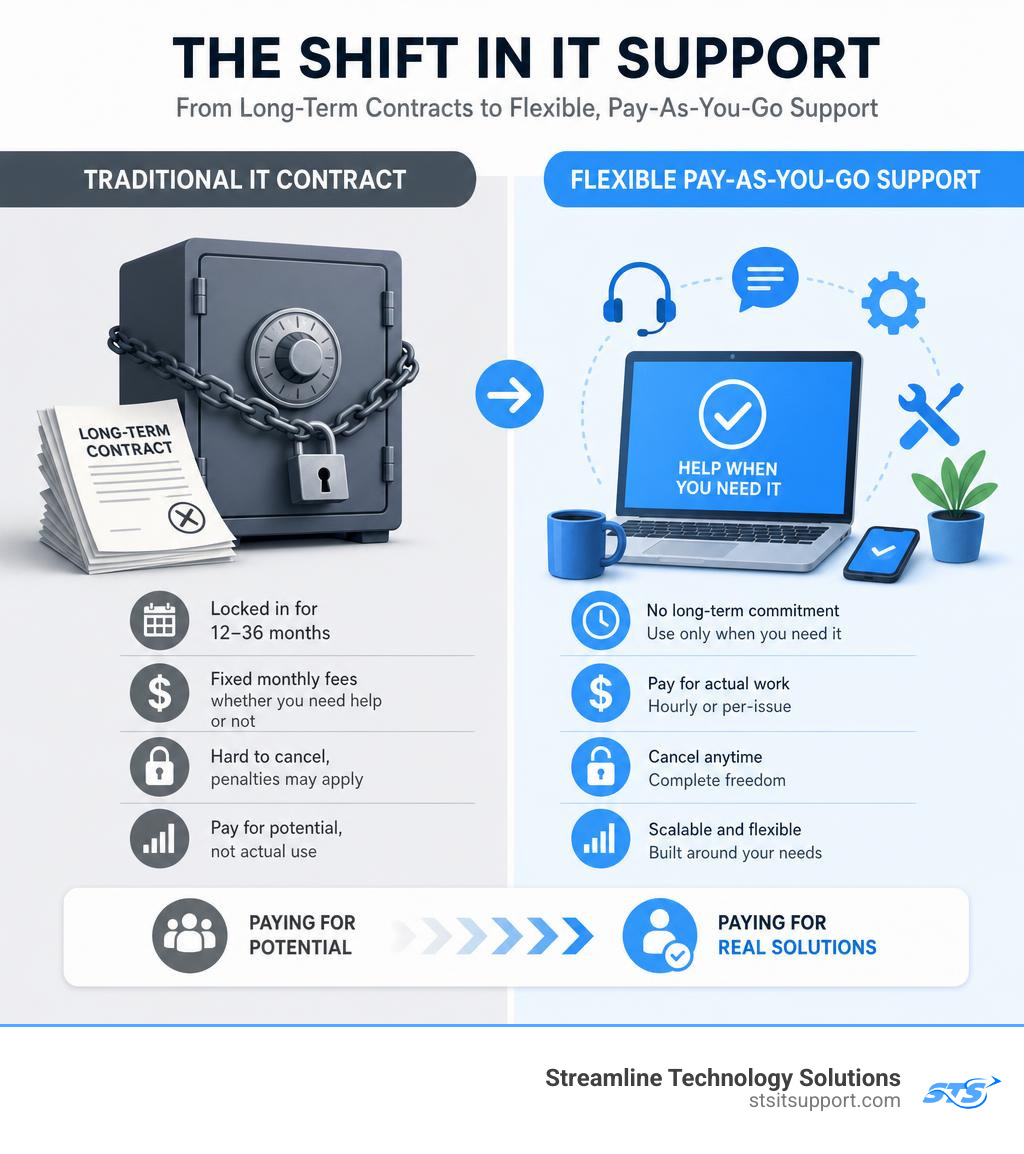
Understanding IT Support Without Contracts vs. Managed Services
To make the best decision for your business, you must first understand the fundamental differences between ad-hoc IT support, the classic break-fix model, and fully managed services. Many providers use these terms interchangeably, but they represent very different approaches to your technology.
At its core, it support without contracts (often called pay-as-you-go or ad-hoc IT) is a reactive relationship. You experience a problem, you call a technician, they fix it, and you receive an invoice for the time spent or a flat fee for the specific job.
In contrast, traditional managed services are proactive. You pay a set monthly retainer, and the provider continuously monitors your systems, runs updates, and handles security behind the scenes.
Here is a side-by-side comparison to help you visualize the operational differences:
Feature Pay-As-You-Go / Ad-Hoc IT Managed Service Agreements Primary Approach Reactive (Fixing what breaks) Proactive (Preventing issues before they happen) Payment Structure Hourly rates or flat-fee per incident Monthly recurring fee (per-user or per-device) Financial Risk High variance; you pay more when things break Low variance; predictable monthly operational costs System Monitoring None (unless requested as a separate service) Continuous 24/7 network and endpoint monitoring Onboarding Process Minimal; immediate dispatch or remote session Comprehensive; full network audit and documentation
While managed services sound ideal on paper, they often require multi-year commitments that lock small businesses into expensive cycles. For organizations that only need occasional help, an IT support desk that operates on an on-demand basis is often the more logical and financially sound choice.
What is Pay-As-You-Go IT Support?
Pay-as-you-go IT support is exactly what it sounds like: a flexible service model where you only pay for the exact hours or services you use. There are no monthly retainers, no minimum commitments, and no upfront block-hour purchases required.
When a computer freezes, the network drops, or you need a new printer configured, you reach out to your provider. They dispatch a certified technician — either remotely or onsite — to resolve the issue. Once the work is completed, you are billed at a set hourly rate, often in precise 15-minute increments. This ensures you never pay for idle time or unused services.
How Traditional Managed Service Agreements Work
Traditional Managed Service Providers (MSPs) operate on a subscription model. They charge a fixed monthly fee, typically ranging from $100 to $150+ per user or device. In exchange, they manage your entire IT infrastructure.
To secure these predictable rates, MSPs almost always require you to sign a long-term contract, usually lasting 12, 24, or 36 months. These agreements include Service Level Agreements (SLAs) that guarantee specific response times. While this model offers cost predictability, it also means you are financially committed to that vendor, regardless of whether your business scales down, your IT needs decrease, or the quality of their support declines.
Why Businesses Choose IT Support Without Contracts
For many small businesses in Coral Springs, Boca Raton, and Fort Lauderdale, the primary driver behind choosing contract-free IT support is control. When you are not bound by a legal contract, the power remains entirely in your hands. If a provider fails to deliver fast, reliable service, you can simply call someone else next time.

This model forces IT providers to earn your business with every single ticket. There is no complacency because there is no contract to hide behind. Furthermore, it allows businesses to scale their tech support in parallel with their actual operational demands. You can read more about how this fits into broader IT support services for small business strategies to see if it aligns with your goals.
The Benefits of IT Support Without Contracts
Zero Vendor Lock-In: You are never trapped in a multi-year agreement. If your business model changes, or if you are unhappy with the service, you can walk away instantly without early termination fees or penalties.
Maximum Cost Control: You pay only for the hours actually used. If your systems run perfectly for three months, your IT support costs for those months are exactly $0.
No Upfront Commitments: Unlike "block-hour" models that force you to buy 20 or 50 hours upfront (which often expire if unused), true pay-as-you-go billing charges you after the work is completed.
Unbiased Recommendations: Because the provider isn't trying to justify a massive monthly contract, their hardware and software recommendations are focused solely on what your business actually needs to succeed.
Is IT Support Without Contracts Right for Your Business?
Non-contract IT support is highly suited for specific business profiles:
Startups: When cash flow is tight and unpredictable, avoiding a fixed monthly overhead is crucial. Startups can leverage pay-as-you-go support to handle initial office setups and cloud migrations without ongoing financial strain.
Small Businesses (1 to 15 employees): Offices with simple networks, standard cloud software (like Microsoft 365 or Google Workspace), and no complex compliance requirements rarely need 24/7 proactive monitoring.
Charities & Non-Profits: Operating on tight, fluctuating budgets makes fixed IT contracts difficult to justify. On-demand support keeps administrative costs low.
Professional Services: Law firms, CPA offices, and real estate agencies in South Florida often have highly capable administrative staff who can handle basic day-to-day troubleshooting, calling in expert technicians only for complex network or server issues.
If you are located in South Florida, finding a local partner who understands the unique needs of businesses in Coral Springs, Boca Raton, Fort Lauderdale, and Pompano Beach is essential. Working with a local team ensures that when onsite assistance is required, help can arrive quickly without the delays associated with national call centers.
Pricing Structures and Hidden Costs to Watch For
When evaluating it support without contracts, transparency is everything. Because you aren't paying a flat monthly rate, you must understand exactly how you will be billed to avoid "sticker shock" when the invoice arrives.
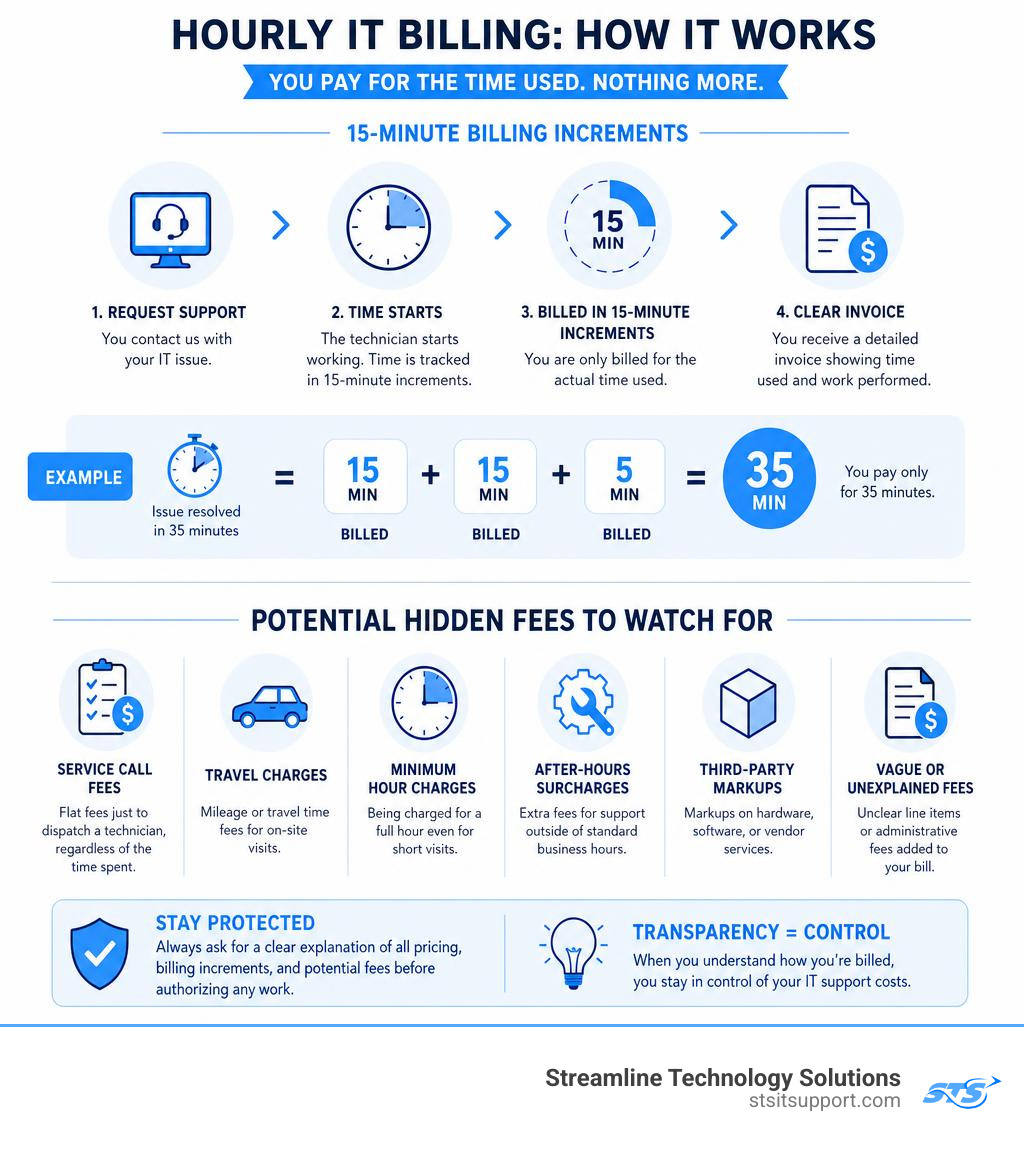
A reputable provider will clearly outline their billing increments, standard rates, and any potential surcharges before they perform any work. This allows you to make informed decisions about which tech issues require professional intervention and which ones can be handled internally. To explore your options further, you can compare these on-demand structures with remote IT support options or review pre-configured affordable IT support packages.
Typical Pricing Models for Non-Contract IT
Hourly Billing (Time & Materials): This is the most common model. You are billed a set hourly rate (typically ranging from $125 to $175 per hour for certified technicians) for the time spent resolving your issue.
15-Minute Increments: To keep billing fair, leading ad-hoc providers bill remote support in 15-minute increments rather than rounding up to the nearest full hour. For example, a quick 15-minute password reset at a $120/hour rate would only cost you $30.
Flat-Fee Per Issue: Some providers offer a flat-rate model for specific, well-defined problems (such as a flat $150 to resolve a malware infection or configure a new router). This eliminates any risk of a technician running up the bill on a stubborn issue.
Hidden Fees in Non-Contract IT Agreements
While contract-free support is highly cost-effective, you must watch out for hidden fees that predatory providers use to inflate their invoices:
Trip Fees / Travel Surcharges: Many providers charge a flat fee (often $50 to $100) just to drive to your office in Pompano Beach or Deerfield Beach, on top of their hourly rate.
Onsite Minimums: It is standard industry practice to have a 1-hour minimum for onsite visits to cover travel time, but ensure this is clearly disclosed upfront.
After-Hours Surcharges: If your server crashes at 8 PM on a Friday, expect to pay an elevated rate (often 1.5x to 2x the standard hourly rate) for emergency support.
Onboarding Fees: Some shady providers will insist on a costly "system audit" or "onboarding fee" before they will even take your first support call. Avoid these traps.
Ensuring Quality and Accountability Without a Contract
A common concern among business owners is: "If I don't sign a contract, why would the IT company care about responding to me quickly?"
It is a valid question. Without a signed Service Level Agreement (SLA), you do not have a legal guarantee that a technician will respond within a specific number of minutes.
However, the reality of the market is quite different. In a contract-free model, the provider's survival depends entirely on their reputation and customer satisfaction. If they make you wait 24 hours to fix a down network, they know you will immediately hire a competitor. The lack of a contract actually increases their accountability, as they must earn your loyalty with every single interaction.

To protect your business, you should establish clear expectations from day one. By choosing a local South Florida provider with a strong physical presence, you ensure that help is always nearby when you need it. You can reach out directly to our team for local tech support in Fort Lauderdale or read about how we handle IT support response times to see how we maintain accountability without locking you down.
Key Questions to Ask a Non-Contract IT Provider
Before you allow any IT company to access your business network, ask them these critical questions:
What are your certified technician credentials? (Are they Microsoft, Cisco, or Apple certified?)
Do you bill in 15-minute increments or round up to the nearest hour?
What is your average response time for urgent, business-critical issues?
Do you charge trip fees for onsite visits to our specific location (e.g., Boca Raton or Coral Springs)?
What is your escalation path if a tier-1 technician cannot resolve our issue?
Do you document our network credentials and configurations, and will we have full ownership of that documentation?
How to Maintain Accountability Without a Formal Agreement
To ensure you receive high-quality service and accurate billing, implement these best practices:
Demand Ticket Referencing: Ensure every invoice you receive includes a detailed breakdown of the work performed, the technician who completed it, and the specific support ticket reference number.
Maintain Your Own Documentation: Never let an IT provider hold the "keys to your kingdom." Keep a secure, internally managed record of all administrative passwords, domain registrations, and network layouts.
Request Post-Resolution Follow-Ups: A quality provider will always follow up a day or two after a major fix to ensure the problem has not returned.
When to Transition to a Managed Service Agreement
While we are massive advocates for the freedom of contract-free IT, we also believe in absolute honesty: there comes a point in every successful company's growth where a reactive, ad-hoc model is no longer sufficient.
As your business scales, your reliance on technology increases. If you reach a size where even an hour of network downtime costs you thousands of dollars in lost productivity, you need to transition from a reactive "break-fix" mindset to a proactive management model. At this stage, having a dedicated partner who continuously monitors your systems, manages security patches, and provides onsite IT support services becomes an asset rather than an unnecessary expense.
Signs Your Business Has Outgrown Ad-Hoc IT
Frequent, Costly Downtime: If you are calling your IT provider multiple times a week, your hourly bills will quickly surpass the cost of a flat-fee managed service agreement.
Compliance Requirements: If your business must comply with strict regulations (such as HIPAA for medical offices, PCI-DSS for retail, or FINRA for financial firms), you need continuous monitoring and documented security compliance that ad-hoc support cannot provide.
Predictable Budgeting Needs: If your monthly IT expenses are fluctuating wildly—costing $100 one month and $2,500 the next due to an unexpected server crash—your CFO will appreciate the predictability of a flat monthly fee.
Co-Managed IT Needs: If you hire an internal IT person but they are overwhelmed by basic helpdesk tickets, you may need a co-managed IT agreement where an external team handles infrastructure and security while your internal resource focuses on strategic projects.
Frequently Asked Questions
What services are typically included in non-contract IT support?
Most pay-as-you-go IT providers offer a comprehensive suite of services on an on-demand basis. This includes day-to-day computer troubleshooting, network and Wi-Fi configuration, software installations and updates, email migrations (such as moving to Microsoft 365), data backup setup, and disaster recovery planning. You can also hire them for one-off projects like office relocations or hardware upgrades.
How do response times compare between contract and non-contract IT support?
Managed service contract clients typically receive priority in the support queue because their agreements include legally binding SLA response times (often guaranteeing help within 1 to 4 hours). However, reputable non-contract providers still maintain impressive response times, often averaging under 2 hours for urgent, business-critical issues and offering 24/7 emergency support for severe network outages.
Is cybersecurity included in pay-as-you-go IT support?
Yes, but it is handled reactively or on a project-by-project basis. You can hire a non-contract provider to perform a one-time vulnerability assessment, install firewalls, set up multi-factor authentication (MFA), or clean up systems after a malware infection. However, continuous 24/7 threat monitoring and active threat hunting generally require an ongoing managed security plan.
Conclusion: Get IT Support on Your Own Terms
At Streamline Technology Solutions, we believe that great IT support shouldn't come with strings attached. We have spent years supporting startups and small businesses across South Florida — including Coral Springs, Boca Raton, Fort Lauderdale, Deerfield Beach, and Pompano Beach — with flexible, transparent, and highly responsive IT services.
We don't believe in trapping our clients in multi-year contracts. Instead, we focus on delivering fast, local support and direct accountability. If we do our job right, we know you'll call us the next time you need help — no legal paperwork required.
Whether you need a quick remote fix, an emergency onsite technician, or a complete network overhaul, we are here to help on your terms.
Ready to experience IT freedom? Get started with Streamline Technology Solutions today and let's discuss how we can keep your business running smoothly without the contractual headache.