How Fast is Fast Enough? Setting the Standard for Managed IT Support
When Every Minute of Downtime Costs You Money, Response Time Isn't Optional
How businesses ensure fast reliable IT support response times is one of the most important questions any business owner should be asking before signing with an IT provider.
Here's a quick answer:
Strategy What It Does Define SLAs by priority level Sets clear expectations: critical issues get a 15-min response, low priority within 4 hours Use automated ticket triage Routes issues to the right technician instantly, cutting resolution time by up to 21% Implement proactive monitoring Catches problems before they impact users, reducing reactive support needs Build a self-service knowledge base Lets users solve common issues themselves, freeing up technicians for complex problems Track KPIs like FRT and FCR Identifies bottlenecks so you can continuously improve performance Offer omnichannel + remote support Lets technicians respond from anywhere, via any channel, without delay
The gap between what businesses expect and what they actually get from IT support is striking. Nearly half of customers expect a response in under four hours - yet the average response time is over 12 hours. For a small business in South Florida, that gap isn't just frustrating. It can mean lost sales, idle employees, and serious security exposure.
Most IT problems don't start big. They start small - and grow while you wait.
I'm Michael Gaigelas, and with 20 years of experience in IT support, managed services, cloud servers, VoIP, and business technology, I've seen how how businesses ensure fast reliable IT support response times separates thriving operations from ones constantly putting out fires. In the sections below, I'll break down exactly what "fast enough" looks like, and what standards you should hold your IT provider to.
The Critical Difference Between Response and Resolution Times
One of the most common points of confusion we see when talking to business owners in Boca Raton or Fort Lauderdale is the distinction between "response" and "resolution." Understanding this difference is the first step in how businesses ensure fast reliable IT support response times.
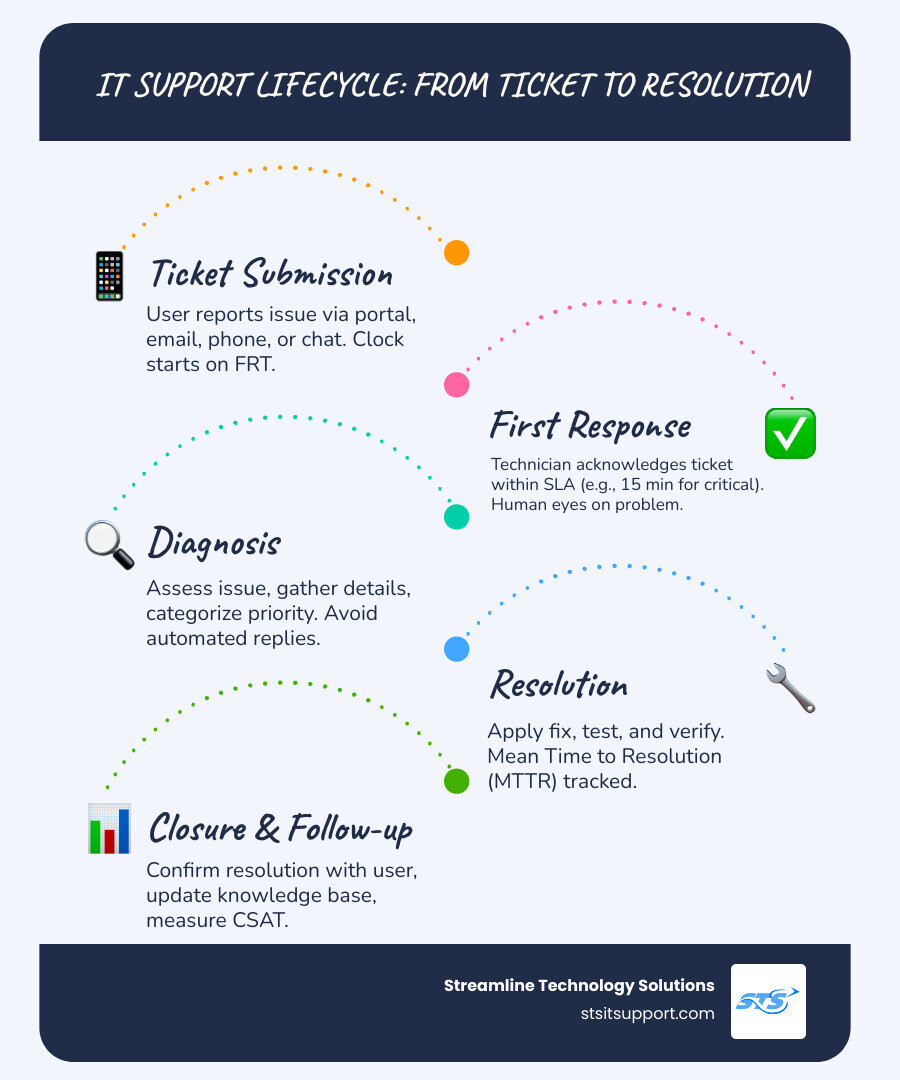
First Response Time (FRT) is the clock that starts the moment you submit a ticket or leave a voicemail and ends when a human technician acknowledges the issue and begins working on it. It’s important to note that an automated "We received your request" email does not count as a response in a high-quality service environment. True response means a qualified expert has put eyes on your problem.
Mean Time to Resolution (MTTR), on the other hand, is the total time it takes to actually fix the problem so your employee can get back to work.
Why does this matter? Because a provider could have a lightning-fast response time of 5 minutes but take three days to resolve a simple password reset. Conversely, a rushed "fix" that doesn't address the root cause leads to "flapping" tickets—issues that keep coming back. At Streamline Technology Solutions, we focus on the "Action Start" time. We believe that once a ticket is acknowledged, troubleshooting should begin immediately to minimize the impact on your business continuity.
If you're tired of waiting hours just to hear back from your current provider, it might be time to learn more about our team and how we prioritize direct accountability.
Industry Benchmarks: How Businesses Ensure Fast Reliable IT Support Response Times
When we talk about "gold standards," we are looking at specific benchmarks that keep South Florida businesses competitive. Research shows that 70% of consumers will abandon a brand after just two negative experiences. In an internal business context, that "negative experience" is an employee sitting idle because the server is down.
Standard Response Windows by Priority Level
To manage resources effectively, we use a priority matrix. Not every issue is a "code red," but when the entire office in Coral Springs can't access the internet, that's a P1 Critical incident. Here is what you should expect:
P1 - Critical (Emergency): Total system outage or security breach affecting all users. Target: 15-30 minute response; 2-hour resolution.
P2 - High Priority: A department is down, or a key executive cannot work. Target: 1-hour response; 4-hour resolution.
P3 - Medium Priority: Individual user issues that hinder work but have workarounds (e.g., a specific software error). Target: 4-hour response; Same business day resolution.
P4 - Low Priority: Routine requests, such as new user setups or general questions. Target: 8-hour response; 24-48 hour resolution.
These expectations are typically documented in a Service Level Agreement, which defines response targets, escalation paths, and accountability standards between a business and its IT provider.
Why Speed Alone Isn't Enough for Reliability
There is a dangerous trap in the IT world: the "quick fix." If a technician is pressured solely on speed, they might apply a "band-aid" that leads to technical debt. For example, restarting a failing server might get you back online in 5 minutes, but if the technician doesn't investigate why it failed, it will crash again tomorrow.
Reliability comes from balancing speed with thorough diagnostics. How businesses ensure fast reliable IT support response times involves choosing a partner who values First Contact Resolution (FCR). Solving the problem correctly the first time is always faster than fixing it poorly three times.
Leveraging Technology to Eliminate Support Delays
Modern IT help desks in Fort Lauderdale use sophisticated tools to bridge the gap between a problem occurring and a technician solving it. One of the biggest killers of productivity is "context switching"—when an agent has to jump between five different tools just to find your account details. Disconnected systems can increase the average time-to-resolution by a staggering 26%.
Leveraging Automation for Fast Reliable IT Support Response Times
Automation is the secret weapon of efficient IT teams. By implementing automated ticket triage, we can resolve issues up to 21% faster. AI-powered routing analyzes the keywords in your request (like "server down" or "email password") and instantly sends the ticket to the specialist best equipped to handle it.
We also use intelligent auto-responders. No, not the generic ones—these provide immediate self-service links or estimated wait times based on live dashboard data. This keeps you informed while our team works behind the scenes. If you want to see the difference this makes, see what our clients say about our responsiveness.
Omnichannel Support and Remote Troubleshooting Tools
In today’s hybrid work environment, you might have employees in Deerfield Beach and others working remotely. How businesses ensure fast reliable IT support response times in this scenario requires omnichannel support. Whether you reach out via phone, email, or a dedicated portal, the context of your issue should follow you.
Remote monitoring and management (RMM) tools allow our technicians to jump onto your screen instantly. This eliminates the "travel time" associated with traditional IT support. For businesses in Pompano Beach, this means a technician can be "on-site" virtually within seconds of your call.
Proactive Management and Team Optimization Strategies
The fastest response time is the one you never have to ask for. This is the hallmark of Managed IT Services in Deerfield Beach. By shifting from a "break-fix" model to a proactive one, businesses can prevent downtime before it even starts.
Implementing Proactive Monitoring for Fast Reliable IT Support Response Times
Proactive monitoring involves installing sensors on your network that watch for "smoke" before there’s a "fire." If a hard drive starts showing signs of failure or a security patch is missing, our system alerts us automatically.
By catching these anomalies early, we can perform maintenance after hours, ensuring your system uptime remains high. This drastically reduces the number of "emergency" tickets, which in turn keeps our response times low for the issues that do require human intervention.
The Impact of Staff Training and Knowledge Bases
Staffing plays a massive role in speed. Companies with comprehensive training programs see 218% higher income per employee. Why? Because a well-trained technician doesn't need to escalate every ticket to a senior engineer.
Furthermore, a robust knowledge base empowers your own employees. If a staff member can find a 30-second video on how to connect to the office VPN, they don't need to submit a ticket at all. This reduces overall ticket volume, ensuring that when a real crisis hits, our lines are open.
Key Metrics to Measure Help Desk Performance
You cannot improve what you do not measure. At Streamline Technology Solutions, we track several Key Performance Indicators (KPIs) to ensure we are meeting the high standards our South Florida clients expect.
Metric Why It Matters Median First Response Time Using the median instead of the average prevents outliers from hiding poor performance. First Contact Resolution (FCR) This is often cited as the single most important metric for customer satisfaction. SLA Attainment Rate The percentage of tickets resolved within the agreed-upon timeframe. Customer Satisfaction (CSAT) The software industry average is 78%; we strive to exceed this daily.
Tracking these metrics allows us to identify peak times and adjust our staffing levels accordingly, so a Monday morning rush doesn't result in Friday-level delays. If you're curious about how we apply these standards to complex setups, explore our IT projects.
Frequently Asked Questions about IT Support Speed
What is a good response time for a critical IT issue?
For a critical (P1) issue, such as a total network failure or a ransomware attack, you should expect an acknowledgment within 15 minutes and active troubleshooting to begin immediately. Resolution should typically occur within 2 to 4 hours, depending on the complexity of the hardware or software involved.
How do SLAs enforce response time guarantees?
A Service Level Agreement (SLA) is a contract that defines exactly what "fast" means. It should include priority definitions and escalation protocols. If a provider consistently misses these targets, the SLA often includes "service credits"—essentially a discount on your monthly bill—to hold the provider accountable. This ensures the IT company has "skin in the game."
Can automation replace human IT support agents?
Not entirely. We believe in a hybrid approach. Automation is fantastic for routine inquiries, ticket routing, and proactive monitoring. However, complex troubleshooting and high-stakes security incidents require human empathy, creativity, and deep technical expertise. Automation handles the "noise" so our humans can focus on you.
Conclusion
In the business corridors of Boca Raton, Coral Springs, and Fort Lauderdale, waiting 12 hours for an IT response is a luxury no one can afford. How businesses ensure fast reliable IT support response times comes down to a combination of clear SLAs, proactive technology, and a team that is locally accountable.
At Streamline Technology Solutions, we pride ourselves on transparent pricing without hidden fees and direct access to engineers who know your business by name. We don't hide behind a faceless ticket queue; we provide the fast, local support South Florida businesses need to thrive.
If you’re ready to stop waiting and start growing, visit our Support Center today to see how we can optimize your operations. Whether you need IT support in Coral Springs, Boca Raton, or Pompano Beach, we are here to set the standard for your success.