Why Your Business Needs a Hosted PBX Phone System Yesterday
Your Business Phone System Is Already Falling Behind
A hosted PBX phone system is a cloud-based business phone solution managed by an off-site provider — giving your team professional call routing, voicemail, auto-attendants, and more, without any on-site hardware.
Quick answer for busy readers:
Question Answer What is it? A business phone system hosted in the cloud by a third-party provider How does it work? Calls travel over the internet using VoIP technology instead of copper phone lines Who manages it? Your provider handles all maintenance, updates, and infrastructure What does it cost? Typically $15–$60 per user per month, with no major upfront hardware costs Who is it for? Businesses of any size — especially remote teams, startups, and growing companies
Traditional phone systems are expensive to maintain, difficult to scale, and increasingly obsolete. The PSTN (Public Switched Telephone Network) — the old copper-wire landline infrastructure most businesses still depend on — is actively being phased out in many countries. Meanwhile, the hosted PBX market is growing at 15% per year and is projected to reach $264 billion by 2036. Businesses that don't adapt will be left managing aging hardware that fewer providers even support.
This isn't a distant problem. If your South Florida business is still running on a legacy phone system, you're already paying more than you need to — and getting less reliability in return.
I'm Michael Gaigelas, and with over 20 years of hands-on experience in IT support, VoIP, and telecommunications, I've helped countless businesses evaluate and implement hosted PBX phone systems that actually fit how they operate. Let's break down everything you need to know to make the right call.
What is a Hosted PBX Phone System?
To understand a hosted PBX phone system, we first have to look at what "PBX" actually means. PBX stands for Private Branch Exchange. In the old days, this was a literal room full of wires and heavy hardware sitting in your office basement. It acted as your private telephone exchange, routing internal calls between desks and connecting your office to the outside world.
A "hosted" system takes that entire room of equipment and moves it to the cloud. Instead of owning and maintaining the hardware yourself, a service provider hosts the technology in secure, off-site data centers. You access all the professional features—like hold music, call transfers, and conference bridges—through your internet connection.
Think of it like the difference between owning a massive DVD collection (on-premises PBX) and having a Netflix subscription (hosted PBX). One requires physical space, cleaning, and manual upgrades; the other is always there, always updated, and accessible from anywhere. For more deep dives into how modern technology impacts your workflow, you can explore our IT resources.
How a hosted PBX phone system works
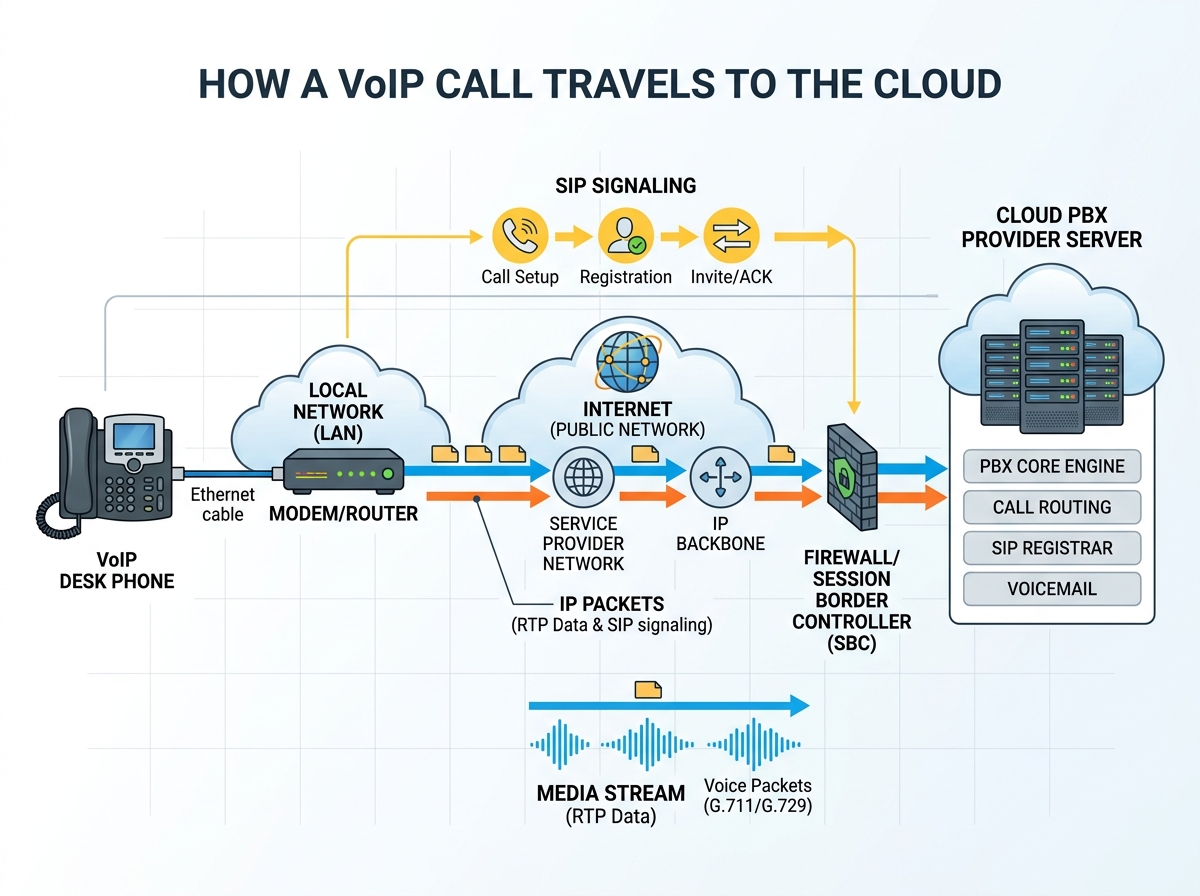
At its core, a hosted PBX phone system relies on VoIP (Voice over Internet Protocol). When you speak into a handset or a headset, your voice is converted into digital data packets. These packets travel over the internet using a set of rules called SIP (Session Initiation Protocol) signaling.
The magic happens at the provider’s server. It receives those data packets, determines where they need to go (whether it’s the desk next to you or a mobile phone in another country), and routes them instantly. Because this happens at the speed of light, it feels exactly like a traditional phone call—only clearer. There’s no need for copper phone lines or expensive "T1" connections from the phone company. If you have high-speed internet, you have a phone system.
The role of virtual PBX in modern business
You might hear the term "virtual PBX" used interchangeably with hosted PBX. While they are very similar, a virtual PBX often refers specifically to the software-based features that handle the "receptionist" side of things.
In a modern South Florida business environment—from Coral Springs to Fort Lauderdale—a virtual PBX allows a three-person startup to sound like a Fortune 500 company. Features like auto-attendants (the "Press 1 for Sales" menu) and virtual extensions mean your team can be spread across Deerfield Beach and Pompano Beach while appearing to be under one roof. With softphone applications, your employees can even use their laptops or personal smartphones as business extensions, keeping their personal numbers private while staying connected to the office.
Hosted PBX vs. On-Premises: The Performance Gap
The debate between keeping an old "box on the wall" versus moving to the cloud usually comes down to performance and agility. On-premises systems represent a "CAPEX" (Capital Expenditure) model—you pay a huge sum upfront for hardware that starts losing value the moment it’s installed. Hosted PBX is an "OPEX" (Operating Expenditure) model, where you pay a predictable monthly fee for a service that actually gets better over time as the provider adds new features.
Feature Traditional On-Premises PBX Hosted PBX Phone System Upfront Cost High (Thousands for hardware/cabling) Low (Cost of IP phones or $0 for apps) Maintenance Your responsibility (Expensive IT labor) Provider's responsibility (Included) Scalability Limited by physical ports/wiring Infinite (Add users in clicks) Remote Work Difficult/Requires complex VPNs Native (Works anywhere with internet) Updates Manual and often paid Automatic and free
The shift is clear: 82% of companies save money by moving to the cloud. Beyond the money, on-premises systems suffer from hardware obsolescence. When a part breaks on a 10-year-old PBX, finding a replacement can be a nightmare that leaves your phones dead for days.
Financial benefits of a hosted PBX phone system
One of the most eye-opening statistics for local business owners is that companies moving to VoIP see average cost savings of 50-75%.
How does a hosted PBX phone system manage this?
Zero Hardware Investment: You don't need to buy a server, a rack, or a cooling system. Most businesses just use their existing computers or affordable IP desk phones.
Reduced IT Labor: You don't need to pay a specialist $150 an hour to come to your Boca Raton office just to "move" a phone extension from one desk to another. You can do it yourself in a web portal in 30 seconds.
Low Long-Distance Rates: Since calls travel over the internet, the "distance" doesn't matter. International and long-distance rates are significantly lower than traditional carrier prices.
Scalability for growing startups and enterprises
In South Florida's dynamic market, your staffing needs can change overnight. A traditional system is "rigid." If you have a 24-port PBX and hire your 25th employee, you often have to buy a whole new expansion module or an entirely new system.
With a hosted PBX phone system, scalability is instant. Whether you are a startup in Ft. Lauderdale adding your first five employees or an enterprise in Pompano Beach opening a second location, you just add seats to your subscription. You can also utilize "seasonal line bursting"—adding extra capacity during your busiest months and scaling back when things quiet down—ensuring you never pay for more than you use.
Key Features and Unified Communications
A hosted PBX phone system is no longer just about voice. It has evolved into a "Unified Communications" (UC) hub. This means your phone system, your video conferencing, your team chat, and even your SMS messaging all live in one place.
When we look at IT Projects for communication upgrades, we focus on these "force multiplier" features:
IVR (Interactive Voice Response): A smart menu that routes callers to the right department without a human operator.
Call Recording: Essential for training, compliance, and resolving customer disputes.
Voicemail-to-Email: Receive a digital audio file and a text transcript of your voicemails directly in your inbox.
CRM Integration: When a client calls, their Salesforce or HubSpot record automatically pops up on your screen, showing your team exactly who is calling and their recent history.
Supporting remote work with a hosted PBX phone system
The "office" isn't a single building anymore. Whether your team is working from a home office in Boca Raton or a coffee shop in Fort Lauderdale, a hosted PBX phone system keeps them unified.
Features like "Follow-Me Calling" ensure that if a desk phone isn't answered, the call rings the employee's mobile app or home computer. Most importantly, when an employee makes a business call from their personal cell phone using the system's app, the client sees the Business Caller ID, not the employee's private number. This maintains professionalism and ensures that if an employee leaves the company, the client relationships (and the phone numbers) stay with the business.
Advanced tools for call centers and sales teams
For businesses that live and die by the phone—like sales teams or customer support centers—hosted PBX offers tools that used to cost tens of thousands of dollars.
Whisper and Barge: A manager can "whisper" advice to an agent during a live call without the customer hearing, or "barge" into the call if things go sideways.
ACD Queues: Automatic Call Distribution ensures that incoming calls are distributed fairly among your team members based on who has been idle the longest or who has the right skills.
Real-Time Analytics: View dashboards showing how many calls are in the queue, average wait times, and agent performance metrics in real-time.
Reliability, Security, and Disaster Recovery
A common concern we hear from business owners in South Florida is: "If my phones are in the cloud, what happens if the internet goes down?"
Ironically, a hosted PBX phone system is often more reliable than a traditional one during a disaster. If a hurricane knocks out power to your Deerfield Beach office, a traditional PBX goes dead. With a hosted system, the "brain" of your phone system is in a secure data center far away from the storm. Your calls can automatically failover to employees' mobile phones or a secondary office location, ensuring your customers can always reach you.
Business continuity during outages
Reliability is built into the architecture. Top-tier providers offer a "five-nines" (99.999%) uptime guarantee. They achieve this through:
Redundant Data Centers: If one data center has an issue, your traffic is instantly rerouted to another.
Mobile Backup: Even if your office internet is cut, your team can continue working via 4G/5G on their mobile devices.
Encryption: Modern systems use SRTP and TLS protocols to encrypt your voice data, making it significantly more secure than old-fashioned analog lines that could be easily tapped.
If you ever run into a technical hurdle, our Support Center is always available to provide local, fast assistance to keep your South Florida business running.
Choosing the right provider for your infrastructure
Not all hosted PBX providers are created equal. When evaluating options, look beyond the price tag. You need a partner who understands the local landscape. Does the provider offer:
Uptime Guarantees: Are they willing to put a 99.9% or higher SLA in writing?
Security Certifications: Do they meet standards like HIPAA (for healthcare) or PCI (for retail)?
Human-Led Support: When things go wrong, do you get a call center in another country, or a local expert who can walk into your office if needed?
Frequently Asked Questions about Hosted PBX
Is a hosted PBX system secure for sensitive business data?
Yes. Modern hosted PBX systems use the same level of encryption (TLS and SRTP) as online banking. Because the system is managed by experts, security patches and updates are applied automatically, which is much safer than an on-premises system that might sit unpatched for years.
Can I keep my existing phone numbers when I switch?
Absolutely. This process is called "porting." You can keep your local South Florida numbers, toll-free numbers, and even your fax numbers. Most providers handle the paperwork for you, and there is typically zero downtime during the transition.
What happens to my phone system if the office internet goes down?
The system itself stays online in the cloud. You can set up "Automatic Failover," which tells the system: "If the office phones are unreachable, immediately ring these three mobile numbers instead." Your customers will never know there was an internet outage at your physical location.
Conclusion
The transition to a hosted PBX phone system isn't just a tech upgrade; it’s a strategic move to future-proof your business. Whether you're looking to cut costs, support a hybrid workforce, or simply ensure your business stays reachable during the next South Florida storm, the cloud is the answer.
At Streamline Technology Solutions, we pride ourselves on providing the local expertise that national providers can't match. We serve businesses across Coral Springs, Boca Raton, Fort Lauderdale, Deerfield Beach, and Pompano Beach with transparent pricing and direct accountability. We don't hide behind scripts—we provide fast, local support to ensure your communication infrastructure is an asset, not a headache.
Don't wait until your legacy hardware fails or your phone bill doubles. Upgrade your business communication today and experience the freedom of a phone system that works as hard as you do.