House Bill 5203: Understanding Direct IT Accountability in Florida
Why Direct IT Accountability Florida Matters for Businesses and Government
Direct IT accountability Florida covers a broad set of laws, oversight structures, and governance frameworks that shape how technology is managed across the state — from public universities and special districts to the Florida Legislature itself.
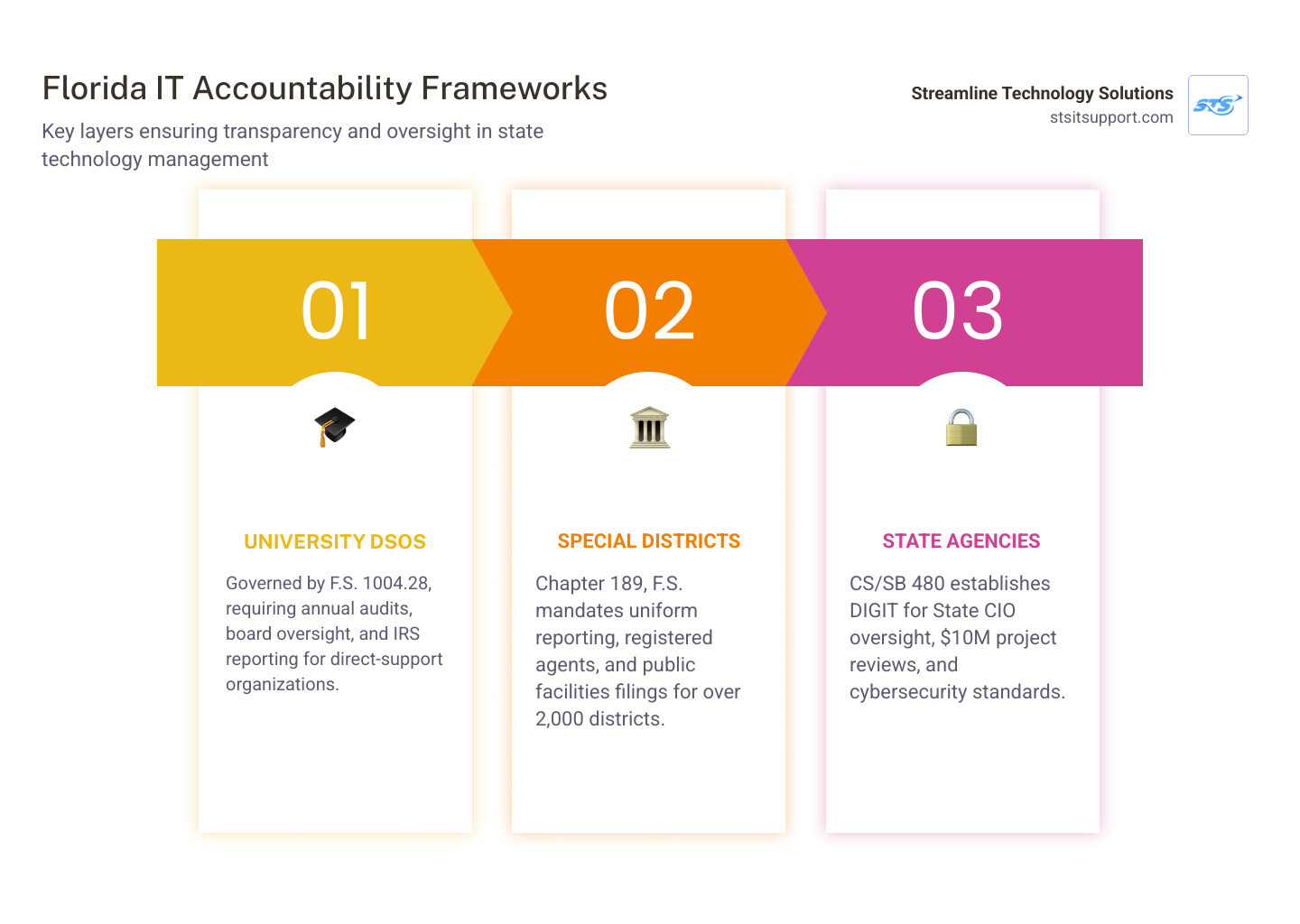
Here is a quick overview of the key frameworks:
Framework Who It Covers Core Requirement F.S. 1004.28 University Direct-Support Organizations Annual audits, board oversight, IRS reporting Chapter 189, F.S. 2,085+ Special Districts Uniform reporting, registered agents, public facilities filings CS/SB 480 (DIGIT) All State Agencies State CIO, $10M project oversight, cybersecurity standards One-UF IT Governance University of Florida Central CIO authority, distributed unit compliance Office of Chief Inspector General State Agencies & Local Government Audits, fraud detection, financial emergency oversight
Florida is not standing still on IT governance. A recent legislative bill — CS for SB 480 — proposed creating a new Division of Integrated Government Innovation and Technology (DIGIT) to centralize state IT oversight, set cybersecurity standards, and require project-level reporting for technology investments over $10 million.
For South Florida businesses, these public-sector standards set a clear benchmark: technology management requires clear ownership, transparent reporting, and proactive accountability — not just reactive fixes.
I'm Michael Gaigelas, and with over 20 years of experience in IT support, cloud infrastructure, VoIP, and managed services, I have seen how the principles behind direct IT accountability Florida frameworks apply just as powerfully to small and mid-sized businesses as they do to state agencies. In the sections below, we will break down each layer of Florida's IT accountability landscape and what it means in practice.
The Framework of Direct IT Accountability Florida Statutes
When we talk about direct IT accountability florida, we aren't just talking about a suggestion; we are talking about the law. Florida has built a robust legal framework to ensure that organizations receiving public support or providing essential services operate with total transparency.
Two major pillars of this framework are F.S. 1004.28 and Chapter 189. These statutes ensure that whether an organization is a university-affiliated nonprofit or a local special district, there is a "paper trail" for every dollar spent and every technology project initiated.
The Chapter 189, Florida Statutes - Uniform Special District Accountability Act serves as the rulebook for over 2,000 entities in the state. It defines how these districts must be created, how they must report their finances, and what happens if they fail to meet state standards. For us in South Florida, from Coral Springs to Fort Lauderdale, these rules ensure that the local districts managing our water, fire safety, or infrastructure are held to the same high standards as the state government in Tallahassee.
Defining University Direct-Support Organizations (DSOs)
A University Direct-Support Organization (DSO) is a Florida not-for-profit corporation organized and operated exclusively to receive, hold, invest, and administer property and to make expenditures to or for the benefit of a state university. Under F.S. 1004.28, these organizations must be certified by the university's Board of Trustees.
Accountability here is strict. The Board of Trustees must appoint representatives to the DSO’s board of directors, and the university president must monitor the DSO's activities to ensure they align with the university’s mission. This includes oversight of IT projects and research-informed practices. DSOs are even prohibited from giving gifts to political committees, ensuring that their focus remains on education and research rather than political maneuvering.
Oversight of Florida’s 2,000+ Special Districts
Florida currently has over 2,085 special districts. These are units of local government created for a very specific purpose—like the Bonaventure Development District or various community development districts in Boca Raton and Deerfield Beach.
Under the Special District Accountability Program, these entities must:
Maintain a registered agent and a registered office.
File public facilities reports that outline their infrastructure and expansion plans.
Pay an annual state fee to fund the oversight program.
Failure to comply isn't just a slap on the wrist. Noncompliant districts are listed on official state reports, which can impact their funding and legal standing. You can check specific deadlines using the Quick Schedule - Special District Public Facilities Reporting Due Dates to see how these entities stay on track.
State Oversight and the Role of the Chief Inspector General
If the statutes provide the rules, the Office of the Chief Inspector General (CIG) provides the enforcement. Created under Section 14.32 of the Florida Statutes, the CIG reports directly to the Governor. Their job is to promote accountability, integrity, and efficiency across state government.
The CIG doesn't just look for "mistakes"; they actively investigate fraud, waste, mismanagement, and misconduct. They also play a critical role in local government by handling notifications of "Financial Emergency Conditions." If a local entity in our service area—say, a municipality near Pompano Beach—meets the criteria for a financial emergency, the CIG is the one who determines if state assistance is necessary.
Monitoring Agency Performance and Quality
Accountability also extends to the quality of services provided. For example, the Office of Accountability and Program Support (OAPS) within the Department of Juvenile Justice (DJJ) monitors approximately $320 million in annual contracting activities.
They ensure that programs are not just "running," but are actually effective. This involves:
Contract Administration: Ensuring providers meet their legal obligations.
Quality Improvement: Using data to refine how youth services are delivered.
Risk Management: Conducting safety inspections and audits.
By maintaining high standards for IT resources and program fidelity, the OAPS ensures that state funds are used to achieve real, measurable outcomes.
Modernizing Governance: DIGIT and Direct IT Accountability Florida Standards
The most exciting (and rigorous) change in direct IT accountability florida is the proposed creation of DIGIT—the Division of Integrated Government Innovation and Technology. This legislative framework (CS/SB 480) aims to centralize IT governance under a single State Chief Information Officer (CIO).
DIGIT is designed to tackle "technical debt"—the cost of maintaining aging, inefficient systems—by requiring agencies to conduct baseline needs assessments. This isn't just about buying new computers; it’s about aligning Florida's technology with world-class standards like the NIST Cybersecurity Framework and ISO 27001.
Key features of the DIGIT framework include:
Project Oversight: Any IT project with a cost over $10 million (or $20 million for Cabinet departments) gets direct oversight from DIGIT.
Phased Roadmaps: Agencies must show exactly how they will modernize their systems over time.
Market Analysis: Every three years, the state will analyze the market to ensure they are getting the best value for IT resources.
The Role of State-Level IT Directors
While DIGIT oversees the "big picture," individual IT Directors handle the daily grind of accountability. Whether it's the CIO of the Office of Legislative Information Technology Services (OLITS) managing 140+ WINTEL servers or a local IT Director in a city like Coral Springs, these roles are the front lines of governance.
These directors are responsible for strategic planning, budgeting, and ensuring that their systems are secure. They often serve as senior policy advisors, bridging the gap between technical needs and legislative or municipal goals. You can see the complexity of these roles by looking at the Online Sunshine Legislative IT Roles, which require a deep understanding of both technology and Florida law.
Reporting and Noncompliance in Direct IT Accountability Florida
Accountability is only as good as the reporting that backs it up. In Florida, DSOs and Special Districts have strict windows for transparency.
Requirement University DSOs Special Districts Audit Frequency Annual by independent CPA Annual (if over certain revenue) Submission Deadline Within 9 months of fiscal year-end Varies by county/municipality Primary Oversight Board of Trustees & Auditor General Dept. of Commerce & Auditor General Public Records Mostly public (with donor exemptions) Fully public
If an organization falls into "noncompliance status," the consequences can range from fines to the loss of state funding. This ensures that direct IT accountability florida is more than just a buzzword—it's a requirement for survival in the public sector.
Performance-Based Funding and Institutional IT Metrics
In Florida’s State University System, which serves over 431,000 students across 12 universities, accountability is tied directly to the wallet through Performance-Based Funding (PBF).
The Board of Governors uses a 10-metric model to evaluate universities. Metric 10 is particularly interesting because it allows the Board of Trustees to choose a metric that reflects the university's specific goals. This might include:
Professional Licensure Exam Pass Rates.
Total Research Expenditures.
Shared Initiatives Savings (often driven by IT efficiencies).
By linking funding to these metrics, Florida ensures that universities are constantly innovating. You can follow the latest updates on these achievements through X The State University System of Florida.
One-UF IT Governance Model
The University of Florida (UF) provides an excellent case study in how to balance centralized authority with local flexibility. Their "One-UF" model gives the UF CIO the authority to direct architecture and security across the entire university.
However, individual colleges and units (like UF Health) maintain "distributed autonomy." They can manage their own local IT needs as long as they comply with the university-wide security and architecture policies. This dual-reporting structure ensures that while the "boots on the ground" can move fast, the central office ensures the entire system is secure and efficient. This framework is detailed in the One-UF IT Governance Policy.
Implementing Direct IT Accountability Florida Best Practices
At Streamline Technology Solutions, we believe that the standards Florida sets for its government agencies are the same standards every business in South Florida should demand. Whether you are in Boca Raton or Ft. Lauderdale, you deserve an IT partner that takes direct IT accountability florida seriously.
We provide IT support services that go beyond just fixing broken computers. We focus on:
Infrastructure Stability: Ensuring your servers and networks are built on solid, documented foundations.
Proactive Prevention: Using monitoring tools to stop problems before they cause downtime.
Transparent Pricing: No hidden fees, no "surprise" invoices. Just clear, honest service.
Why Businesses Seek Direct IT Accountability Florida Providers
Most IT companies operate on a "ticket-based" mindset. You call, they fix it, they leave. But if the same issue keeps happening, that’s not a technical failure—it’s an accountability failure.
We focus on:
Clear Ownership: Every issue has a name attached to it. No passing the buck.
Ticket Trends: We look at the data. If we see three workstations in your Deerfield Beach office having the same issue, we find the root cause.
Escalation Structures: If a problem is complex, it gets moved to a senior engineer immediately, not after three days of silence.
Our Support Center is designed to provide this level of direct responsibility to every client we serve.
Frequently Asked Questions about Florida IT Accountability
What is the purpose of F.S. 1004.28 regarding DSOs?
The purpose of F.S. 1004.28 is to ensure that university-affiliated nonprofits (DSOs) operate transparently and in the best interest of the university. It mandates annual audits, Board of Trustee oversight, and strict rules on how university property and funds can be used.
How does the Special District Accountability Program enforce compliance?
The program enforces compliance by maintaining an "Official List of Special Districts." Districts that fail to file financial reports, pay their fees, or maintain a registered agent are marked as noncompliant. This status is reported to the Auditor General and can lead to the dissolution of the district or the withholding of state funds.
What are the new requirements under the DIGIT legislative framework?
Under the DIGIT framework (CS/SB 480), state agencies must appoint a State CIO, conduct baseline needs assessments to identify "technical debt," and adhere to centralized cybersecurity standards. Additionally, any IT project exceeding $10 million is subject to quarterly status reporting and strict oversight to prevent waste.
Conclusion
The landscape of direct IT accountability florida is complex, but the underlying message is simple: transparency and responsibility are non-negotiable. From the rigorous audits of University DSOs to the centralized oversight of the proposed DIGIT division, Florida is leading the way in modernizing how the public sector manages technology.
At Streamline Technology Solutions, we bring that same spirit of governance and transparency to the private sector. We don't believe in "black box" IT where you don't know what you're paying for or who is responsible when things go wrong. We offer fast, local support with the direct accountability your business needs to thrive.
Ready to see the difference that real accountability makes? Schedule Appointment with us today and let’s get your technology running the way it should.