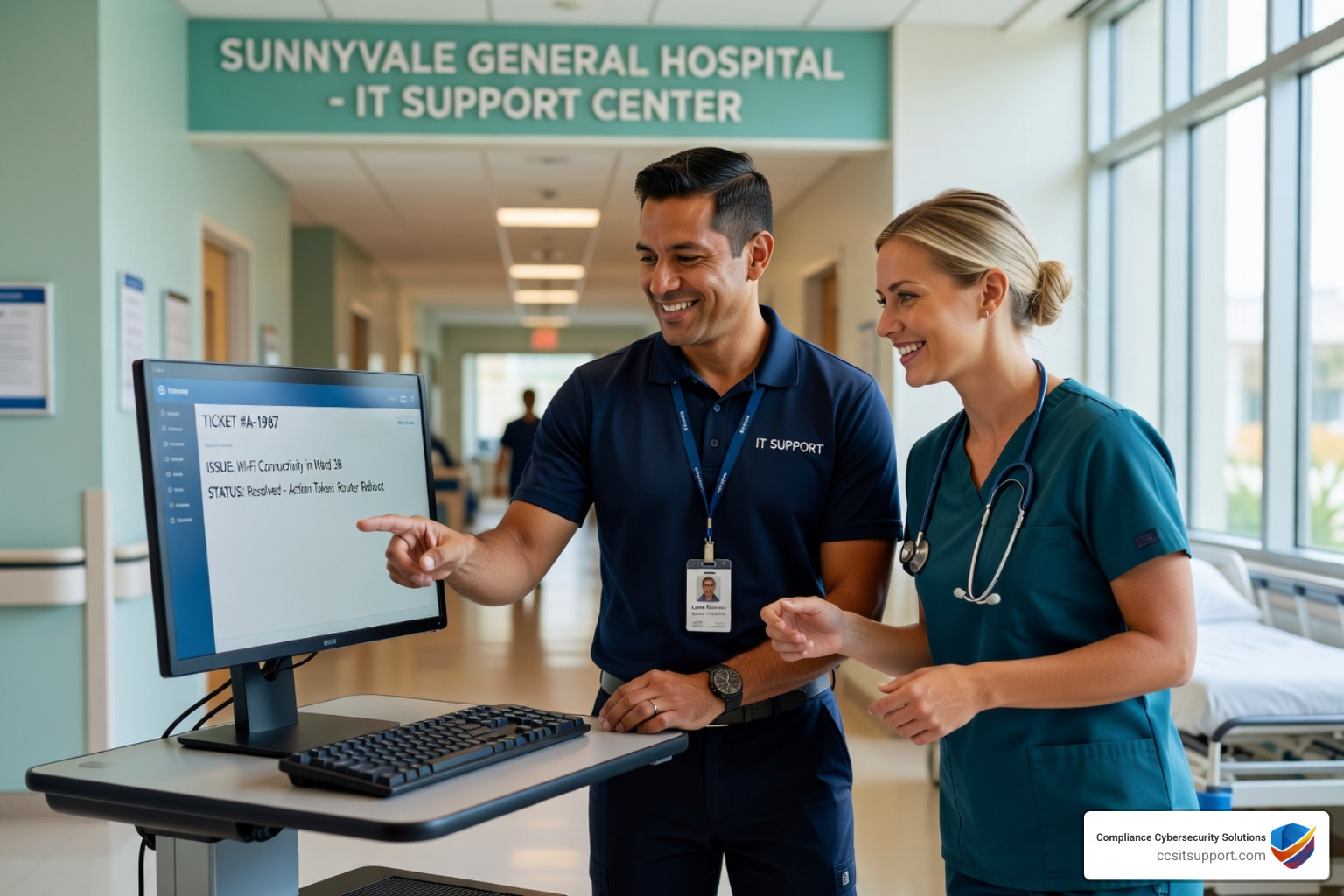
Healthcare IT Helpdesk Services That Keep Your Patient Data Safe
Why Healthcare IT Helpdesk Services Are Critical for Patient Safety and Operations
Healthcare IT helpdesk services are specialized technical support solutions designed to keep clinical systems running, protect patient data, and ensure compliance with regulations like HIPAA — 24 hours a day, 7 days a week.
Here's a quick look at what they cover:
What You Need What Healthcare IT Helpdesk Services Provide System uptime 99.95%–99.99% medical application availability Data security HIPAA-aligned controls, BAA agreements, ePHI protection Clinical support EHR/EMR, PACS, imaging, and telehealth troubleshooting User support Multi-channel help desk for clinicians, staff, and patients Emergency response 24/7 monitoring with rapid incident escalation Compliance Audit-ready documentation and regulatory alignment
Running a healthcare practice today means your technology never gets a day off. EHR systems go down. Ransomware attacks happen. Patients can't access their portals. And every minute of downtime isn't just an IT problem — it's a patient care problem.
The stakes are high. Over a ten-year period ending in 2018, roughly 59% of the U.S. population had their medical data compromised due to hacking at a facility where they were treated. That's not a technology statistic — that's a public health issue.
Most general IT support teams aren't built for this environment. Healthcare requires a different level of expertise, urgency, and accountability.
I'm Michael Gaigelas II, and through my work at Compliance Cybersecurity Solutions I've helped healthcare organizations navigate exactly these challenges — from building HIPAA-compliant healthcare IT helpdesk services to implementing Zero Trust security frameworks that protect sensitive patient data without slowing down clinical workflows. In the sections ahead, I'll break down everything you need to know to get this right.
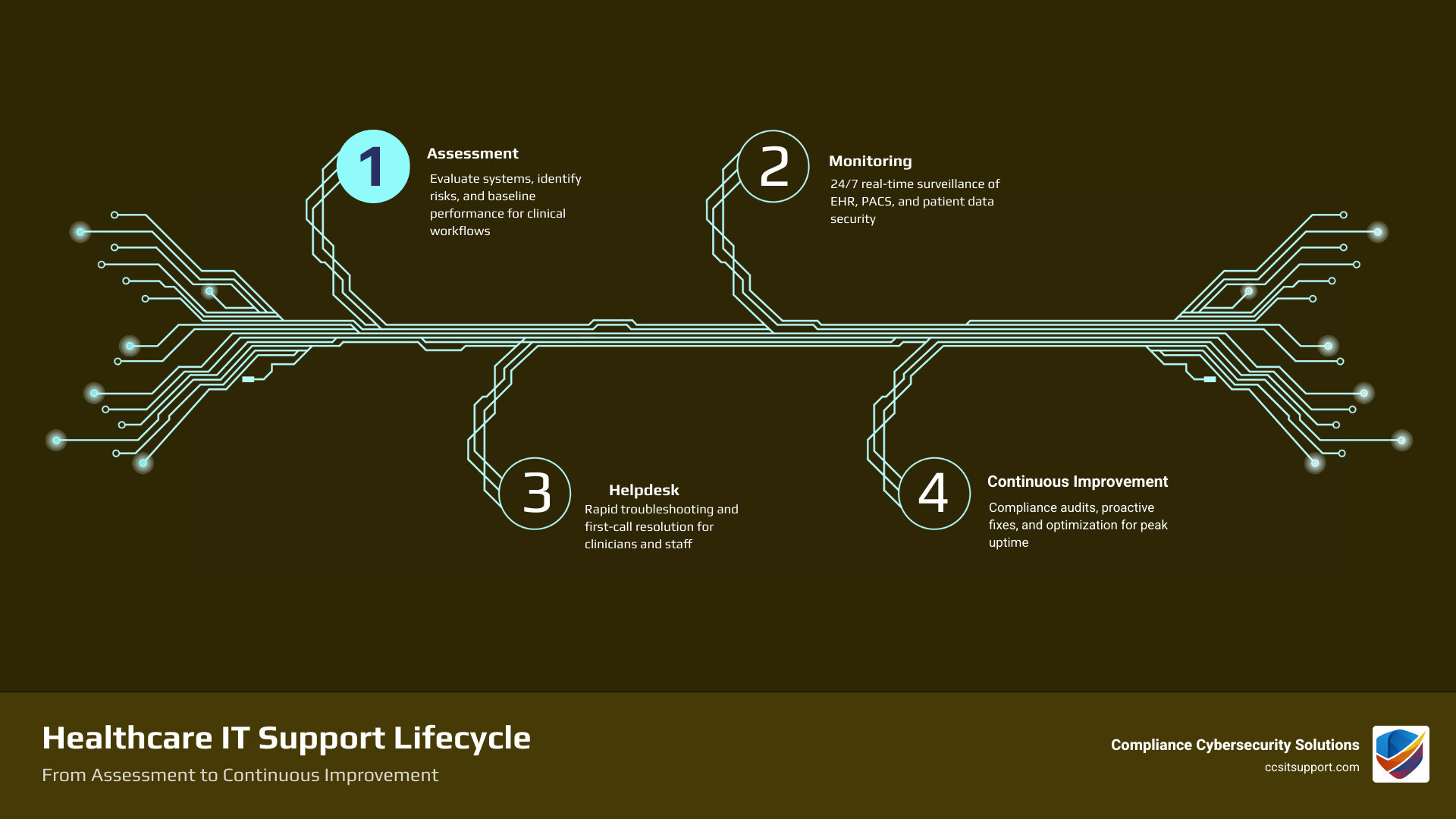
The Strategic Value of Healthcare IT Helpdesk Services
In IT, "one size fits all" usually fits no one—especially not doctors. When a printer jams in a law firm, it’s an annoyance. When an EHR system freezes during a surgical consultation, it’s a crisis. This is why specialized healthcare IT helpdesk services are a strategic necessity rather than a luxury.
General IT vs. Healthcare IT: What’s the Difference?
General IT support focuses on keeping "the boxes and wires" working. Healthcare IT support focuses on keeping "the care" moving. Here is how they stack up:
Feature General IT Support Healthcare IT Helpdesk Services Primary Goal Business continuity Patient safety and clinical uptime Compliance General (SOC2, GDPR) Strict (HIPAA, HITECH, Florida Statutes) Software Focus Office 365, CRM, Accounting EHR/EMR, PACS, DICOM, Patient Portals Availability Often 9-to-5 Typically 24/7/365 Urgency Ticket-based queue Immediate clinical triage
Boosting Clinician Productivity
When technology works, clinicians can focus on patients. It sounds simple, but the data proves it. Research shows that specialized IT support can lead to a 5% productivity boost for nurses and physicians. This happens because they spend less time wrestling with login errors and more time in the exam room.
By achieving 99.95% to 99.99% application availability, we ensure that the tools doctors rely on are ready when they are. If you want to dive deeper into how we structure these environments, check out our Support Center.
Reducing Downtime and Improving Satisfaction
Downtime is the enemy of the modern medical practice. Beyond the lost revenue, it erodes patient trust. Specialized helpdesks use proactive monitoring to catch a failing server or a network bottleneck before the clinic opens its doors.
The result? Over 90% physician and patient satisfaction rates. When issues are resolved quickly—or prevented entirely—the entire healthcare experience improves.
One of our clients recently shared their experience, noting that a partnership with a dedicated IT group provided "top-notch service and seamless installations" that significantly enhanced their infrastructure. That is the kind of stability every Florida practice deserves.
Core Components of a Modern Clinical Service Desk
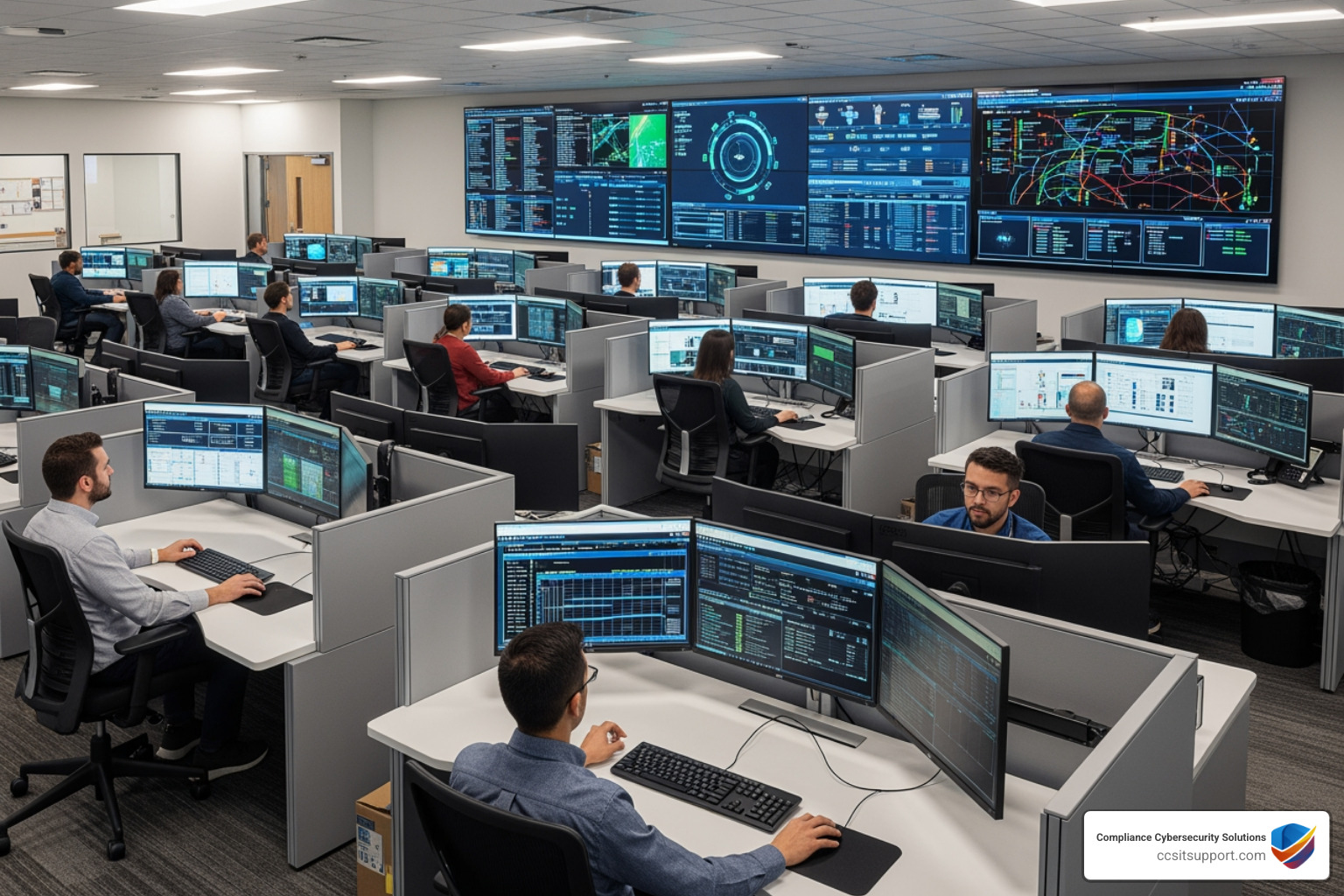
A modern clinical service desk isn't just a phone number you call when your mouse stops working. It is a high-tech nerve center that understands the unique pulse of a medical facility. At CCS, we emphasize that managed IT support for healthcare must be built from the ground up to handle clinical workflows.
Supporting Critical Systems: EHR, PACS, and Imaging
The Electronic Health Record (EHR) is the heart of your practice. Whether you use Epic, eClinicalWorks, or a specialized platform, your helpdesk must understand how these systems integrate with your local network.
EMR Integration: Ensuring that patient data flows correctly between different modules.
PACS and Imaging: Troubleshooting high-resolution imaging systems (PACS) that require massive bandwidth and specialized performance tuning.
Workflow Optimization: Helping staff use software more efficiently to reduce "click fatigue."
Medical Device Connectivity: Managing the Internet of Medical Things (IoMT), from vitals monitors to smart infusion pumps.
For more technical deep dives on these systems, you can browse our Resources.
Patient Portal Support and User Experience
In the age of digital health, your patients are also your "users." If a patient can't log in to see their lab results or schedule an appointment, they call your front desk. A specialized helpdesk can take that burden off your staff.
First-Call Resolution: Resolving patient portal issues on the first try so they don't have to call back.
Caregiver Access: Helping families manage permissions for elderly or minor patients.
Persona-Based Support: Recognizing that a doctor needing a password reset is a different priority level than a back-office billing clerk.
Multi-Channel Communication: Offering support via phone, secure chat, email, and self-service portals.
By providing this level of care, you aren't just fixing a computer; you are improving the patient experience. We tailor these solutions for Florida-based providers to ensure they meet the highest standards of clinical efficiency.
Ensuring HIPAA Compliance and Data Security
If there is one thing that keeps healthcare administrators up at night, it’s the word "breach." As mentioned earlier, with a 59% breach rate affecting the U.S. population over a decade, security cannot be an afterthought. For organizations that want a plain-language overview of the law behind these requirements, the HIPAA framework is a useful reference point alongside your legal and compliance guidance.
The BAA and ePHI Protection
Any IT provider you work with must sign a Business Associate Agreement (BAA). This is a legal requirement under HIPAA that ensures the provider assumes responsibility for protecting Electronic Protected Health Information (ePHI). At CCS, we treat Compliance as the foundation of every ticket we close.
Layered Security and NIST Controls
A helpdesk should be your first line of defense. When a staff member calls about a suspicious email, a HIPAA-trained technician knows exactly how to handle a potential phishing attempt.
We utilize a "Layered Security" approach, which includes:
Endpoint Protection: Monitoring every laptop and tablet for malware.
Access Control: Ensuring only authorized personnel can touch sensitive data.
Threat Detection: Using AI-driven tools to spot unusual network behavior in real-time.
NIST Alignment: Following the gold standard of cybersecurity frameworks to ensure your practice is audit-ready.
To see how we defend against modern threats, read more about our approach to Cybersecurity.
Future Trends in Healthcare IT Helpdesk Services
The world of healthcare technology is moving fast. We are shifting away from "break-fix" models toward "predict-and-prevent" models. Our About Us page highlights our commitment to staying ahead of these technological shifts.
AI and Automation in Healthcare IT Helpdesk Services
Artificial Intelligence isn't just a buzzword; it’s a tool that makes healthcare IT helpdesk services faster and more accurate.
Robotic Process Automation (RPA): Automating repetitive tasks like password resets or account provisioning.
Ticket Triage: AI can analyze a support request and automatically route it to the technician best suited for that specific EHR or medical device.
Predictive Analytics: Identifying "ticket trends." If five people in the same clinic report a slow connection, AI flags a potential network outage before the sixth person calls.
Automated Patching: Ensuring all medical software is updated with the latest security patches without human intervention, reducing the "window of vulnerability."
Key Criteria for Selecting Healthcare IT Helpdesk Services
If you are looking for a partner in Florida, don't settle for a generic call center. Here is what you should look for:
U.S.-Based Support: Communication is critical in high-stress clinical situations.
HIPAA-Secure Facilities: Your IT provider should practice what they preach, with redundant power and secure data centers.
Scalable Plans: Your IT costs should grow (or shrink) with your practice.
Predictable Pricing: Look for volume-based or per-provider models so there are no surprises at the end of the month.
Disaster Recovery: They must have a proven plan to get you back online after a hurricane or a cyberattack.
Frequently Asked Questions
How do healthcare IT helpdesks differ from general IT support?
Healthcare helpdesks are staffed by technicians trained in HIPAA compliance and clinical workflows. They understand the urgency of patient care and are familiar with specialized software like EHRs and PACS, which general IT teams rarely encounter.
What are the common pricing models for these services?
Most providers use one of three models:
Per-User/Per-Month: A flat fee for every staff member supported.
Per-Device: Useful for clinics with many shared workstations.
Tiered/Volume-Based: A scalable model where you pay based on the complexity and hours of support required.
How is emergency response handled during a disaster?
A high-quality healthcare IT provider has geographically redundant service centers. If a hurricane hits Florida, your support should seamlessly transition to a center in another state. They also maintain off-site, encrypted backups to ensure your patient data can be restored quickly after a hardware failure or ransomware event.
Conclusion
At the end of the day, healthcare IT helpdesk services are about more than just fixing computers—they are about protecting the people who provide care and the patients who receive it.
At Compliance Cybersecurity Solutions (CCS), based right here in Fort Lauderdale, we specialize in aligning your IT infrastructure with the strictest standards, including HIPAA and CMMC. We don't just close tickets; we build a fortress around your data using layered security and proactive threat detection.
Don't wait for a system failure to realize your IT support isn't up to the task. Secure your practice today and give your clinicians the reliable, compliant technology they need to focus on what matters most: saving lives.

How Can We Help?
Call us at (954) 368-0648 or fill out the form below.
Featured Posts
Healthcare IT Helpdesk Services That Keep Your Patient Data Safe
Why Healthcare IT Helpdesk Services Are Critical for Patient Safety and Operations
Healthcare IT helpdesk services are specialized technical support solutions designed to keep clinical systems running, protect patient data, and ensure compliance with regulations like HIPAA — 24 hours a day, 7 days a week.
Here's a quick look at what they cover:
What You Need What Healthcare IT Helpdesk Services Provide System uptime 99.95%–99.99% medical application availability Data security HIPAA-aligned controls, BAA agreements, ePHI protection Clinical support EHR/EMR, PACS, imaging, and telehealth troubleshooting User support Multi-channel help desk for clinicians, staff, and patients Emergency response 24/7 monitoring with rapid incident escalation Compliance Audit-ready documentation and regulatory alignment
Running a healthcare practice today means your technology never gets a day off. EHR systems go down. Ransomware attacks happen. Patients can't access their portals. And every minute of downtime isn't just an IT problem — it's a patient care problem.
The stakes are high. Over a ten-year period ending in 2018, roughly 59% of the U.S. population had their medical data compromised due to hacking at a facility where they were treated. That's not a technology statistic — that's a public health issue.
Most general IT support teams aren't built for this environment. Healthcare requires a different level of expertise, urgency, and accountability.
I'm Michael Gaigelas II, and through my work at Compliance Cybersecurity Solutions I've helped healthcare organizations navigate exactly these challenges — from building HIPAA-compliant healthcare IT helpdesk services to implementing Zero Trust security frameworks that protect sensitive patient data without slowing down clinical workflows. In the sections ahead, I'll break down everything you need to know to get this right.
The Strategic Value of Healthcare IT Helpdesk Services
In IT, "one size fits all" usually fits no one—especially not doctors. When a printer jams in a law firm, it’s an annoyance. When an EHR system freezes during a surgical consultation, it’s a crisis. This is why specialized healthcare IT helpdesk services are a strategic necessity rather than a luxury.
General IT vs. Healthcare IT: What’s the Difference?
General IT support focuses on keeping "the boxes and wires" working. Healthcare IT support focuses on keeping "the care" moving. Here is how they stack up:
Feature General IT Support Healthcare IT Helpdesk Services Primary Goal Business continuity Patient safety and clinical uptime Compliance General (SOC2, GDPR) Strict (HIPAA, HITECH, Florida Statutes) Software Focus Office 365, CRM, Accounting EHR/EMR, PACS, DICOM, Patient Portals Availability Often 9-to-5 Typically 24/7/365 Urgency Ticket-based queue Immediate clinical triage
Boosting Clinician Productivity
When technology works, clinicians can focus on patients. It sounds simple, but the data proves it. Research shows that specialized IT support can lead to a 5% productivity boost for nurses and physicians. This happens because they spend less time wrestling with login errors and more time in the exam room.
By achieving 99.95% to 99.99% application availability, we ensure that the tools doctors rely on are ready when they are. If you want to dive deeper into how we structure these environments, check out our Support Center.
Reducing Downtime and Improving Satisfaction
Downtime is the enemy of the modern medical practice. Beyond the lost revenue, it erodes patient trust. Specialized helpdesks use proactive monitoring to catch a failing server or a network bottleneck before the clinic opens its doors.
The result? Over 90% physician and patient satisfaction rates. When issues are resolved quickly—or prevented entirely—the entire healthcare experience improves.
One of our clients recently shared their experience, noting that a partnership with a dedicated IT group provided "top-notch service and seamless installations" that significantly enhanced their infrastructure. That is the kind of stability every Florida practice deserves.
Core Components of a Modern Clinical Service Desk
A modern clinical service desk isn't just a phone number you call when your mouse stops working. It is a high-tech nerve center that understands the unique pulse of a medical facility. At CCS, we emphasize that managed IT support for healthcare must be built from the ground up to handle clinical workflows.
Supporting Critical Systems: EHR, PACS, and Imaging
The Electronic Health Record (EHR) is the heart of your practice. Whether you use Epic, eClinicalWorks, or a specialized platform, your helpdesk must understand how these systems integrate with your local network.
EMR Integration: Ensuring that patient data flows correctly between different modules.
PACS and Imaging: Troubleshooting high-resolution imaging systems (PACS) that require massive bandwidth and specialized performance tuning.
Workflow Optimization: Helping staff use software more efficiently to reduce "click fatigue."
Medical Device Connectivity: Managing the Internet of Medical Things (IoMT), from vitals monitors to smart infusion pumps.
For more technical deep dives on these systems, you can browse our Resources.
Patient Portal Support and User Experience
In the age of digital health, your patients are also your "users." If a patient can't log in to see their lab results or schedule an appointment, they call your front desk. A specialized helpdesk can take that burden off your staff.
First-Call Resolution: Resolving patient portal issues on the first try so they don't have to call back.
Caregiver Access: Helping families manage permissions for elderly or minor patients.
Persona-Based Support: Recognizing that a doctor needing a password reset is a different priority level than a back-office billing clerk.
Multi-Channel Communication: Offering support via phone, secure chat, email, and self-service portals.
By providing this level of care, you aren't just fixing a computer; you are improving the patient experience. We tailor these solutions for Florida-based providers to ensure they meet the highest standards of clinical efficiency.
Ensuring HIPAA Compliance and Data Security
If there is one thing that keeps healthcare administrators up at night, it’s the word "breach." As mentioned earlier, with a 59% breach rate affecting the U.S. population over a decade, security cannot be an afterthought. For organizations that want a plain-language overview of the law behind these requirements, the HIPAA framework is a useful reference point alongside your legal and compliance guidance.
The BAA and ePHI Protection
Any IT provider you work with must sign a Business Associate Agreement (BAA). This is a legal requirement under HIPAA that ensures the provider assumes responsibility for protecting Electronic Protected Health Information (ePHI). At CCS, we treat Compliance as the foundation of every ticket we close.
Layered Security and NIST Controls
A helpdesk should be your first line of defense. When a staff member calls about a suspicious email, a HIPAA-trained technician knows exactly how to handle a potential phishing attempt.
We utilize a "Layered Security" approach, which includes:
Endpoint Protection: Monitoring every laptop and tablet for malware.
Access Control: Ensuring only authorized personnel can touch sensitive data.
Threat Detection: Using AI-driven tools to spot unusual network behavior in real-time.
NIST Alignment: Following the gold standard of cybersecurity frameworks to ensure your practice is audit-ready.
To see how we defend against modern threats, read more about our approach to Cybersecurity.
Future Trends in Healthcare IT Helpdesk Services
The world of healthcare technology is moving fast. We are shifting away from "break-fix" models toward "predict-and-prevent" models. Our About Us page highlights our commitment to staying ahead of these technological shifts.
AI and Automation in Healthcare IT Helpdesk Services
Artificial Intelligence isn't just a buzzword; it’s a tool that makes healthcare IT helpdesk services faster and more accurate.
Robotic Process Automation (RPA): Automating repetitive tasks like password resets or account provisioning.
Ticket Triage: AI can analyze a support request and automatically route it to the technician best suited for that specific EHR or medical device.
Predictive Analytics: Identifying "ticket trends." If five people in the same clinic report a slow connection, AI flags a potential network outage before the sixth person calls.
Automated Patching: Ensuring all medical software is updated with the latest security patches without human intervention, reducing the "window of vulnerability."
Key Criteria for Selecting Healthcare IT Helpdesk Services
If you are looking for a partner in Florida, don't settle for a generic call center. Here is what you should look for:
U.S.-Based Support: Communication is critical in high-stress clinical situations.
HIPAA-Secure Facilities: Your IT provider should practice what they preach, with redundant power and secure data centers.
Scalable Plans: Your IT costs should grow (or shrink) with your practice.
Predictable Pricing: Look for volume-based or per-provider models so there are no surprises at the end of the month.
Disaster Recovery: They must have a proven plan to get you back online after a hurricane or a cyberattack.
Frequently Asked Questions
How do healthcare IT helpdesks differ from general IT support?
Healthcare helpdesks are staffed by technicians trained in HIPAA compliance and clinical workflows. They understand the urgency of patient care and are familiar with specialized software like EHRs and PACS, which general IT teams rarely encounter.
What are the common pricing models for these services?
Most providers use one of three models:
Per-User/Per-Month: A flat fee for every staff member supported.
Per-Device: Useful for clinics with many shared workstations.
Tiered/Volume-Based: A scalable model where you pay based on the complexity and hours of support required.
How is emergency response handled during a disaster?
A high-quality healthcare IT provider has geographically redundant service centers. If a hurricane hits Florida, your support should seamlessly transition to a center in another state. They also maintain off-site, encrypted backups to ensure your patient data can be restored quickly after a hardware failure or ransomware event.
Conclusion
At the end of the day, healthcare IT helpdesk services are about more than just fixing computers—they are about protecting the people who provide care and the patients who receive it.
At Compliance Cybersecurity Solutions (CCS), based right here in Fort Lauderdale, we specialize in aligning your IT infrastructure with the strictest standards, including HIPAA and CMMC. We don't just close tickets; we build a fortress around your data using layered security and proactive threat detection.
Don't wait for a system failure to realize your IT support isn't up to the task. Secure your practice today and give your clinicians the reliable, compliant technology they need to focus on what matters most: saving lives.