
Catching the Bad Guys with Intrusion Detection Services
Understanding the Network Intrusion Detection System (NIDS)
When we talk about a network intrusion detection system, we are describing a sophisticated "digital lookout." Unlike a firewall, which acts as a gatekeeper deciding who gets in or out based on a set of pre-defined rules, a NIDS sits inside the network and watches the actual behavior of the traffic. It is a passive observer, meaning it doesn't usually sit directly in the path of the data where it could slow things down. Instead, it looks at a copy of the traffic.

This process involves "packet sniffing," where the system captures data packets as they travel across the wire. By performing deep traffic analysis, the NIDS can identify patterns that shouldn't be there. For example, if a workstation that usually only sends emails suddenly starts trying to connect to every other computer in the office at 3:00 AM, the NIDS flags this as a potential "port scan" or signs of a spreading virus.
At Compliance Cybersecurity Solutions, we emphasize that a NIDS provides two critical types of visibility:
North-South Traffic: This is traffic entering or leaving your network (e.g., from the internet to your internal server).
East-West Visibility: This is traffic moving between devices inside your network. This is where many data breaches are caught, as attackers often try to move laterally once they gain an initial foothold.
By providing real-time alerting mechanisms, a NIDS ensures that your team knows about a threat the moment it is detected, which is a core requirement of modern Cybersecurity strategies.
Core Components of a Network Intrusion Detection System
To understand how these systems work, it helps to look under the hood. A standard NIDS isn't just one piece of software; it’s a coordinated team of components:
Sensor Nodes: These are the "eyes" placed at strategic points in your network to collect traffic.
Management Server: The "brain" that correlates data from all the sensors.
Database: A storage area for signatures (known threat patterns) and logs of past events.
Console Interface: The dashboard where your IT team views alerts and manages the system.
One of the most famous examples of this architecture is Snort - Network Intrusion Detection & Prevention System, which has become a global standard for how these components interact to protect data.
NIDS vs. Host-based Intrusion Detection (HIDS)
We often get asked if a NIDS is all an organization needs. The truth is, the best defense is layered. While a NIDS watches the "pipes" (the network), a Host-based Intrusion Detection System (HIDS) watches the "rooms" (the individual computers or endpoints).
Feature Network-based (NIDS) Host-based (HIDS) Scope Entire network segment Single device/endpoint Visibility Network traffic and protocols System logs and file integrity Detection Packet-level threats (DoS, scans) Unauthorized file changes, local logins Performance Impact Negligible (passive) Uses local CPU/RAM Encryption Harder to see inside encrypted packets Can see data after it is decrypted on the host
For regulated industries, using both is often necessary to meet strict Compliance standards.
Detection Mechanisms: Signatures, Anomalies, and Hybrids
How does a network intrusion detection system actually "know" that a packet is malicious? It generally uses two main methods, often combining them into a "hybrid" approach.
Signature-Based Detection
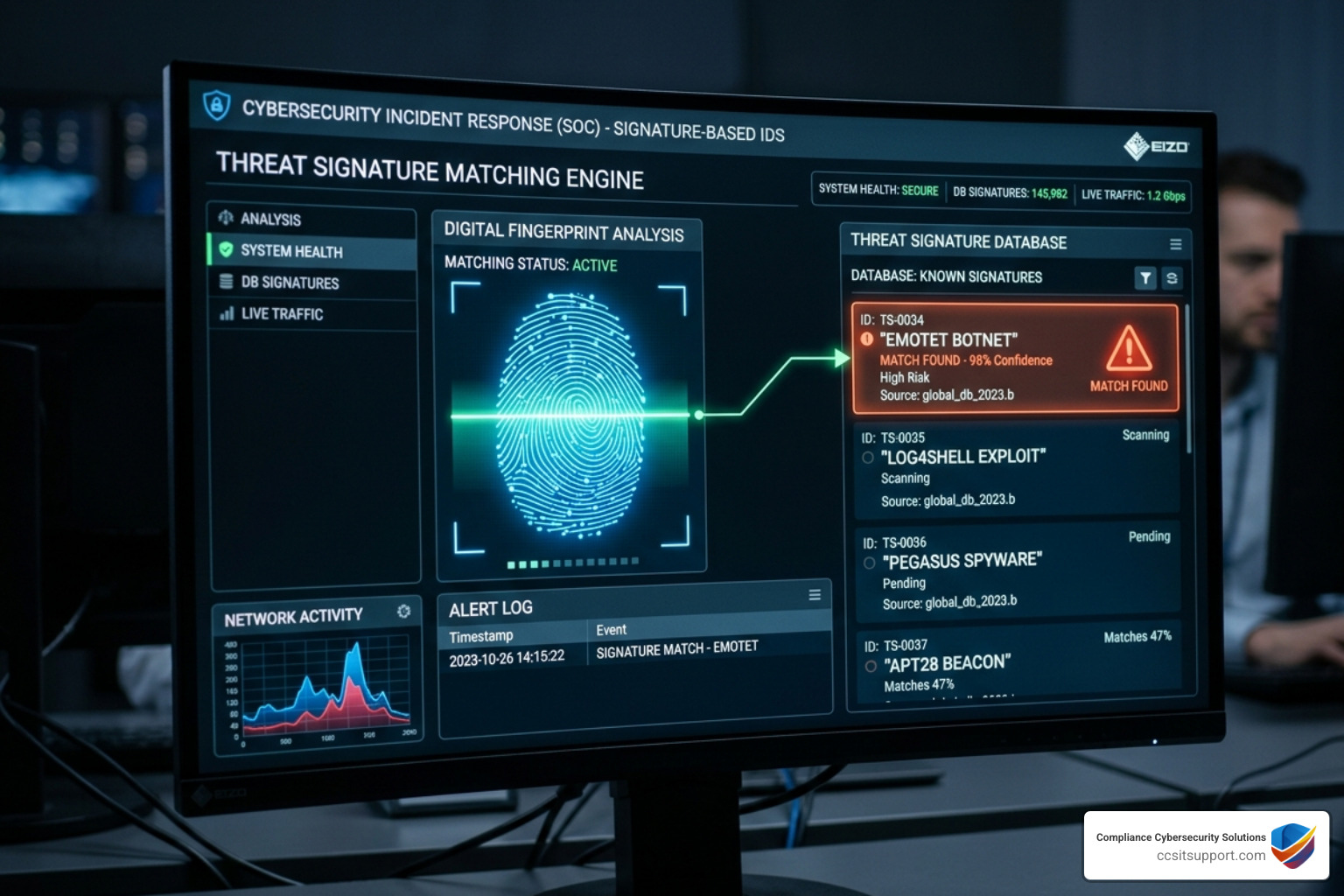
This is the most common method. Think of it like a "Most Wanted" poster. The NIDS has a database of "signatures"—specific patterns of data known to belong to malware or exploit attempts. When it sees a match, it rings the alarm.
This method is excellent because it has very low false positives; if the signature matches, you almost certainly have a problem. Organizations like Cisco Talos constantly update these databases to keep up with new threats. You can even find specialized rule sets through resources like Snort - Network Intrusion Detection & Prevention System to ensure your "Most Wanted" list is always current.
Anomaly-Based Detection and Machine Learning
What happens if a hacker uses a brand-new "zero-day" attack that doesn't have a signature yet? This is where anomaly-based detection shines. Instead of looking for known bad patterns, it learns what "normal" looks like for your specific network.
By establishing behavioral baselines using machine learning, the system can flag statistical deviations. If your accounting department suddenly starts uploading 50GB of data to an unknown server in another country, the NIDS doesn't need a signature to know that’s suspicious. This proactive approach is often referred to as Network Detection and Response (NDR).
Deployment Strategies for a Network Intrusion Detection System
Placement is everything. If you put your sensors in the wrong spot, you’ll be blind to half your traffic.
Out-of-Band vs. Inline
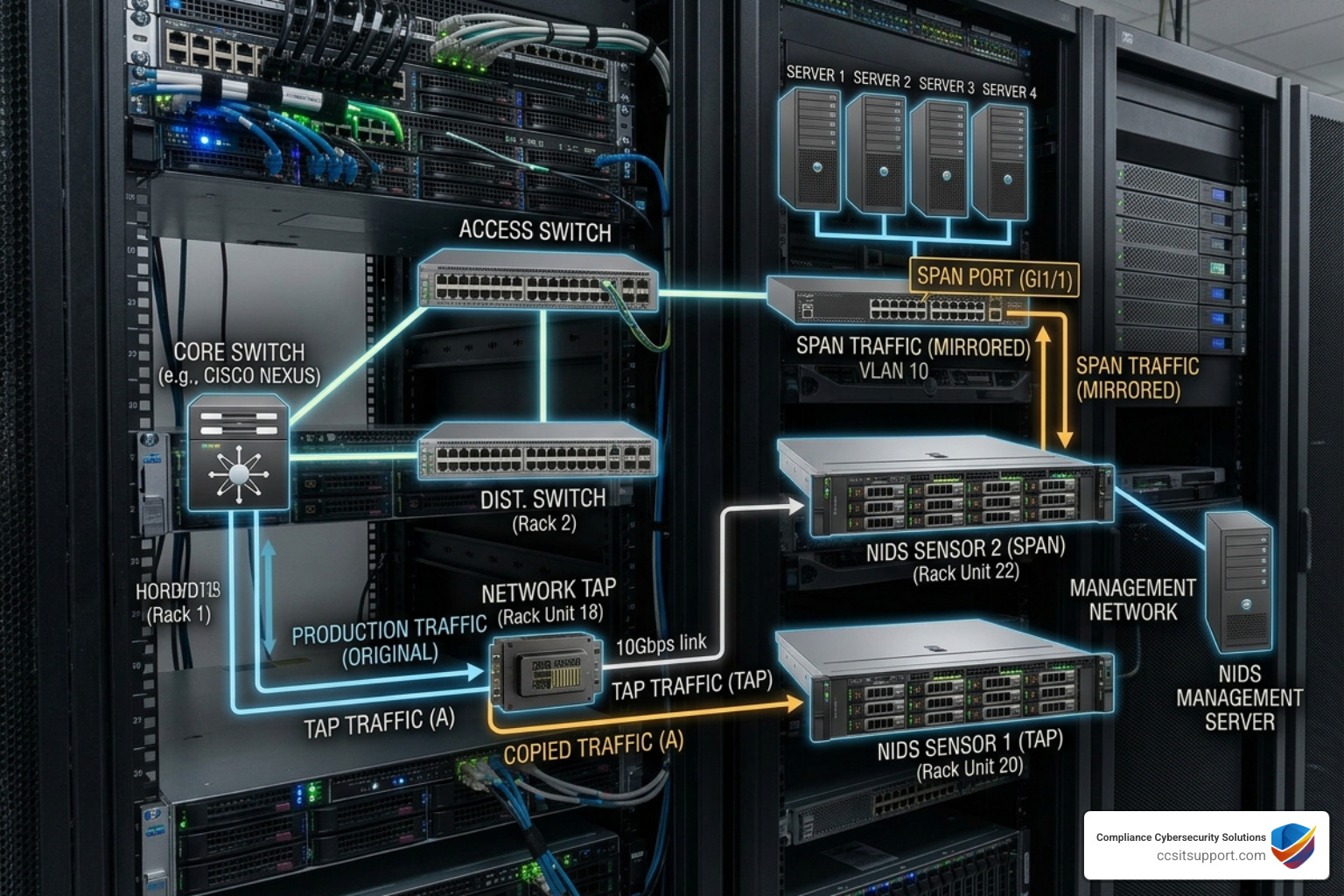
Most NIDS are deployed "out-of-band." This means the system sits off to the side. We use a TAP (Test Access Point) or a SPAN port (Switch Port Analyzer) to mirror all the network traffic and send a copy to the NIDS. This ensures that even if the NIDS is busy processing a heavy load, your actual network speed isn't affected.
In contrast, some systems are deployed "inline," meaning the traffic must pass through them. This is more common for Intrusion Prevention Systems (IPS), which need the ability to drop a packet instantly if it’s dangerous. For many of our clients in Florida, we look at SECURITY SYSTEMS - Advanced Network Services of Florida to help determine the best physical deployment strategy for their specific office layouts.
Overcoming Evasion Tactics in a Network Intrusion Detection System
Attackers aren't' sitting still; they use "evasion tactics" to try and slip past the NIDS. Common tactics include:
Packet Fragmentation: Breaking a malicious command into tiny pieces so the NIDS doesn't recognize the full pattern.
Encryption: Hiding the payload inside an encrypted tunnel.
Flooding: Overwhelming the NIDS with "noise" so it misses the real attack.
To mitigate these, modern NIDS use "stateful inspection" to reassemble packets before analyzing them. For businesses in South Florida, working with local experts like Security & Access Control, service & support South FL, Central ... can help ensure your hardware is powerful enough to handle these complex reassembly tasks without failing.
Why Your Organization Needs a Network Intrusion Detection System
For us at Compliance Cybersecurity Solutions, the "why" usually comes down to two things: protecting your reputation and staying legal.
Regulatory Requirements and Risk Mitigation
If you are in healthcare, HIPAA requires you to have a way to detect unauthorized access to Protected Health Information (PHI). If you are a defense contractor, CMMC 2.0 mandates "incident monitoring." A network intrusion detection system is often the most cost-effective way to check these boxes.
Beyond just passing an audit, a NIDS is a vital part of your incident response plan. It provides the "forensic trail" you need to figure out exactly what happened after a breach. If you ever need to call our Support Center during a security event, having NIDS logs makes our job of cleaning up the mess much faster and more accurate.
Open-Source Excellence: Snort and Suricata
You don't always need a million-dollar budget to get world-class protection. Open-source tools have changed the game:
Snort: With over 5 million downloads and 600,000 registered users, it is the most widely deployed detection engine in the world. It’s reliable, heavily documented, and has a massive community behind it.
Suricata: A newer alternative that supports "multi-threading," meaning it can use all the cores of a modern computer processor to inspect traffic much faster than older systems. It also supports Lua scripting for custom detection rules.
You can explore these tools further at Snort - Network Intrusion Detection & Prevention System.
Frequently Asked Questions about NIDS
How does a NIDS differ from a standard Firewall?
Think of a firewall as a "Stop/Go" sign at a gate. It looks at the header of a packet (where it’s coming from and where it’s going) and decides to let it through or block it. A NIDS is more like a detective. It does "Deep Packet Inspection," looking at the actual content of the message inside the packet to see if it contains a hidden threat.
Can NIDS prevent cyber attacks?
Technically, no. A NIDS is a detection tool—it alerts you. However, many modern systems can be configured to work with your firewall or switched into "IPS mode" to provide an automated response. For most organizations, the NIDS provides the "intelligence" that tells the rest of your security stack what to do.
What are the main limitations of NIDS in 2026?
As we move through 2026, the biggest challenge is encryption. Since more than 90% of web traffic is now encrypted, a NIDS can’t always see what’s inside. To solve this, we often implement "SSL/TLS Decryption" proxies that safely peek inside the traffic before sending it to the NIDS. Another challenge is "operator fatigue"—if a NIDS isn't tuned correctly, it can produce too many false positives, leading IT teams to ignore the alerts.
Conclusion
At Compliance Cybersecurity Solutions (CCS), we know that managing a network intrusion detection system can feel like a full-time job. Between tuning out false positives and keeping signature databases updated, it’s easy for small to mid-sized teams to feel overwhelmed.
However, for regulated industries in Florida and beyond, this technology isn't optional. Whether you are aiming for HIPAA alignment or CMMC readiness, having a watchful eye on your network traffic is a non-negotiable part of a modern layered defense. We specialize in taking the complexity out of these systems, aligning your IT infrastructure with the highest security standards while you focus on running your business.
Protect your network with expert Cybersecurity services and let us help you catch the bad guys before they can do real damage.

How Can We Help?
Call us at (954) 368-0648 or fill out the form below.
Featured Posts
Catching the Bad Guys with Intrusion Detection Services
Understanding the Network Intrusion Detection System (NIDS)
When we talk about a network intrusion detection system, we are describing a sophisticated "digital lookout." Unlike a firewall, which acts as a gatekeeper deciding who gets in or out based on a set of pre-defined rules, a NIDS sits inside the network and watches the actual behavior of the traffic. It is a passive observer, meaning it doesn't usually sit directly in the path of the data where it could slow things down. Instead, it looks at a copy of the traffic.
This process involves "packet sniffing," where the system captures data packets as they travel across the wire. By performing deep traffic analysis, the NIDS can identify patterns that shouldn't be there. For example, if a workstation that usually only sends emails suddenly starts trying to connect to every other computer in the office at 3:00 AM, the NIDS flags this as a potential "port scan" or signs of a spreading virus.
At Compliance Cybersecurity Solutions, we emphasize that a NIDS provides two critical types of visibility:
North-South Traffic: This is traffic entering or leaving your network (e.g., from the internet to your internal server).
East-West Visibility: This is traffic moving between devices inside your network. This is where many data breaches are caught, as attackers often try to move laterally once they gain an initial foothold.
By providing real-time alerting mechanisms, a NIDS ensures that your team knows about a threat the moment it is detected, which is a core requirement of modern Cybersecurity strategies.
Core Components of a Network Intrusion Detection System
To understand how these systems work, it helps to look under the hood. A standard NIDS isn't just one piece of software; it’s a coordinated team of components:
Sensor Nodes: These are the "eyes" placed at strategic points in your network to collect traffic.
Management Server: The "brain" that correlates data from all the sensors.
Database: A storage area for signatures (known threat patterns) and logs of past events.
Console Interface: The dashboard where your IT team views alerts and manages the system.
One of the most famous examples of this architecture is Snort - Network Intrusion Detection & Prevention System, which has become a global standard for how these components interact to protect data.
NIDS vs. Host-based Intrusion Detection (HIDS)
We often get asked if a NIDS is all an organization needs. The truth is, the best defense is layered. While a NIDS watches the "pipes" (the network), a Host-based Intrusion Detection System (HIDS) watches the "rooms" (the individual computers or endpoints).
Feature Network-based (NIDS) Host-based (HIDS) Scope Entire network segment Single device/endpoint Visibility Network traffic and protocols System logs and file integrity Detection Packet-level threats (DoS, scans) Unauthorized file changes, local logins Performance Impact Negligible (passive) Uses local CPU/RAM Encryption Harder to see inside encrypted packets Can see data after it is decrypted on the host
For regulated industries, using both is often necessary to meet strict Compliance standards.
Detection Mechanisms: Signatures, Anomalies, and Hybrids
How does a network intrusion detection system actually "know" that a packet is malicious? It generally uses two main methods, often combining them into a "hybrid" approach.
Signature-Based Detection
This is the most common method. Think of it like a "Most Wanted" poster. The NIDS has a database of "signatures"—specific patterns of data known to belong to malware or exploit attempts. When it sees a match, it rings the alarm.
This method is excellent because it has very low false positives; if the signature matches, you almost certainly have a problem. Organizations like Cisco Talos constantly update these databases to keep up with new threats. You can even find specialized rule sets through resources like Snort - Network Intrusion Detection & Prevention System to ensure your "Most Wanted" list is always current.
Anomaly-Based Detection and Machine Learning
What happens if a hacker uses a brand-new "zero-day" attack that doesn't have a signature yet? This is where anomaly-based detection shines. Instead of looking for known bad patterns, it learns what "normal" looks like for your specific network.
By establishing behavioral baselines using machine learning, the system can flag statistical deviations. If your accounting department suddenly starts uploading 50GB of data to an unknown server in another country, the NIDS doesn't need a signature to know that’s suspicious. This proactive approach is often referred to as Network Detection and Response (NDR).
Deployment Strategies for a Network Intrusion Detection System
Placement is everything. If you put your sensors in the wrong spot, you’ll be blind to half your traffic.
Out-of-Band vs. Inline
Most NIDS are deployed "out-of-band." This means the system sits off to the side. We use a TAP (Test Access Point) or a SPAN port (Switch Port Analyzer) to mirror all the network traffic and send a copy to the NIDS. This ensures that even if the NIDS is busy processing a heavy load, your actual network speed isn't affected.
In contrast, some systems are deployed "inline," meaning the traffic must pass through them. This is more common for Intrusion Prevention Systems (IPS), which need the ability to drop a packet instantly if it’s dangerous. For many of our clients in Florida, we look at SECURITY SYSTEMS - Advanced Network Services of Florida to help determine the best physical deployment strategy for their specific office layouts.
Overcoming Evasion Tactics in a Network Intrusion Detection System
Attackers aren't' sitting still; they use "evasion tactics" to try and slip past the NIDS. Common tactics include:
Packet Fragmentation: Breaking a malicious command into tiny pieces so the NIDS doesn't recognize the full pattern.
Encryption: Hiding the payload inside an encrypted tunnel.
Flooding: Overwhelming the NIDS with "noise" so it misses the real attack.
To mitigate these, modern NIDS use "stateful inspection" to reassemble packets before analyzing them. For businesses in South Florida, working with local experts like Security & Access Control, service & support South FL, Central ... can help ensure your hardware is powerful enough to handle these complex reassembly tasks without failing.
Why Your Organization Needs a Network Intrusion Detection System
For us at Compliance Cybersecurity Solutions, the "why" usually comes down to two things: protecting your reputation and staying legal.
Regulatory Requirements and Risk Mitigation
If you are in healthcare, HIPAA requires you to have a way to detect unauthorized access to Protected Health Information (PHI). If you are a defense contractor, CMMC 2.0 mandates "incident monitoring." A network intrusion detection system is often the most cost-effective way to check these boxes.
Beyond just passing an audit, a NIDS is a vital part of your incident response plan. It provides the "forensic trail" you need to figure out exactly what happened after a breach. If you ever need to call our Support Center during a security event, having NIDS logs makes our job of cleaning up the mess much faster and more accurate.
Open-Source Excellence: Snort and Suricata
You don't always need a million-dollar budget to get world-class protection. Open-source tools have changed the game:
Snort: With over 5 million downloads and 600,000 registered users, it is the most widely deployed detection engine in the world. It’s reliable, heavily documented, and has a massive community behind it.
Suricata: A newer alternative that supports "multi-threading," meaning it can use all the cores of a modern computer processor to inspect traffic much faster than older systems. It also supports Lua scripting for custom detection rules.
You can explore these tools further at Snort - Network Intrusion Detection & Prevention System.
Frequently Asked Questions about NIDS
How does a NIDS differ from a standard Firewall?
Think of a firewall as a "Stop/Go" sign at a gate. It looks at the header of a packet (where it’s coming from and where it’s going) and decides to let it through or block it. A NIDS is more like a detective. It does "Deep Packet Inspection," looking at the actual content of the message inside the packet to see if it contains a hidden threat.
Can NIDS prevent cyber attacks?
Technically, no. A NIDS is a detection tool—it alerts you. However, many modern systems can be configured to work with your firewall or switched into "IPS mode" to provide an automated response. For most organizations, the NIDS provides the "intelligence" that tells the rest of your security stack what to do.
What are the main limitations of NIDS in 2026?
As we move through 2026, the biggest challenge is encryption. Since more than 90% of web traffic is now encrypted, a NIDS can’t always see what’s inside. To solve this, we often implement "SSL/TLS Decryption" proxies that safely peek inside the traffic before sending it to the NIDS. Another challenge is "operator fatigue"—if a NIDS isn't tuned correctly, it can produce too many false positives, leading IT teams to ignore the alerts.
Conclusion
At Compliance Cybersecurity Solutions (CCS), we know that managing a network intrusion detection system can feel like a full-time job. Between tuning out false positives and keeping signature databases updated, it’s easy for small to mid-sized teams to feel overwhelmed.
However, for regulated industries in Florida and beyond, this technology isn't optional. Whether you are aiming for HIPAA alignment or CMMC readiness, having a watchful eye on your network traffic is a non-negotiable part of a modern layered defense. We specialize in taking the complexity out of these systems, aligning your IT infrastructure with the highest security standards while you focus on running your business.
Protect your network with expert Cybersecurity services and let us help you catch the bad guys before they can do real damage.